
 Bitaigen Research
 Common Vocabulary in the Crypto Space and Web3
The crypto ecosystem and Web3 encompass a vast array of terminology, covering the digital assets themselves, wallet management, on‑chain finance, and even industry‑specific slang. Mastering these concepts is the first step toward entering the world of blockchain, especially becoming familiar with mainstream chains such as Bitcoin (BTC) and Ethereum (ETH), stablecoins (e.g., USDT), and core ideas like Decentralized Autonomous Organizations (DAO). At the same time, don’t forget the mental models of Do Your Own Research (DYOR) and long‑term holding (HODL), as well as the importance of securely storing your seed phrase.
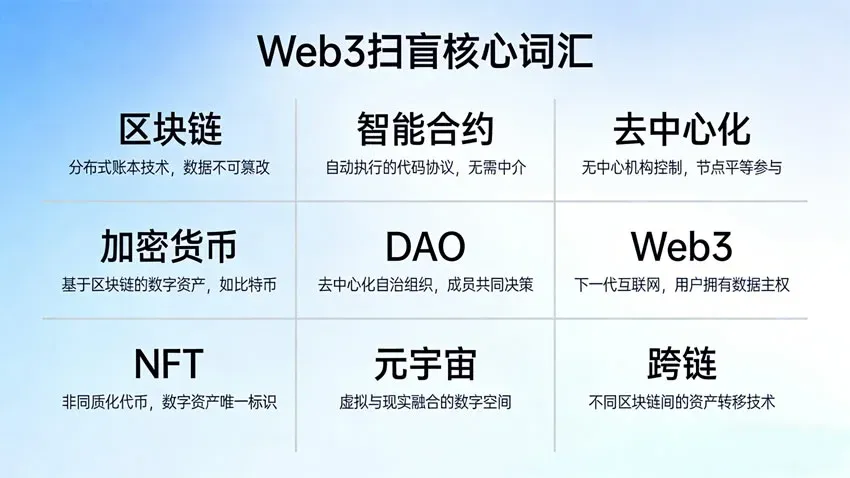
Below, the most frequently encountered terms are organized by function:
We have compiled the core concepts of the crypto space and Web3, covering main chains, stablecoins, decentralized organizations, and other key terminology. The article also breaks down common operational mindsets and security essentials. Reading this piece will help newcomers quickly build a conceptual framework; subsequent sections will expand each term in detail, so a careful read is recommended.
1. Fundamental Assets and Chain Layers
- BTC – Bitcoin, the first native token of a blockchain.
- ETH – Ethereum, a public chain that supports smart contracts.
- USDT – A stablecoin pegged to fiat currencies (commonly USD) via mechanisms such as SEPA or SWIFT.
- SOL / BNB – Representative tokens of public chains like Solana and Binance Smart Chain.
- Layer 1 (L1) – The base blockchain network.
- Layer 2 (L2) – A second‑layer solution that provides scaling on top of an L1.
- Cross chain – Cross‑chain technology enabling asset interoperability between different blockchains.
- Bridge – A cross‑chain bridge used to transfer assets from one chain to another.
2. Wallets, Keys, and Security
- Wallet – A tool for storing digital assets.
- MetaMask – A widely used browser‑extension wallet.
- Private Key – The credential that uniquely controls assets.
- Public Key – Generates the address that others use to send funds.
- Seed Phrase – A set of words used to recover a wallet.
- KYC – “Know Your Customer,” an identity‑verification process.
- AML – Anti‑Money‑Laundering compliance requirements.
3. Market Conditions and Trading Behaviors
- Bull Market – A market phase where prices trend upward overall.
- Bear Market – A market phase where prices trend downward overall.
- FOMO – “Fear Of Missing Out,” a psychological driver that pushes investors to buy at peaks.
- FUD – The spread of fear, uncertainty, and doubt.
- Pump and Dump – A manipulative scheme that inflates price before a rapid sell‑off.
- Whale – An entity that holds a large amount of assets.
- Paper hand – A retail trader who sells assets too readily.
- Diamond hand – An investor who holds assets steadfastly despite volatility.
- Rekt – A state of severe loss.
- BTD / BTFD – “Buy the dip,” a strategy of purchasing assets at lower price points.
4. Decentralized Finance (DeFi) and Contracts
- DeFi – Decentralized finance, offering lending, trading, and other services without intermediaries.
- Staking – Locking assets to earn rewards.
- Yield Farming – Supplying liquidity to earn additional returns.
- Liquidity Pool (LP) – The reserve that powers a trading pair.
- Smart Contract – Self‑executing code that runs on the blockchain.
- Gas Fee – The transaction fee paid for on‑chain operations.
- PoS – Proof‑of‑Stake consensus mechanism.
- PoW – Proof‑of‑Work consensus mechanism.
- Oracle – An off‑chain data provider that feeds external information to on‑chain contracts.
5. Issuance Models and Trading Platforms
- ICO – Initial Coin Offering.
- IDO – Initial DEX Offering, typically conducted on a decentralized platform.
- IEO – Initial Exchange Offering, led by a centralized exchange.
- CEX – Centralized exchange, e.g., Binance (U.S. residents should use Binance.US) and OKX.
- DEX – Decentralized exchange, where users retain custody of their assets.
- Whitelist – A pre‑approved list that grants early participation rights.
- Pre‑sale – The fundraising phase before a project’s official launch.
- Bonus – Additional incentives distributed during a token issuance.
6. Other Frequently Used Terms
- Crypto – The umbrella term for cryptocurrencies.
- Meme – Tokens that originate from internet memes or jokes.
- NFT – Non‑fungible token, representing a unique asset.
- GameFi – On‑chain projects that blend gaming with financial incentives.
- SocialFi – Ecosystems that combine social networking with financial services.
- Airdrop – Free distribution of tokens to community members.
- Rug Pull – A scam where project developers abruptly withdraw funds and abandon the project.
- Soft Fork / Hard Fork – Types of blockchain protocol upgrades.
- Block Reward – The compensation miners receive for adding a new block.
- Hash Rate – A metric of the network’s computational power.
- Satoshi (SATS) – The smallest unit of Bitcoin.
- Gwei – The unit used to measure Ethereum transaction fees.
- APY – Annual Percentage Yield.
- TVL – Total Value Locked, a measure of assets secured in DeFi protocols.
- MC – Short for market capitalization.
- ATH / ATL – All‑time high and all‑time low price levels.
- Shill – Promotion of a project, often with the intent of attracting new participants.
- AMA – “Ask Me Anything,” an open Q&A session.
- DM – Direct Message, a private communication channel.
- VC – Venture Capital firm.
- KOL – Key Opinion Leader, an influential figure in the space.
- U – A generic shorthand for stablecoins.
- CMC – CoinMarketCap, a platform aggregating market data.
The list above summarizes the most common terminology in the crypto and Web3 arenas. To deepen your understanding of these concepts, feel free to follow Bitaigen (比特根) and its upcoming specialized articles.
*Note: Cryptocurrency transactions and gains may be subject to taxation in many jurisdictions. Users should consult local tax regulations or a qualified professional to ensure compliance.*
💡 Register on Binance with referral code B2345 for the maximum trading fee discount. See Binance complete guide.



