
 Bitaigen Research
 What Is Liquidity Mining?
Liquidity mining is a financial product built on the Automated Market Maker (AMM) mechanism. The platform creates a number of liquidity pools, each containing two crypto assets or fiat currencies.
- As a liquidity provider, you can deposit assets into a pool and subsequently earn transaction fees and on‑chain interest.
- At the same time, you can also perform rapid swaps between the two assets within the pool.
---
In this article we systematically outline the core concepts, product classifications, and common terminology of liquidity mining, helping you quickly grasp its operating mechanics and yield characteristics. With clear table comparisons you can assess the suitability of “conservative” versus “innovative” offerings, and then dive into the practical details on the Binance platform. To master the key points, keep reading.
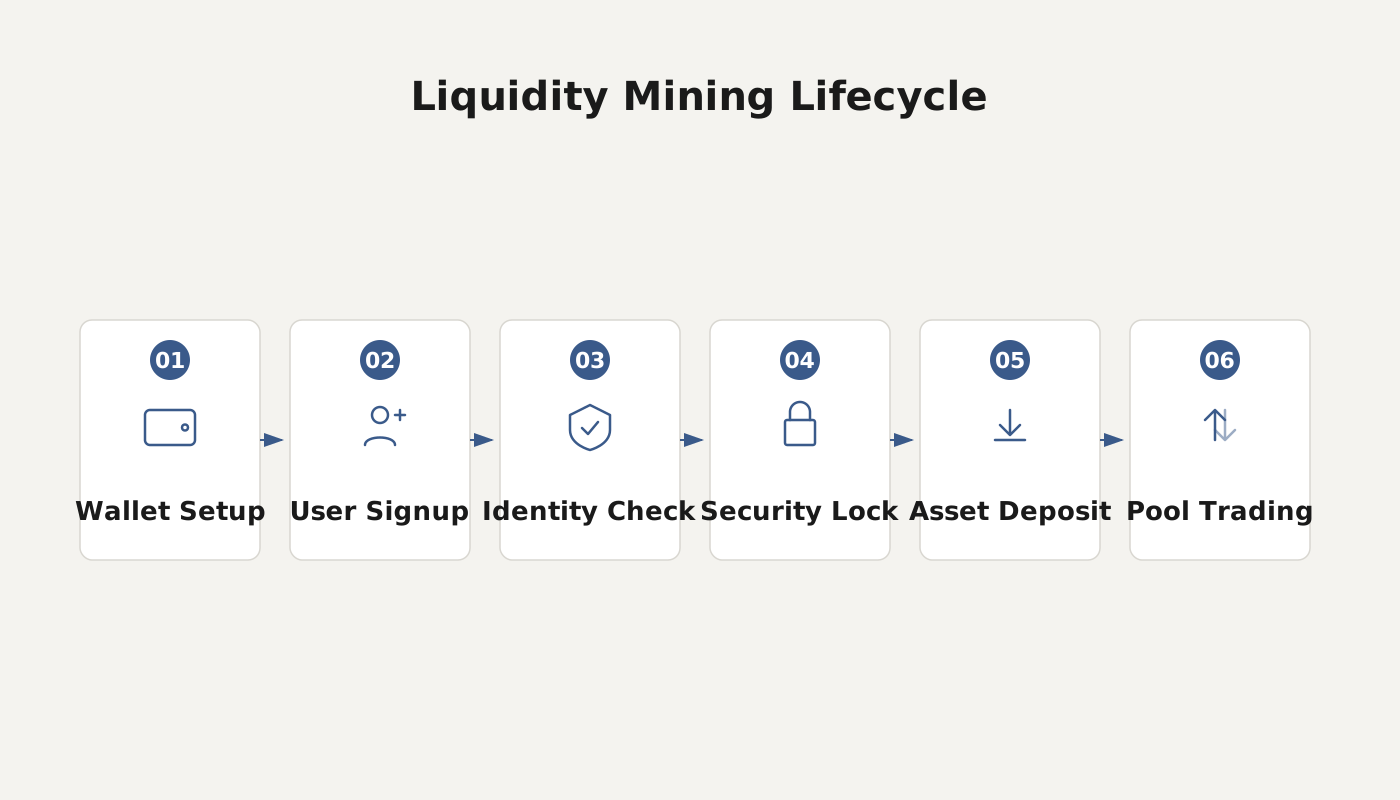
Types of Liquidity‑Mining Products
Liquidity mining is mainly divided into conservative and innovative categories:
| Type | Model Used | Price‑Movement Characteristics | Yield Profile |
|---|---|---|---|
| Conservative | Hybrid constant‑function AMM system | Prices of the two stablecoins are relatively insensitive to exchange‑rate or crypto‑price fluctuations | Yield is relatively stable, with low slippage |
| Innovative | Constant‑mean AMM system | Prices of the two digital currencies/fiat pairs can swing more widely with exchange‑rate or crypto‑price changes | Yield is more volatile |
---
Quick‑Reference Glossary
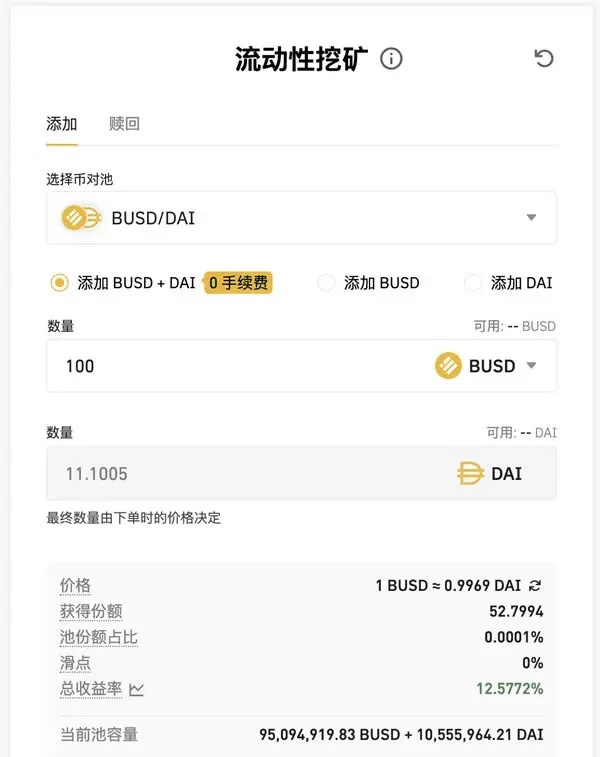
- Add: Deposit assets into a liquidity pool.
- Redeem: Withdraw assets from a liquidity pool.
- Token‑pair pool: A liquidity pool composed of two different tokens.
- Price (internal price): The relative price of the two tokens in the pool, calculated from their quantity ratio via a formula.
- Estimated share: The pool share you are expected to receive after depositing assets.
- Share proportion: Your share as a percentage of the total pool shares.
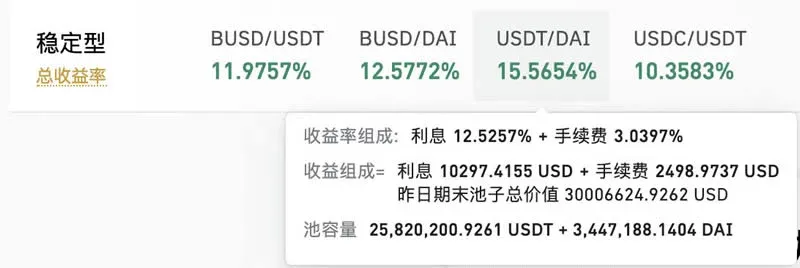
- Total APR: The combined annualised return derived from yesterday’s on‑chain interest and fees.
- Current pool composition: The actual proportion of the two tokens in the pool; new assets are allocated according to this ratio.
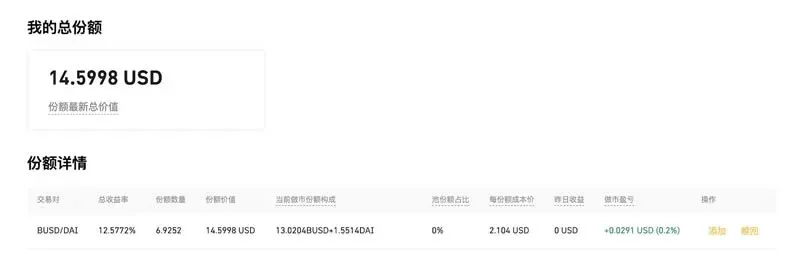
- Share: The certificate you receive after adding assets, represented as a combination of the two tokens and adjusted in real time as the pool composition changes.
- Total APR: The latest reference yield.
- Number of shares: The total amount of shares you hold.
- Share value: The total USD‑denominated value represented by your shares.
- Share composition: The exact quantities of the two assets that make up each share.
- Cost per share: The per‑share cost you incurred when you deposited, expressed in USD.
- Yesterday’s earnings: Includes yesterday’s fee and interest earnings, excluding impermanent loss.
- Market‑making P&L (profit‑and‑loss ratio): Calculated from the difference between current share value and cost per share, denominated in USD and influenced by exchange‑rate movements, token price changes, impermanent loss, and other factors.
---
How Yields and Fees Are Calculated
Total APR Formula
\[
\text{Total APR}= \frac{\text{Yesterday’s on‑chain interest}+\text{Yesterday’s fees}}{\text{Pool total value at 23:59:59 UTC (previous day)}}\times365
\]
- Interest APR = Yesterday’s on‑chain interest ÷ (Yesterday’s pool total value × 365)
- Fee APR = Yesterday’s total fees ÷ (Yesterday’s pool total value × 365)
Share‑Value Calculation
\[
\text{Share value}= \sum_{i}{\text{Asset}_i \times \text{Spot rate}_i}
\]
*Example*: If a share is composed of 100 USDT + 50 DAI, with spot rates 1 USDT = 1.005 USD and 1 DAI = 1.01 USD, then
Share value = 100 × 1.005 + 50 × 1.01 = 151 USD.
Yesterday’s Earnings Calculation
\[
\text{Yesterday’s earnings}= \text{Per‑share yesterday’s earnings} \times \text{Minimum full‑day share balance held yesterday}
\]
Rule for determining the “minimum full‑day share balance”
- If the ending share balance of the prior day is 0, the minimum is 0.
- If the prior‑day ending balance is 100 and you added 50 during the day without withdrawing, the minimum remains 100.
- If the prior‑day ending balance is 100, you add 50 and later withdraw 80, the minimum becomes 70.
- If the prior‑day ending balance is 100, you first withdraw 60 and then add 80, the minimum becomes 40.
Market‑Making P&L and P&L Ratio
\[
\text{Market‑making P\&L}= \text{Share value} - (\text{Cost per share} \times \text{Number of shares})
\]
\[
\text{P\&L Ratio (\%)}= \frac{\text{Market‑making P\&L}}{\text{Share value}} \times 100
\]
---
Is Principal Protected?
Liquidity mining does not guarantee the safety of your principal. Potential losses mainly stem from:
- Token price or exchange‑rate fluctuations, which can reduce share value (see Binance Academy’s “What Is Impermanent Loss”).
- Large single‑token additions or withdrawals, which may cause significant slippage and affect share value.
- Frequent add/redeem actions, which increase transaction costs and exposure to market moves.
Tax note: Gains from liquidity‑mining activities may be taxable in your jurisdiction. Consult a local tax professional to understand reporting obligations, especially for jurisdictions that treat crypto earnings as capital gains or ordinary income.
---
Situations That Generate Fees
The following actions incur fees:
- Performing a swap on the [Liquidity Mining] → [Trade] page.
- Adding a single token on the [Liquidity Mining] → [Liquidity Mining] page.
- Redeeming a single token on the [Liquidity Mining] → [Liquidity Mining] page.
---
Step‑by‑Step Guide for Adding and Redeeming
Adding Liquidity
- Dual‑token add: The system shows the required amounts of both tokens based on the current pool composition; you deposit in that proportion.
- Single‑token add: The platform automatically swaps a portion of the token you provide into the other token, incurring a fee. If the expected slippage is excessive, the system will warn you in advance.
Redeeming Liquidity
- Dual‑token redeem: Based on the shares you own and their composition, the system transfers the two tokens back to your spot wallet.
- Single‑token redeem: The platform automatically swaps one of the tokens in your share into the other token, also generating a fee; a large slippage will trigger a system prompt.
---
Slippage and Its Impact
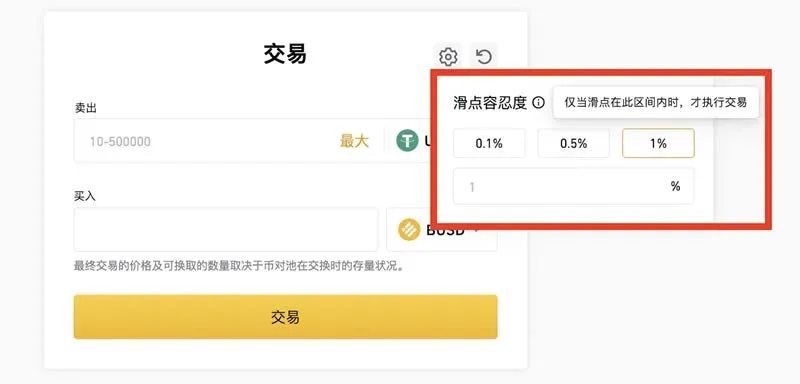
Slippage is the difference between the price you expect when placing an order and the price at which the order is actually executed. On the [Liquidity Mining] → [Trade] page you can set an acceptable slippage range; only trades that fall within this range will be executed.
Large single‑token additions or withdrawals can also trigger slippage. The platform will display a warning before the operation proceeds, helping you avoid unintended losses.
---
At this point the basic explanation of “What is liquidity mining?” and the common Binance liquidity‑mining FAQs is complete. For more hands‑on tutorials, search for past articles by Bitaigen (比特根) or continue scrolling through the related links below. Thank you for your attention and support!
Important for U.S. users: Access to Binance’s global platform is not available in the United States. U.S. residents should use Binance.US (or another compliant U.S. exchange) for liquidity‑mining activities, which may have different fee structures and product offerings.
Fiat considerations: Deposits and withdrawals of fiat currencies are typically processed via SEPA (for EUR) or SWIFT (for USD and other major currencies). Always verify the applicable processing times and fees with your chosen gateway.
Related Reading
- Liquidity Mining vs Traditional Crypto Mining: Key Differences Explained
- MetaMask Wallet Guide: Secure Ethereum, DeFi & NFT Management
- Taproot Assets Mainnet Review: Multi‑Asset Issuance on Bitcoin & DeFi Impact
💡 Register on Binance with referral code B2345 for the maximum trading fee discount. See Binance complete guide.



