
 Bitaigen Research
 In this article we systematically analyze the sources of risk in liquidity mining, focusing on the formation mechanism and possible magnitude of impermanent loss, and demonstrate the calculation process with a real‑world example to help readers assess whether earnings can offset potential losses. For details and mitigation strategies, keep reading.
Can the principal in liquidity mining be lost?
The principal invested in liquidity mining can indeed suffer a loss, primarily due to impermanent loss. The size of this loss depends on price volatility and typically ranges from a few percentage points to around a dozen percent.
The principal in liquidity mining can be reduced because decentralized exchanges (DEXes) use an AMM (Automated Market Maker) model that pools all assets into a shared liquidity pool and determines trade prices through a fixed algorithm. Taking Uniswap as an example, it employs the constant‑product formula X·Y = K, enabling real‑time, relatively fair trading without traditional market makers.
However, this price relationship holds only inside the specific pool; prices across different pools or on centralized markets are often different, creating arbitrage opportunities. Arbitrageurs “rebalance” the price disparity, restoring the trading pair to its original ratio until supply and demand are balanced again. The profit captured by arbitrageurs effectively becomes a loss for liquidity providers (i.e., investors participating in liquidity mining)—the value of their principal is diluted, and the pool’s rewards may not be sufficient to offset the loss caused by price migration.
Rough magnitude of impermanent loss
Below we illustrate the impermanent loss calculation with a concrete example:
- Assumption: Token ALT is priced at 1 ALT = 100 USD. After depositing into a Uniswap liquidity pool, the participant receives ALT as a reward. The total principal is 1,000 USD, half of which is used to buy ALT and provide liquidity. Subsequently, ALT’s price drops 36 %, after which the participant withdraws.
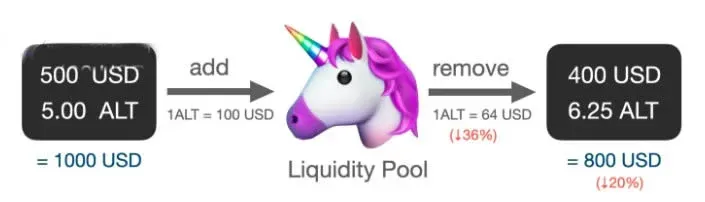
- Result: The impermanent loss equals ‑2.44 % (about ‑20 USD), not ‑20 % (‑200 USD).
Definition of impermanent loss
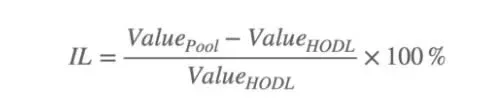
Impermanent loss = (Value of assets held in the pool – Value of the same assets held outside the pool) ÷ Value of assets held outside the pool × 100 %
Calculation illustration
| Position | Value | Explanation |
|---|---|---|
| Yellow block | Value before the price drop | 500 USD of the 1,000 USD principal is invested in ALT and added to the pool |
| Blue block | Value after the price drop | Split into **HODL** (assets kept out of the pool) and **Pool** (assets already in the pool) |
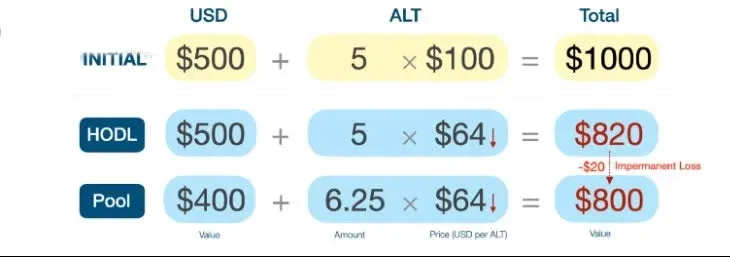
Plugging the numbers into the formula:
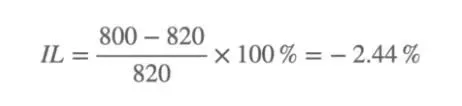
From the calculation we can see that although ALT’s price fell 36 %, the impermanent loss is only ‑2.44 %. Therefore, in this scenario the primary source of the loss is the token’s own price decline, while the impermanent loss merely adds a modest extra drag on the overall loss.
Points to consider before joining liquidity mining
- Platform research: Start by browsing the official website to understand the project’s background, team members, and technical whitepaper.
- Community activity: Check the platform’s presence on Twitter, Discord, Telegram and other social channels for activity levels and user feedback.
- Security assessment: If official information is scarce and the community is silent, be wary of potential security and authenticity risks.
The above constitutes a complete analysis of “Will liquidity mining principal suffer loss? Approximate impermanent loss?” For more Q&A on liquidity mining, follow Bitaigen (比特根) and explore its other related articles.
Related Reading
- DeFi Staking Mining: Risks, Rewards, and How It Works
- Beginner’s Step‑by‑Step Guide to DeFi Liquidity Mining
- What Is DeFi? A Beginner's Guide to Decentralized Finance
💡 Register on Binance with referral code B2345 for the maximum trading fee discount. See Binance complete guide.



