
 Bitaigen Research
 What Is the NFT Concept?
NFT (Non‑Fungible Token) is a blockchain‑based non‑fungible token, representing a unique, indivisible, and non‑replaceable digital asset. Within the current NFT sector, the highest‑market‑cap and most actively traded leading concept coin is MATIC (Polygon).
We examine the core concept of NFTs from both technical and ecosystem perspectives, and point out the most vibrant on‑chain projects in today’s market, helping readers quickly grasp the industry’s outline. The following sections will further dissect value‑driving factors and investment angles, so a careful read is worthwhile. Follow our viewpoint for an in‑depth understanding.
What Is the NFT Concept?
NFT stands for Non‑Fungible Token, known in Chinese as “非同质化代币”. It usually follows Ethereum’s ERC‑721 standard and possesses three main traits: indivisibility, non‑replaceability, and uniqueness. Each NFT carries its own metadata and serial number, making it impossible to be swapped on a one‑to‑one basis with any other token.
Definition: Any token issued under the ERC‑721 (or a similar) protocol is an NFT.
Take CryptoKitties as an example: every cat in the game has a distinct appearance and set of attributes. Zhang owns a yellow cat valued at $200, while Hua owns a blue, winged cat valued at $400; the two cannot be exchanged, illustrating the non‑replaceable nature of NFTs. In contrast, Bitcoin or Ether are fungible tokens—any two units hold equal value and can be freely interchanged.
Core Characteristics of NFTs
| Characteristic | Explanation |
|---|---|
| **Indivisibility** | NFTs must be transferred as whole units; they cannot be split into smaller fractions like BTC. |
| **Uniqueness** | Each NFT has an independent ID and metadata, resulting in differing values. |
| **Non‑replaceability** | No equivalent exchange exists between identical NFTs; value is driven by scarcity. |
Which Coins Represent the NFT Concept?
Below is a list of concept tokens that are relatively active within the NFT ecosystem (for informational purposes only):
- ENJ / Enjin Coin
- Singapore‑based project aimed at providing blockchain‑backed value tokens for virtual goods in gaming communities.
- MANA / Decentraland
- A blockchain‑powered virtual world where users can permanently own and trade virtual land and assets.
- FFF / Force For Fast Token
- An automotive‑enthusiast community; vehicles and related industry assets are represented as NFTs on the platform.
- SAND / The Sandbox
- A virtual gaming universe where players use SAND to create, own, and trade in‑game NFT assets.
- NASH / Nash
- A blockchain‑based 3D virtual space that lets users explore, gather resources, and manage territories.
- SLP / Small Love Potion
- The ERC‑20 token within the Axie Infinity ecosystem, used for breeding and raising game characters (Axies).
- ZXC / 0xcert
- An open protocol that assists in creating, owning, and verifying digital assets (such as certificates or game items) on the blockchain.
- RARI / Rarible
- Governance token of the Rarible NFT marketplace; holders can participate in platform upgrade votes and decision‑making.
Which Coin Leads the NFT Sector?
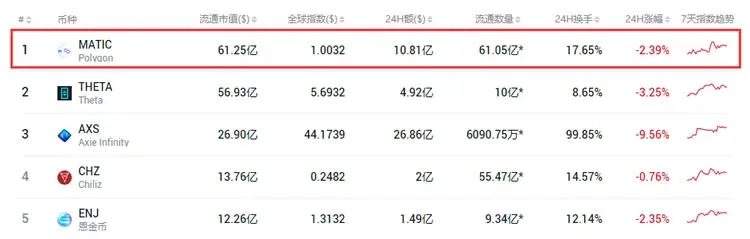
According to publicly available data, MATIC (Polygon) holds the top spot in both circulating market cap and 24‑hour trading volume within the NFT space. Its low transaction fees and high throughput make it widely adopted for NFT‑related payments, exchanges, gaming networks, and large‑scale airdrops.
Main Uses of MATIC (Polygon)
- Payments
- Through the Matic Payments API/SDK, dApps can achieve sub‑second confirmations with minimal cost, supporting assets such as ERC‑20 tokens, ETH, and BTC. When acquiring MATIC, users outside the United States can typically use major exchanges that accept USD via SEPA or SWIFT transfers, while U.S. residents should use Binance.US rather than the global Binance platform.
- Decentralized Exchanges (DEX)
- High throughput and low latency make MATIC an ideal base layer for DEXs, enhancing trade speed and reducing user costs.
- Gaming Networks
- Provides fast, low‑fee asset transfer channels for blockchain games, ensuring players retain ownership of in‑game items.
- Token Airdrops
- Its inexpensive batch‑transfer capability enables projects to execute large‑scale airdrops without incurring prohibitive fees.
The above constitutes a comprehensive analysis of “What Is the NFT Concept? Which Coin Leads the NFT Concept?”. For more NFT‑related news and updates, follow Bitaigen and its forthcoming articles.
Related Reading
- Step‑by‑Step Guide to Mint NFTs on Flow with IPFS
- Top Layer 2 Tokens: Polygon, Elrond, NEAR & Other Leading L2 Cryptos
- GameFi, Metaverse & NFT: Solana & Avalanche Power Crypto
💡 Register on Binance with referral code B2345 for the maximum trading fee discount. See Binance complete guide.



