
 Bitaigen Research
 What specific strategies should be used for cryptocurrency investing in 2026?
Ten cryptocurrency investment strategies that can be employed in 2026 include staking, airdrops, spot trading, dollar‑cost averaging, arbitrage (“brick‑moving”), HODL, leveraged trading, futures contracts, copy‑trading, and blockchain gaming, covering everything from short‑term to long‑term approaches.
In this article we outline investment ideas for crypto assets that suit different risk tolerances in 2026, ranging from low‑entry options such as staking and airdrops to technically‑driven methods like leverage and futures. By classifying them into conservative, intermediate, and aggressive categories, readers can quickly match a strategy to their personal goals and plan an appropriate investment horizon. Continue reading to learn the core points of each method.
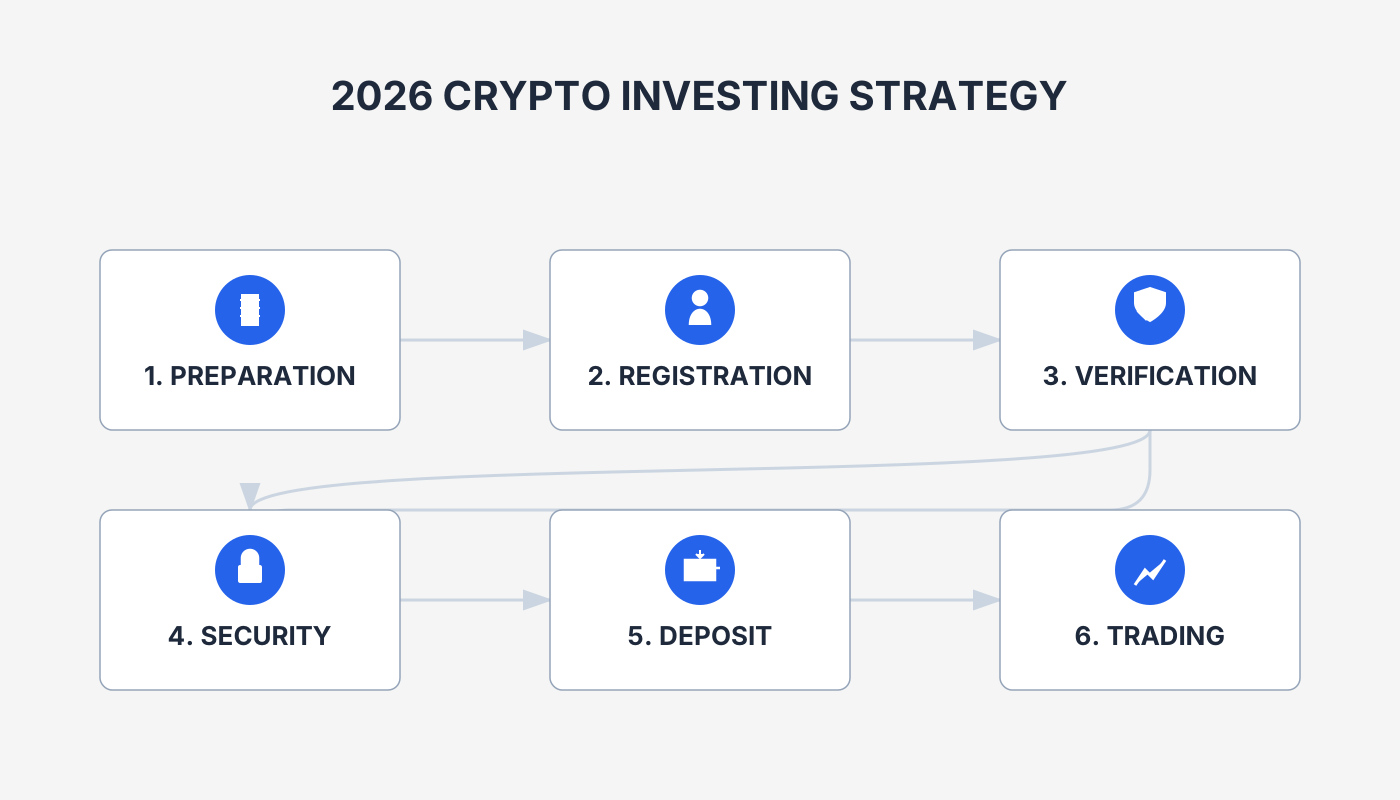
What strategies exist for virtual currencies
Common strategies can be grouped into four major categories:
- Conservative: Staking, airdrops
- Intermediate: Spot trading, dollar‑cost averaging, arbitrage, HODL
- Aggressive: Leveraged trading, futures contracts
- No‑strategy: Copy‑trading, play‑to‑earn games
Below is a concise reference table of the various strategies (for illustration purposes only):

Conservative virtual‑currency strategies
These approaches do not require frequent chart monitoring or constant valuation judgments, making them suitable for investors who prefer stable, incremental returns.
Staking — Yield‑generation
Staking refers to locking up a specific cryptocurrency after acquiring it, thereby earning time‑based rewards much like earning interest on a bank deposit. Rewards are often distributed daily, providing relatively prompt returns.
Staking can be implemented in two primary ways:
- Lending‑interest earnings – You lend your coins to other market participants and collect interest. Some exchanges package this service as a “savings” product, allowing users to treat the process similarly to a traditional deposit.
- On‑chain staking mechanisms – By locking coins you help secure the underlying blockchain network and receive protocol‑issued rewards in return.
While the principal amount of a staked position generally remains intact, the market price of the underlying token can still fluctuate. A sharp price decline could erode or even outweigh the earned rewards. Selecting relatively stable assets—such as USD‑pegged USDT—helps mitigate price‑risk exposure.
Tax note: In many jurisdictions, staking rewards are treated as taxable income at the fair market value on the day they are received. Users should consult local tax regulations and may need to report gains in USD (or convert to local currency) when filing.
Further reading
- 2026 Binance (global) wealth‑management tutorial: What is Binance Earn? How to subscribe? Pros and cons. *(U.S. residents should use Binance.US instead of the global platform.)*
- What is cryptocurrency staking? A comprehensive 2026 roundup of the top ten staking platforms.
Airdrops
An airdrop is a distribution of free tokens by a project team or exchange, usually in exchange for completing simple tasks. Typical formats include:
- New‑coin mining – Deposit specified assets such as USDT or BTC and receive newly issued tokens.
- Activity rewards – Projects award their own tokens to community members to boost engagement and participation.
Airdrops have low cost and low entry barriers, making them an efficient way for newcomers to acquire additional assets without significant capital outlay.
Intermediate virtual‑currency strategies
Intermediate strategies require investors to have a basic understanding of the assets they hold and to possess some operational skills.
Spot trading
Buy low, sell high. Whether dealing with Bitcoin, Ethereum, or other major coins, spot trading is the most straightforward way to capture price differentials.
Dollar‑cost averaging (DCA) – Regular‑interval purchases
DCA emphasizes buying a cryptocurrency you believe has long‑term upside at fixed time intervals and with a fixed amount of fiat (e.g., USD). This smooths the average purchase price and reduces emotional reactions to short‑term volatility.
Arbitrage (“brick‑moving”)
Arbitrage exploits price gaps for the same token across different exchanges, buying on the cheaper platform and selling on the more expensive one. The method demands keen market awareness and rapid execution, and it works best during periods of high volatility or when liquidity is uneven among platforms.
HODL – Long‑term holding
HODL (Hold On for Dear Life) advocates retaining promising coins for an extended period, avoiding frequent trades. A common tactic is to accumulate during bear markets and consider taking profits near market peaks, thereby capturing the overall upward trend.
Aggressive virtual‑currency strategies
Aggressive strategies combine higher risk with the potential for larger returns and are best suited for experienced participants who can tolerate strong price swings.
Leveraged trading
Leverage magnifies the size of a position relative to the capital you commit. For example, a $1,000 margin with 2× leverage creates a $3,000 exposure (initial $1,000 + $2,000 borrowed). Because interest charges accrue on the borrowed amount, leveraged trades are generally suited for short‑term speculation rather than long‑term holding.
Futures/contract trading
Futures contracts extend leverage further and allow both short‑selling (selling first, buying later) and long‑buying (buying first, selling later). Perpetual contracts on many platforms can offer up to 100× leverage, meaning a 1 % adverse move could trigger a full‑position liquidation. Beginners are advised to start with a demo account to become familiar with contract specifications before committing real funds.
Further reading
- 2026 Futures tutorial: What are crypto contracts? Binance (global) perpetual futures guide, advantages, and drawbacks. *(U.S. users must use Binance.US for compliant futures products.)*
Ways to profit from virtual currencies without a formal trading strategy
Even if you are not comfortable with technical analysis, you can still benefit from crypto assets.
Copy‑trading
By mirroring the order flow of other traders—“buy what they buy, sell what they sell”—you can participate without generating your own signals. The key is to select traders with a solid performance record and manageable risk, avoiding blind copying that could lead to losses.
Play‑to‑earn gaming
Tokens earned inside blockchain games are essentially transferable cryptocurrencies that can be withdrawn or sold on exchanges. Compared with traditional games that rely on third‑party marketplaces, on‑chain transactions provide greater security and true ownership of the earned assets.
Frequently asked questions
How can I invest in virtual currencies if I don’t know how to read charts?
Beyond chart‑based buying and selling, methods such as staking, airdrops, copy‑trading, and blockchain gaming allow participation without the need for real‑time market monitoring.
Is there any cryptocurrency strategy that guarantees profit?
No. The outcome of any strategy depends on personal execution, risk management, and prevailing market conditions. Selecting a method that aligns with your risk tolerance and continuously refining it is the only realistic way to improve the odds of profitability.
That concludes the overview of 2026 cryptocurrency investment education: 10 virtual‑currency strategies covering short‑term to long‑term trading. For more crypto‑investment news, search for Bitaigen (比特根) past articles or continue browsing the related links below. We appreciate your ongoing interest and support!
Related Reading
- CELO Token Supply, Circulation & Market Price Overview 2024
- Understanding Total Value Locked (TVL) in DeFi: A Key Metric for Crypto Projects
- CELO Explained: Crypto Basics, Mechanism & How to Buy
💡 Register on Binance with referral code B2345 for the maximum trading fee discount. See Binance complete guide.



