
 Bitaigen Research
In this article we systematically outline how cross‑chain bridges work and their ecosystem significance, reveal how they solve the asset “island” problem between blockchains, and analyze their key roles in DeFi, NFTs and other scenarios. Read on to gain a comprehensive understanding of why this technology has become an indispensable cornerstone of the crypto space.
What Is a Cross‑Chain Bridge? Why Is It Inescapable in the Crypto World?
A cross‑chain bridge is a technology that enables assets to be transferred safely between different blockchains, linking the isolated “islands” of each chain so that asset circulation and use‑cases become possible.
A cross‑chain bridge functions like a “big bridge” in the blockchain universe, helping assets move from one chain to another much like a physical bridge spans a river.
Why Do We Need It?
- Blockchain Diversity: Ethereum, BNB Chain, Solana, Arbitrum, Base and many others each have their own rules, asset standards and ecosystems, akin to different countries using distinct currencies and languages.
- Asset Migration Demand: Holding USDC on Ethereum but wanting to use DeFi on Arbitrum requires a cross‑chain bridge to move the assets safely.
- Functional Coverage: Bridges support token transfers, NFT transfers, and even cross‑chain data communication, connecting otherwise isolated blockchain networks.
Core Value of Cross‑Chain Bridges: Breaking Down Blockchain Islands
Each public chain operates as an independent system, similar to a sovereign nation with its own currency, language and policies. Bitcoin only moves BTC, Ethereum mainly handles ETH, while Solana, Arbitrum, Base, etc., each run their own ecosystems. Without bridges, these chains cannot communicate directly, making asset migration virtually impossible.
Cross‑chain bridges act as “transfer stations” and “translators,” enabling:
- Asset Mapping: For example, locking BTC on its native chain and minting an equivalent WBTC on Ethereum.
- Cross‑Chain Transactions: Using SOL from Solana to purchase an NFT on Polygon requires a bridge to convert SOL into the appropriate asset format on Polygon.
Thus, bridges become the high‑speed highways that connect all chains, turning the crypto world into a true “Internet of assets.”
How Cross‑Chain Bridges Work: Three Main Models
Chains cannot converse directly, so a bridge acts as an interpreter. It does not physically move the coin; instead, it implements mechanisms that achieve value‑equivalent transfers. The three dominant implementations today are:
1️⃣ Lock & Mint
- Process: Assets are locked on the source chain, and an equivalent token is minted on the destination chain.
- Analogy: Like depositing money in a bank and withdrawing the equivalent amount at another bank using a check.
2️⃣ Burn & Release
- Process: The minted token on the destination chain is burned, after which the original asset is released on the source chain.
- Analogy: Handing a check back to the bank, which then returns the cash after verification.
- Note: Usually paired with Lock & Mint to form the “outbound” and “return” legs of a cross‑chain move.
3️⃣ Liquidity‑Based Swaps
- Examples: Across, Hop, etc.
- Process: Transfers are completed through cross‑chain liquidity pools, eliminating the need for explicit locking or releasing.
- Analogy: Finding a bilingual intermediary who instantly swaps the currencies, offering higher efficiency.
Overview of Bridge Types: Which One Do You Need?
| Category | Representative Projects | Key Features | Main Drawbacks |
|---|---|---|---|
| **A. CEX Transfer Services (Off‑Chain Bridges)** | Binance, Bitget | Simple UI, suitable for beginners | Cannot participate in on‑chain activities; fully reliant on the exchange’s credit |
| **B. Decentralized (Trustless) Bridges** | Hop, Across, Synapse | Executed by smart contracts, theoretically trust‑free | Smart‑contract bugs can lead to losses |
| **C. Bridge Aggregators** | Rango, Jumper, LI.FI | Auto‑selects optimal route, similar to “Booking.com” for bridges | Path opacity, difficult to trace |
| **D. Native Official Bridges** | Arbitrum Bridge, Optimism Gateway, zkSync Portal | Secure, officially supported | Slower, poorer UX, relatively high fees |
A. CEX Transfer Services (Off‑Chain Bridges)
- Representatives: Binance, Bitget and other centralized exchanges that provide cross‑chain channels.
- How It Works: Assets are moved via internal ledger adjustments and the corresponding tokens are issued on the target chain; this is not a traditional on‑chain bridge.
- Target Users: Newcomers who only need to move tokens between chains.
- Note for U.S. Residents: Use Binance.US (or other U.S.–compliant exchanges) rather than the global Binance platform.
B. Decentralized (Trustless) Bridges
- Representatives: Hop, Across, Synapse.
- Advantages: Fully reliant on smart contracts, theoretically eliminating the need to trust a third party.
- Risks: Vulnerabilities in contract code may result in asset loss.
C. Bridge Aggregators
- Representatives: Rango, Jumper, LI.FI.
- Function: Automatically compares fees and speeds across multiple bridges, selecting the most efficient route.
- Drawbacks: The routing logic is opaque, making it hard to audit the exact path taken.
D. Native Official Bridges
- Representatives: Arbitrum Bridge, Optimism Gateway, zkSync Portal.
- Characteristics: Backed by official security audits and enjoy strong compatibility.
- Limitations: Slower transaction times, average user experience, and higher fees compared with some third‑party solutions.
2025 Mainstream Bridge Rankings (Recommendations & Analysis)
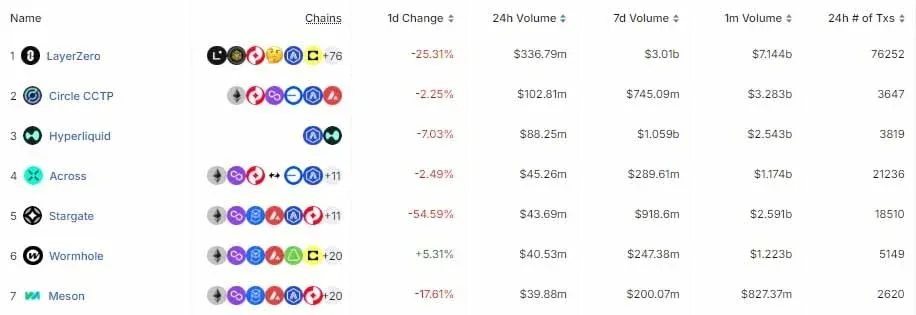
| Rank | Bridge Name | Main Features | Drawbacks | Supported Chains |
|---|---|---|---|---|
| 1 | LayerZero | Highest volume (24 h $336.79 M, 1 mo $714.4 B) <br> Supports 30+ chains, flexible interoperability <br> Fast finality (< 1 min) | Technically complex, potential vulnerabilities | Ethereum, Solana, BNB Chain, Polygon, Arbitrum, etc. |
| 2 | Circle CCTP | Stable volume (24 h $102.81 M, 1 mo $3.283 B) <br> Native USDC transfer, no wrapper needed <br> Low fee ≈ 0.05% | USDC‑only, limited use‑cases <br> Dependent on Circle ecosystem | Ethereum, Polygon, Arbitrum, Optimism, Solana, etc. |
| 3 | Hyperliquid | High volume (7 d $1.059 B, 1 mo $2.543 B) <br> Focused on derivatives, rapid settlement | Low transaction count (24 h 3,819) <br> Derivatives‑only | Ethereum L2s (Arbitrum, Optimism) and related chains |
| 4 | Across | Optimized for L2 ecosystem (24 h $45.26 M, 1 mo $1.174 B) <br> Low fees (0.05%‑0.1%) <br> Fast (< 30 s) | Limited to Ethereum L2s <br> Weak cross‑non‑EVM capability | Ethereum L2s (Optimism, Arbitrum, Base) |
| 5 | Stargate | Consistent long‑term volume (1 mo $2.591 B) <br> Multi‑chain support (10+ chains) <br> Liquidity pools reduce slippage | Recent volume drop (24 h $13.69 M, ‑54.59%) <br> Relies on LayerZero stability | Ethereum, BNB Chain, Polygon, Arbitrum, Avalanche, etc. |
Five Major Risks of Cross‑Chain Bridges and Mitigation Strategies
1️⃣ Phishing Site Risk
- What It Looks Like: Fake pages masquerading as official Stargate or other bridge sites, luring users to send funds which are then stolen.
- Mitigation: Always access bridges via official Discord, Twitter, or verified links provided on the project’s authentic website.
2️⃣ Chain‑Name or Version Confusion
- What It Looks Like: zkSync Era and zkSync Lite have similar names but are completely different networks; sending assets to the wrong version can make recovery extremely difficult.
- Mitigation: Double‑check the target chain name and version before initiating a transfer; use the bridge’s built‑in dropdown selector.
3️⃣ Large Single‑Transaction Risk
- What It Looks Like: If a bridge contract is exploited or malfunctions, a single large transfer could result in the total loss of the amount.
- Mitigation: Start with a small test transfer (e.g., $10) and only scale up after confirming success; consider limiting each transaction to 10%‑20% of your total holdings.
4️⃣ Un‑Audited or Newly Launched Bridge Contracts
- What It Looks Like: Bridges advertising ultra‑low fees and instant speeds may not yet have undergone comprehensive security audits.
- Mitigation: Prioritize bridges with publicly available audit reports from reputable firms (e.g., Certik, Quantstamp, PeckShield). Verify that the audit covers the exact contract versions you are using.
5️⃣ Token‑Mapping Errors (Wrapped Token Confusion)
- What It Looks Like: Sending native USDC but receiving an “anyUSDC”, “nUSDC” or other wrapped variant that some wallets or platforms cannot handle directly.
- Mitigation: Confirm the token standard and version supported on the destination chain; prefer official partner bridges or native tokens. Verify contract addresses using resources like CoinGecko or Etherscan.
Advanced Bridge Usage: Bridge Aggregator in Practice
🌐 Aggregator + Automated Workflow
Tool Recommendation: Jumper.exchange (alternatives include Rango and LI.FI)
Step 1 | Open the Aggregator Site
- Visit Jumper.exchange
- Connect your wallet (MetaMask, Rabby, etc.)
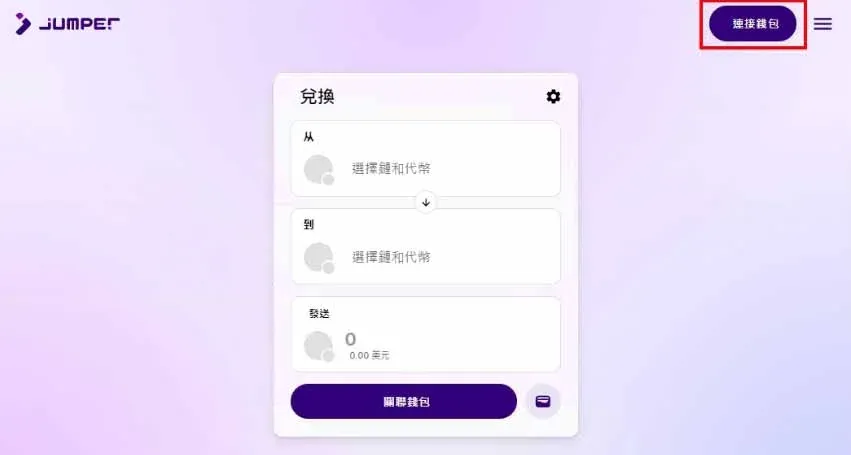
Step 2 | Select Source and Destination Chains
- From: Choose the source chain and token (e.g., Ethereum → USDC)
- To: Choose the destination chain and receiving token (e.g., BSC → USDC)
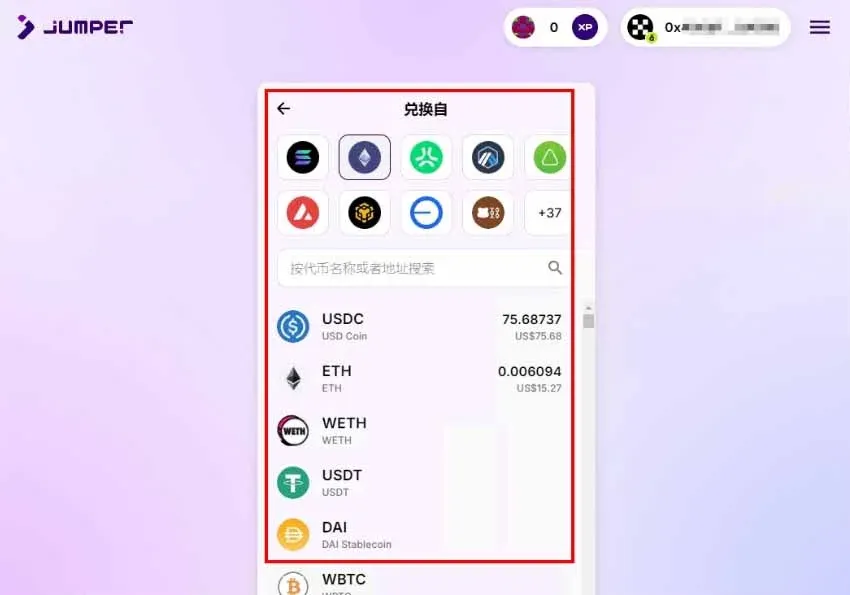
Step 3 | Automatic Price Comparison
- The aggregator compares Across, Hop, Stargate and other bridges for fees and speed, then suggests the “fastest, cheapest, safest” route
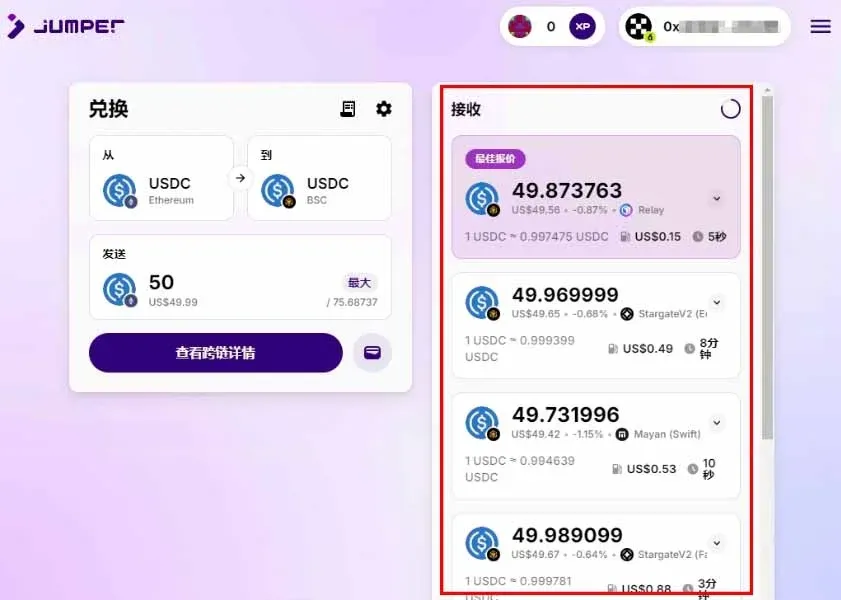
Step 4 | Confirm Details and Gas Costs
- Review the specific bridge that will be used and whether any wrapped token (e.g., anyUSDC) is involved
- When everything looks correct, click Confirm
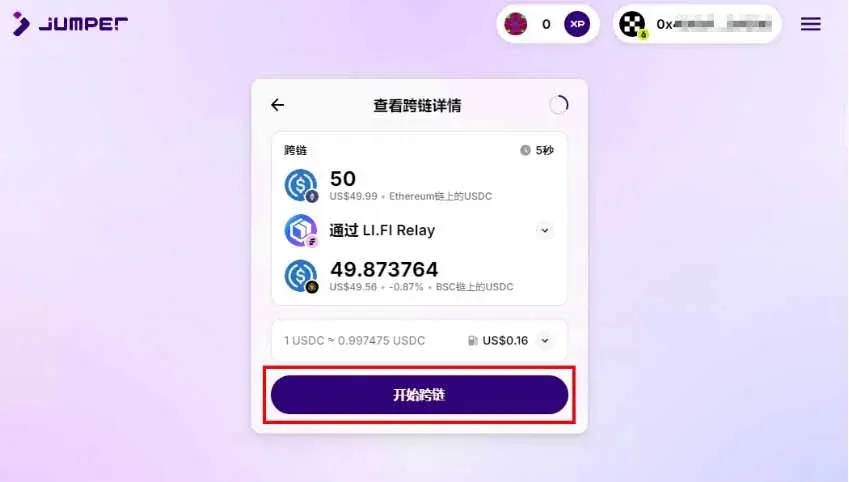
Step 5 | Send Transaction and Wait for Arrival
- After signing, the assets leave the source chain
- Within minutes the destination chain receives the specified assets
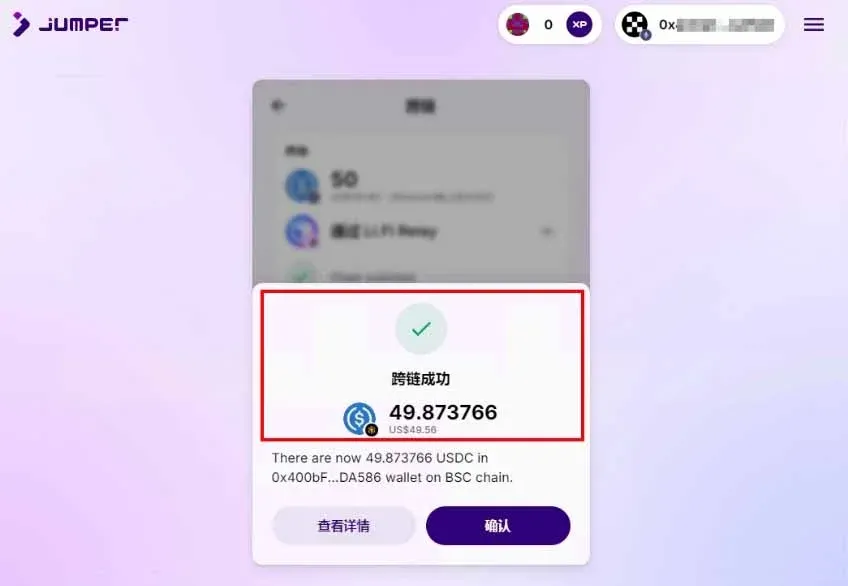
Conclusion: Cross‑Chain Bridges Are the Passport to the Future Blockchain Ecosystem
Cross‑chain technology is more than just moving assets; it is a core capability for participating in the next wave of blockchain innovation. Every bridge represents a pathway to new opportunities, but each also carries inherent risks. Selecting trustworthy bridges and managing operational risk are essential for navigating the multi‑chain world safely.
This article ends here. For deeper analyses of cross‑chain bridges, search for past articles from Bitaigen or continue exploring the related links below. Thank you for your support and attention!
*Note: Cryptocurrency gains may be taxable in your local jurisdiction. Consult a qualified tax professional for guidance.*
Related Reading
- Tokenizing Data: Unlocking Real‑World Asset Value in DeFi
- 2025 Cross‑Chain Bridge Guide: Top 5 Asset Migration Options
- 2026 DeFi Shift: AI, Tokenized Assets & Privacy
💡 Register on Binance with referral code B2345 for the maximum trading fee discount. See Binance complete guide.



