
 Bitaigen Research
 In this article we will outline the definition of ERC20, its technical implementation, and its pivotal role within the Ethereum ecosystem, helping readers understand why it has become the foundation of DeFi and DApps, and discuss the current scaling and security challenges it faces. Subsequent sections will further analyze real‑world cases and best practices, making it worth a careful read.
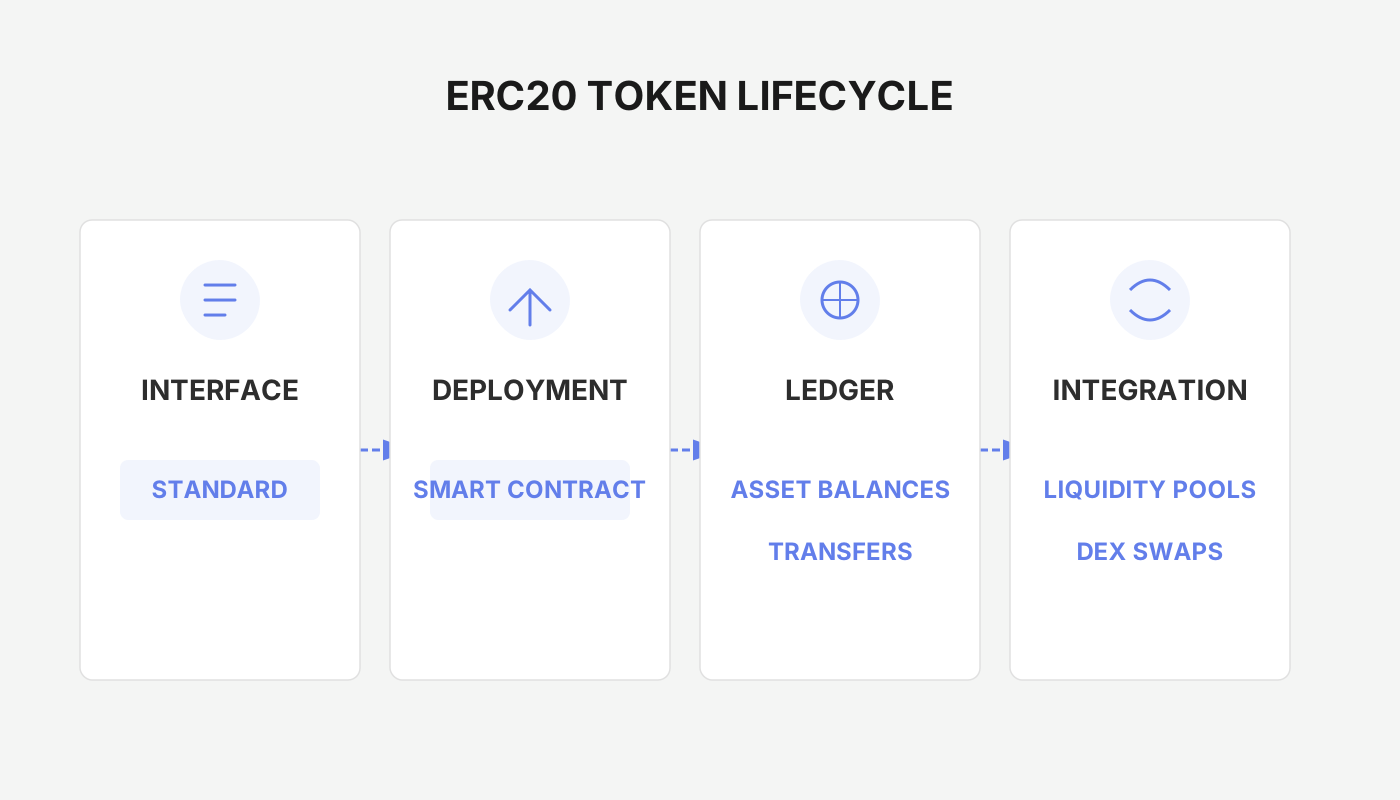
The Role and Impact of ERC20 in the Ethereum Ecosystem
On the Ethereum network, ERC20 tokens have become one of the most widespread asset forms. According to data from etherscan.io, as of February 4 2023 there were more than 300,000 ERC20 contracts on‑chain, with a total market value exceeding USD 200 billion. Representative projects that are commonly cited include:
- USDT: A stablecoin pegged to the U.S. dollar, 1 USDT ≈ 1 USD (transfers typically use SEPA or SWIFT for fiat on‑ramps).
- LINK: The native token of the Chainlink network, used to incentivize off‑chain oracles that provide trustworthy data.
- UNI: The governance token of the Uniswap protocol; holders can participate in platform governance votes.
- AAVE: The governance token of the Aave protocol, also used for voting on protocol decisions.
- WBTC: Wrapped Bitcoin, which encapsulates Bitcoin as an ERC20 token, 1 WBTC ≈ 1 BTC.
These tokens provide liquidity and functional support for decentralized exchanges (DEXs), decentralized finance (DeFi) platforms, and a wide variety of DApps, driving rapid iteration within the Ethereum ecosystem. However, the widespread adoption of ERC20 also brings challenges such as network congestion, rising transaction fees, and occasional security vulnerabilities, which require ongoing community optimization.
Note for U.S. users: When interacting with fiat on‑ramps, use services that support Binance.US rather than the global Binance platform.
What Is ERC20?
ERC20 is one of the earliest and most mature token standards on Ethereum. Its full name is Ethereum Request for Comments 20, indicating a community‑driven proposal for a technical specification. The standard was introduced by Fabian Vogelsteller in November 2015 and formally published in September 2016.
ERC20 defines a uniform set of function interfaces and events, allowing different token contracts to interoperate on the same platform. As long as a smart contract implements the six mandatory functions and two standard events listed below, it is considered compliant with the ERC20 specification.
Mandatory Functions
| Function | Description |
|---|---|
| `name()` | Returns the token’s full name, e.g., “DAI Stablecoin”. |
| `symbol()` | Returns the token’s short ticker symbol, such as “DAI”. |
| `decimals()` | Returns the number of decimal places used by the token, commonly 18. |
| `totalSupply()` | Retrieves the total amount of tokens that have been minted. |
| `balanceOf(address _owner)` | Returns the token balance of a specific address. |
| `transfer(address _to, uint256 _value)` | Moves a specified amount of tokens from the caller to a target address; returns a boolean indicating success. |
| `transferFrom(address _from, address _to, uint256 _value)` | Transfers tokens from a source address to a destination address after prior approval; also returns a boolean result. |
| `approve(address _spender, uint256 _value)` | Grants another address permission to spend up to a certain amount of the caller’s tokens in the future. |
| `allowance(address _owner, address _spender)` | Queries the remaining amount that a spender is allowed to transfer on behalf of the token owner. |
Standard Events
- `Transfer(address indexed _from, address indexed _to, uint256 _value)`: Emitted whenever tokens are moved, recording the sender, recipient, and amount.
- `Approval(address indexed _owner, address indexed _spender, uint256 _value)`: Emitted after an approval operation, recording the owner, the spender, and the approved allowance.
Once a contract implements these interfaces, it can issue, store, transfer, and be safely recognized by other applications on Ethereum.
Advantages and Limitations of the ERC20 Standard
Strengths
- Strong Interoperability: A unified interface enables tokens from different projects to flow freely across DEXs, DeFi protocols, and other on‑chain services.
- Low Development Barrier: Developers only need to follow a fixed specification to deploy a token quickly, reducing the risk of coding errors.
- Enhanced Liquidity: Standardization improves user confidence and recognizability, fostering higher trading activity.
Limitations
- Implementation Variance Leads to Risk: Some contracts deviate from the spec, potentially exposing batch‑transfer or approval vulnerabilities.
- Limited Extensibility: The native ERC20 spec does not include built‑in minting, burning, pausing, or other advanced features; these must be added separately or via newer standards.
- Insufficient Innovation Space: Emerging needs such as cross‑chain bridging or layer‑2 scaling expose the relatively conservative design of ERC20.
What Is a Token?
A token is a digital asset built on blockchain technology that can be issued, stored, transferred, and verified within a decentralized network. Based on whether units are interchangeable, tokens fall into two broad categories:
- Fungible Tokens: Each unit is identical in attributes and value, making them mutually interchangeable. Ethereum’s native coin ETH is a classic example; any two 1 ETH amounts are indistinguishable in value.
- Non‑Fungible Tokens (NFTs): Each token possesses unique properties and cannot be directly swapped on a one‑to‑one basis. CryptoKitties, an early NFT project, assigned each “cat” a distinct set of genes and visual traits.
ERC20 is a specification for implementing fungible tokens, aiming to standardize and compose business logic for this class of assets within the Ethereum ecosystem.
Summary
ERC20 provides a common set of functions and events that serve as an interoperable technical foundation for tens of thousands of tokens on Ethereum. It boosts development efficiency and underpins asset‑level prerequisites for innovative applications such as DeFi platforms and decentralized exchanges. At the same time, the standard still has room for improvement in terms of security, scalability, and adaptability to emerging requirements. As the Ethereum ecosystem continues to evolve, newer standards like ERC777, ERC1155, and others are striving to strike a better balance between backward compatibility and advanced functionality.
Tax Disclaimer: Cryptocurrency gains may be subject to tax in your local jurisdiction; please consult a qualified tax professional for guidance.
For more detailed coverage of ERC20, stay tuned to Bitaigen’s (比特根) upcoming reports.
Related Reading
- ERC20 Guide: Standards, Gas & Secure Token Storage
- BEP20 vs ERC20: Guide to Cross‑Chain Token Conversion
- Ethereum: Vitalik Buterin, Smart Contracts & ERC Standards
💡 Register on Binance with referral code B2345 for the maximum trading fee discount. See Binance complete guide.



