
 Bitaigen Research
 ERC20 on Ethereum is a smart‑contract standard that defines the basic interfaces for token issuance, transfer, and query, helping developers quickly create, use, and securely store ERC20 tokens.
From the underlying technical principles to hands‑on operations, this guide systematically explains the core points of the ERC20 standard, clarifies the relationship among tokens, Gas, and Ether, and offers practical advice for safe storage. By reading this article, you will be able to grasp the basic workflow of issuing, transferring, and querying tokens on Ethereum. Subsequent chapters will dive deeper into implementation details and common risks, making it a worthwhile read.
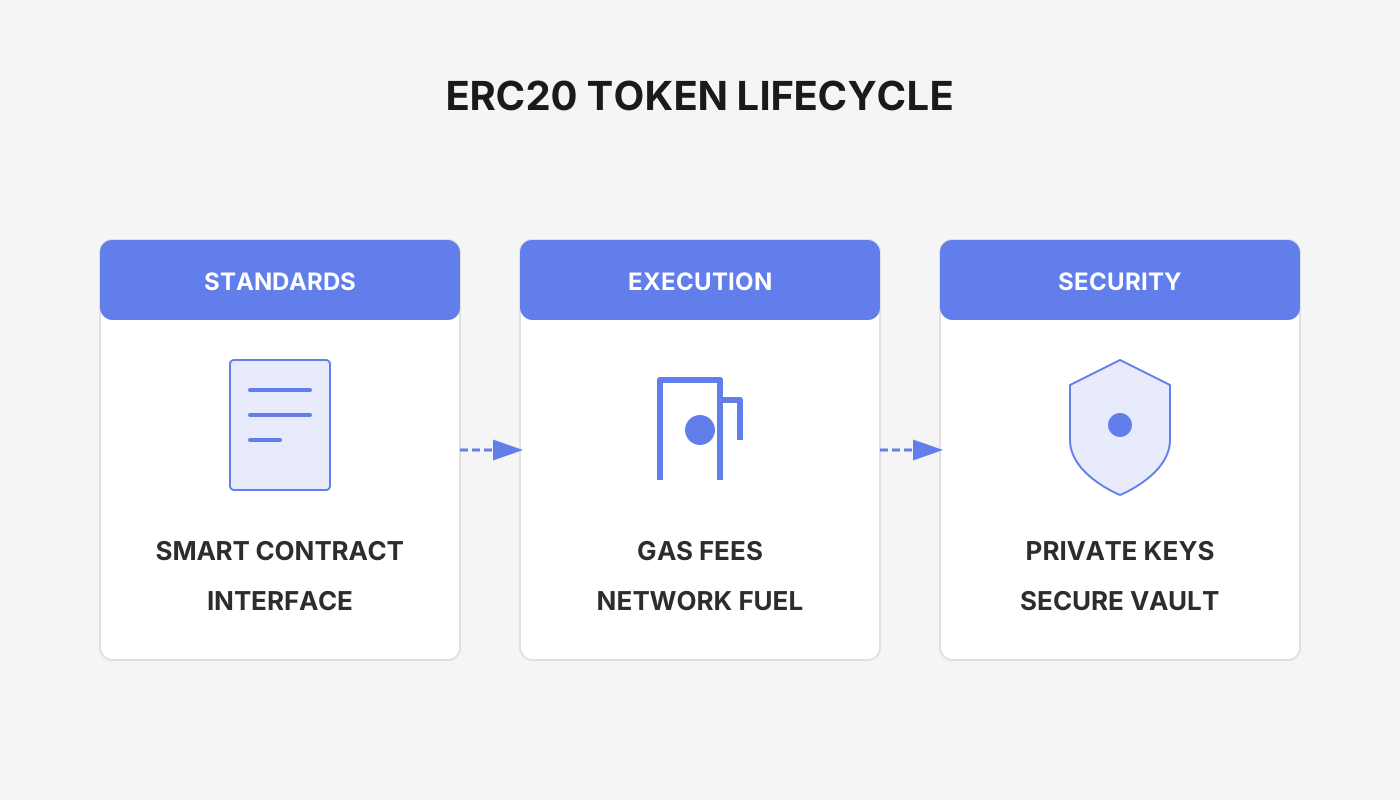
What Are Gas, Ether, and ERC20?
Gas
- The fee charged by the Ethereum network when processing a transaction or executing a smart contract.
Ether
- The native cryptocurrency used to pay for Gas, also known as Ether (ETH).
ERC20
- A smart‑contract standard (or specification) on Ethereum that mandates six essential functions and two events that a token contract must implement.
These three components together form the engine of the Ethereum ecosystem, providing computational resources while ensuring that tokens can move freely on‑chain.
What Is Ether?
- Ether is comparable to fuel for a car; you must hold Ether in order to initiate a transaction or call a contract on Ethereum.
- Unlike Bitcoin, Ether does not have a fixed maximum supply; the network can generate sufficient Gas to meet demand as needed.
The Relationship Between Gas and Ether
- Sending Ether, invoking a smart contract, or recording any data on the blockchain all require payment of Gas, which is denominated in Ether.
- When the network is congested, the Gas Price (the amount of Ether you pay per unit of Gas) rises with demand, causing the same operation to become more expensive.
The Birth of the ERC20 Standard
As the Ethereum ecosystem expanded rapidly, many developers wrote their own token contracts, leading to incompatibilities that made interaction between different tokens cumbersome. To solve this compatibility problem, the community introduced the ERC20 standard, allowing any token that follows the specification to be handled uniformly by wallets, exchanges, and decentralized applications (DApps).
Core Functions Defined by ERC20
| Function | Description |
|---|---|
| **totalSupply** | Returns the total amount of tokens that have been minted. |
| **balanceOf(address)** | Returns the token balance of a specific address. |
| **transfer(address,uint256)** | Moves tokens from the caller’s address to a target address. |
| **transferFrom(address,address,uint256)** | After an allowance has been set, transfers tokens from one address to another. |
| **approve(address,uint256)** | Grants a third‑party address permission to spend a specified number of tokens on the owner’s behalf. |
| **allowance(address,address)** | Checks the remaining allowance that a spender is permitted to use. |
| **Transfer** (event) | Emits a log entry whenever a token transfer occurs. |
| **Approval** (event) | Emits a log entry whenever an allowance is set or changed. |
Real‑World Use Cases of ERC20 Tokens
Golem
- A distributed computing platform where users can rent out idle CPU/GPU resources in exchange for GNT (the Golem token).
- ERC20 is used to automate the settlement of resource‑rental fees.
OmiseGO (OMG)
- A decentralized payment network built on Ethereum that offers low‑cost, high‑throughput cross‑chain payments.
- The ERC20 token OMG is used for value transfer and settlement within the network.
Augur
- A decentralized prediction‑market platform where users create and trade contracts based on real‑world events.
- The REP (Augur Reputation) token follows the ERC20 standard and rewards participants who make accurate forecasts.
How to Purchase and Store ERC20 Tokens
- Obtain an Ethereum wallet – Recommended options include MyEtherWallet, MetaMask, or hardware wallets such as Ledger and Trezor.
- Fund the wallet with Ether – Purchase or transfer enough Ether into the wallet to cover Gas fees. For fiat purchases, you can use USD via credit‑card processors, SEPA transfers for Euro‑zone users, or SWIFT for other regions.
- Buy ERC20 tokens on an exchange – Platforms that support ERC20 trading include Binance (global users), Binance.US for United States residents, Coinbase, Huobi, and many others.
- Transfer tokens to your personal wallet – Withdraw the tokens from the exchange to your own Ethereum address and keep the private key secure.
Cold wallets (hardware devices or offline paper wallets) are the safest way to store large amounts of ERC20 assets because they never connect directly to the internet, reducing exposure to online attacks.
*Note: In many jurisdictions, gains from the sale or exchange of cryptocurrencies may be subject to tax. Users should consult local tax regulations or a qualified professional to ensure compliance.*
Advantages and Challenges of ERC20
- Advantages
- A unified interface reduces development costs.
- Broad compatibility: almost every Ethereum wallet and exchange supports ERC20 tokens.
- Strong composability: contracts can interact directly with one another without additional adapters.
- Challenges
- Once a smart contract is deployed, its code cannot be altered; bugs must be addressed by deploying a new contract and migrating users.
- Over‑standardization can limit functionality, prompting the creation of extensions such as ERC777 and ERC1155 to meet more complex use cases.
Summary
- ERC20 provides a universal standard for issuing, transferring, and querying tokens on Ethereum, enabling developers to create interoperable crypto assets quickly.
- By paying Gas with Ether, users can perform token transfers and invoke smart contracts on‑chain.
- Secure storage of ERC20 tokens requires a reliable Ethereum wallet, with cold‑storage solutions strongly recommended for long‑term holdings.
This article offers a complete overview of what ERC20 is, what it can do, and how to store ERC20 tokens. For deeper technical details on blockchain development, stay tuned to Bitaigen’s upcoming specialist posts.
Related Reading
- BEP20 vs ERC20: Guide to Cross‑Chain Token Conversion
- Ethereum: Vitalik Buterin, Smart Contracts & ERC Standards
- Ethereum ERC‑20 Tokens: Guide to Standards, Uses & Examples
💡 Register on Binance with referral code B2345 for the maximum trading fee discount. See Binance complete guide.



