
 Bitaigen Research
 Ethereum and ERC‑20 Tokens: A Comprehensive Overview
Ethereum was launched in 2015, and within the Ethereum ecosystem tokens represent a wide variety of digital assets. Ethereum tokens are essentially implemented through smart contracts on the Ethereum blockchain, and one of the most important token standards is ERC‑20, which has become the industry‑wide technical specification. This article will explain in detail what ERC‑20 is, which tokens follow the ERC‑20 standard, and what other Ethereum standards exist besides ERC‑20, helping you quickly grasp the whole ecosystem.
ERC‑20 is the technical standard on Ethereum for issuing fungible tokens. Common examples include USDT, USDC, LINK, UNI, WBTC, and many others. Additional standards include ERC‑721, ERC‑1155, and more.
In this article we outline the core concepts of ERC‑20 and its most widely used tokens, and we compare other Ethereum standards such as ERC‑721 and ERC‑1155. The goal is to give you a quick yet complete picture of token technology. Subsequent sections will dive deeper into the specific use‑cases of each specification, so a careful read is recommended.
What Is ERC‑20?
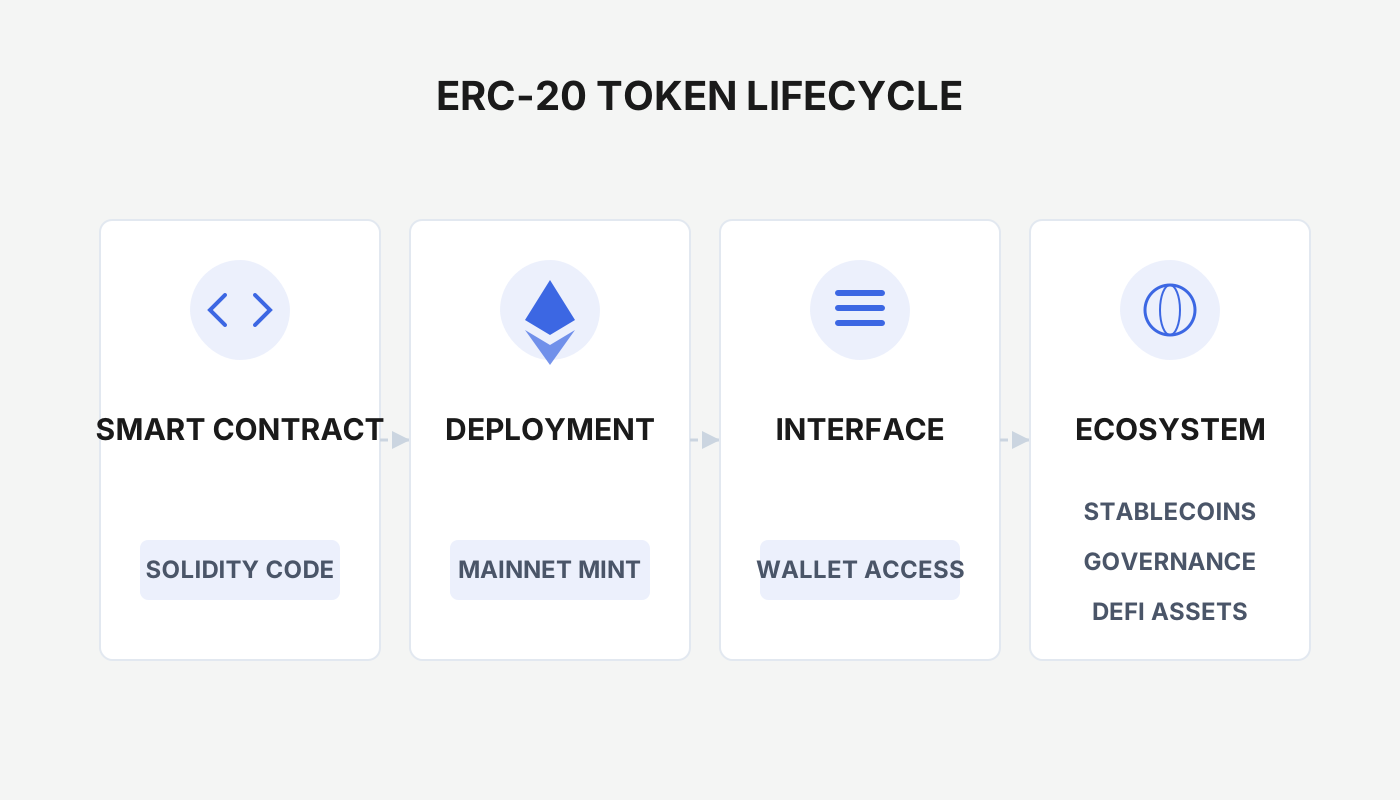
ERC‑20 (Ethereum Request for Comments 20) is the technical standard used to issue and manage assets on the Ethereum blockchain. “ERC” stands for “Ethereum Request for Comments,” and the number 20 uniquely identifies this particular proposal. The standard enumerates the required function interfaces for creating, transferring, and querying tokens, ensuring compatibility across different smart contracts.
In short, ERC‑20 provides a unified set of rules for fungible assets on Ethereum, defining basic operations such as token transfer, balance inquiry, and total supply, thereby allowing tokens to move smoothly throughout the entire ecosystem.
Historical Origin of ERC‑20
- In 2015, developer Fabian Vogelsteller introduced the concept of an ERC standard.
- In September 2017, the proposal was formally incorporated as Ethereum Improvement Proposal EIP‑20.
Before this, Ethereum lacked a universal token interface, making interoperability between projects difficult. To address the problem, the community submits EIPs (Ethereum Improvement Proposals) that describe new features and protocols; after review and revision they become official ERC standards. The emergence of ERC‑20 meant that all tokens adhering to the standard behaved consistently, establishing a cornerstone of the Ethereum ecosystem.
It is worth noting that in October 2023 Ethereum split the improvement tracks into two parallel lanes: ERC focuses on application‑layer interaction standards, while EIP concentrates on network, consensus, and low‑level protocol upgrades.
Why Create ERC‑20 Tokens?
The Ethereum network allows anyone to deploy a smart contract and issue a token, but the absence of a common rule set leads to several problems:
- Tokens cannot easily interact with one another.
- dApp developers must write custom integration code for each token.
- Exchanges and wallets face higher compatibility costs.
ERC‑20 solves these issues by forcing all tokens to implement the same interface, removing the barriers above and encouraging collaborative growth. Other blockchains have adopted the same model; for example, Binance Smart Chain uses BEP‑20, which mirrors ERC‑20.
Core Interface of the ERC‑20 Standard
An ERC‑20 contract must implement the following functions (all are view or pure except for `transfer`, `transferFrom`, and `approve`):
| Function | Description |
|---|---|
| **totalSupply()** | Returns the total number of tokens in existence. |
| **balanceOf(address account)** | Retrieves the token balance of the specified address. |
| **transfer(address to, uint256 amount)** | Moves `amount` tokens from the caller to the `to` address. |
| **transferFrom(address from, address to, uint256 amount)** | Transfers tokens on behalf of `from`; the caller must have prior approval. |
| **approve(address spender, uint256 amount)** | Allows `spender` to withdraw up to `amount` tokens in the future. |
| **allowance(address owner, address spender)** | Returns the remaining amount that `spender` is allowed to withdraw from `owner`. |
These functions constitute the minimal interaction set for a token. All wallets, exchanges, and DeFi protocols that claim ERC‑20 compatibility rely on this interface to perform operations.
Advantages of ERC‑20 Tokens
- Easy Deployment – Solidity (or Vyper) offers ready‑made templates, allowing developers to write and launch a contract within minutes.
- Highly Customizable – On top of the basic interface, developers can add logic such as gas rebates, freezing/unfreezing, minting/burning, and other business rules.
- Standard Blueprint – The uniform interface removes the need to reinvent token functionality from scratch, reducing development costs.
- Liquidity & Interoperability – Any token that follows ERC‑20 can be transferred freely between any wallet, exchange, or DeFi protocol that supports the standard.
- Broad Acceptance – Major exchanges, wallets, and on‑chain services universally support ERC‑20, boosting a token’s accessibility.
- Anti‑Counterfeit Mechanism – All transfers require an `approve` step, and the total supply is capped at the contract level, lowering the risk of accidental over‑issuance.
Limitations of ERC‑20 Tokens
| Issue | Explanation |
|---|---|
| **Network Instability** | During Ethereum’s transition from PoW to PoS, temporary disturbances can occur; some contracts have unintentionally burned tokens during calls. |
| **High Gas Fees** | Transaction costs fluctuate with network congestion; during peak periods users may face significantly higher expenses. |
| **Transfer Errors** | Sending tokens to a contract address that does not support ERC‑20 can lock funds permanently; there are known cases with losses approaching a million USD. |
| **Transaction Delays** | Block confirmation times depend on network load; heavy traffic slows down finality. |
| **Irreversibility** | Mistakenly sending tokens to the wrong address cannot be undone; the sender bears the loss. |
| **Low Barrier to Abuse** | Anyone can issue an ERC‑20 token, leading to projects with little intrinsic value and increasing the risk of scams. |
Common ERC‑20 Token Examples
The following tokens are widely recognized in the community and all conform to the ERC‑20 standard:
- USDT (Tether) – A stablecoin pegged 1:1 to the US dollar, extensively used on DEXs and liquidity pools.
- USDC (USD Coin) – Another dollar‑pegged stablecoin, favored for its transparency and regulatory compliance.
- LINK (Chainlink) – The incentive token for the decentralized oracle network.
- UNI (Uniswap) – Governance token of the Uniswap decentralized exchange.
- WBTC (Wrapped Bitcoin) – Represents Bitcoin on Ethereum, providing Bitcoin liquidity to the ecosystem.
- SHIB (Shiba Inu) – Originally a meme coin that has expanded into a full DeFi ecosystem.
Other notable ERC‑20 projects include COMP, BAT, MATIC, SAND, IMX, WETH, among many others, collectively forming a diverse token landscape on Ethereum.
Other Ethereum Token Standards
Beyond ERC‑20, Ethereum defines several additional standards tailored to specific use‑cases:
| Standard | Primary Use |
|---|---|
| **ERC‑721** | Non‑fungible tokens (NFTs); each token is unique, suitable for digital art, collectibles, etc. |
| **ERC‑1155** | Multi‑token standard supporting both fungible and non‑fungible assets within a single contract (“one contract, many assets”). |
| **ERC‑777** | An upgraded version of ERC‑20 that reduces transaction costs and adds hook functions for more flexible interactions. |
| **ERC‑223** | Addresses the problem of token loss when sending ERC‑20 tokens to contracts, and enables paying transaction fees with tokens. |
| **ERC‑1400** | Security‑token standard that incorporates KYC/AML mechanisms to meet regulatory issuance requirements. |
These standards continue to evolve, reflecting the Ethereum community’s ongoing pursuit of functionality, security, and compliance.
Future Outlook for ERC‑20
ERC‑20 has laid the foundation for token interoperability and has accelerated the growth of DeFi, DAO, NFT, and other innovative applications. Although challenges such as high gas fees and network congestion remain, the community is actively working on improvements in several directions:
- Scalability – Ethereum 2.0, sharding, and Layer‑2 solutions (e.g., Optimism, Arbitrum) are expected to dramatically lower transaction costs.
- Security – Formal verification, rigorous audit processes, and bounty programs are raising the overall safety level of token contracts.
- Standard Evolution – Newer specifications like ERC‑777 and ERC‑1155 are gaining traction and may replace ERC‑20 in certain scenarios.
As decentralized finance matures and mainstream adoption accelerates, tokens built on ERC‑20 will continue to play a pivotal role in enhancing financial accessibility, liquidity, and innovation.
Frequently Asked Questions
Q: What can ERC‑20 tokens be used for?
A: ERC‑20 tokens are widely employed in DeFi (e.g., liquidity provision, lending), DAO governance, stablecoins, and as utility tokens for various dApps—examples include Uniswap trading pairs, Maker collateral, and Brave browser’s BAT rewards.
Q: Is an ERC‑20 token the same as ETH?
A: No. ERC‑20 refers to a contract that follows a specific token standard, whereas ETH is the native cryptocurrency of the Ethereum network. They serve different functions and have distinct roles.
Q: How do I store and transfer ERC‑20 tokens?
A: Use Ethereum‑compatible wallets such as MetaMask, Ledger hardware wallets, Trust Wallet, or others. Adding the token’s contract address to the wallet will display the balance and enable transfers.
Q: Are ERC‑20 tokens completely safe?
A: Like all blockchain assets, ERC‑20 tokens are subject to smart‑contract vulnerabilities. Developers should conduct thorough audits, consider formal verification, and run bug‑bounty programs on testnets. Users should rely on reputable wallets and exchanges (U.S. residents should use Binance.US rather than the global Binance platform).
Note on Taxation: Cryptocurrency gains, including those from ERC‑20 tokens, may be taxable in many jurisdictions. Users should consult local tax regulations or a professional advisor to understand their obligations.
---
This completes the full analysis of “What Is ERC‑20? Which Tokens Are ERC‑20? What Other Ethereum Standards Exist?”. For more in‑depth technical details on Ethereum, stay tuned to Bitaigen’s upcoming articles.
Related Reading
- March 2025 Crypto Airdrops: BROC, FireChicken, CUBS, BYB, ABG
- 2026 Crypto Bull Market: Bitcoin, Ethereum, AI & RWA Surge
- Ethereum to Outperform Bitcoin in 2026: DeFi & Upgrades
💡 Register on Binance with referral code B2345 for the maximum trading fee discount. See Binance complete guide.



