
 Bitaigen Research
 From both technical and business perspectives, we have organized the core concepts of Brevis as a zero‑knowledge (ZK) full‑chain data platform, its innovative features, the financing journey behind it, and the founding team. By reading this article, readers can quickly grasp its potential value for multi‑chain data access and trust‑less computation, and decide whether the project merits further attention.
What Is Brevis? Funding Background, Features, and Founder Overview
Brevis is a zero‑knowledge (ZK) proof‑based full‑chain data access platform that enables decentralized applications (dApps) to securely and trustlessly obtain and compute historical on‑chain data across multiple blockchains.
Below, the Bitaigen editorial team systematically breaks down Brevis’s concept, financing details, core characteristics, and the background of its founding team for readers who are interested.
Brevis Overview
Introduction
Brevis aims to let smart contracts access and process complete historical data from multiple chains without requiring any trust in external parties. The platform offers customizable computation capabilities that support innovative use cases such as DeFi, cross‑chain identity verification, and liquidity management, thereby helping developers build smarter applications with minimal trust assumptions.
The founder, Dong Mo, holds a deep background in computer science. While pursuing her Ph.D. at the University of Illinois at Urbana‑Champaign (UIUC), she focused on distributed systems and network security. She also serves as a venture partner at IOSG Ventures and is a co‑founder of Celer Network.
Funding
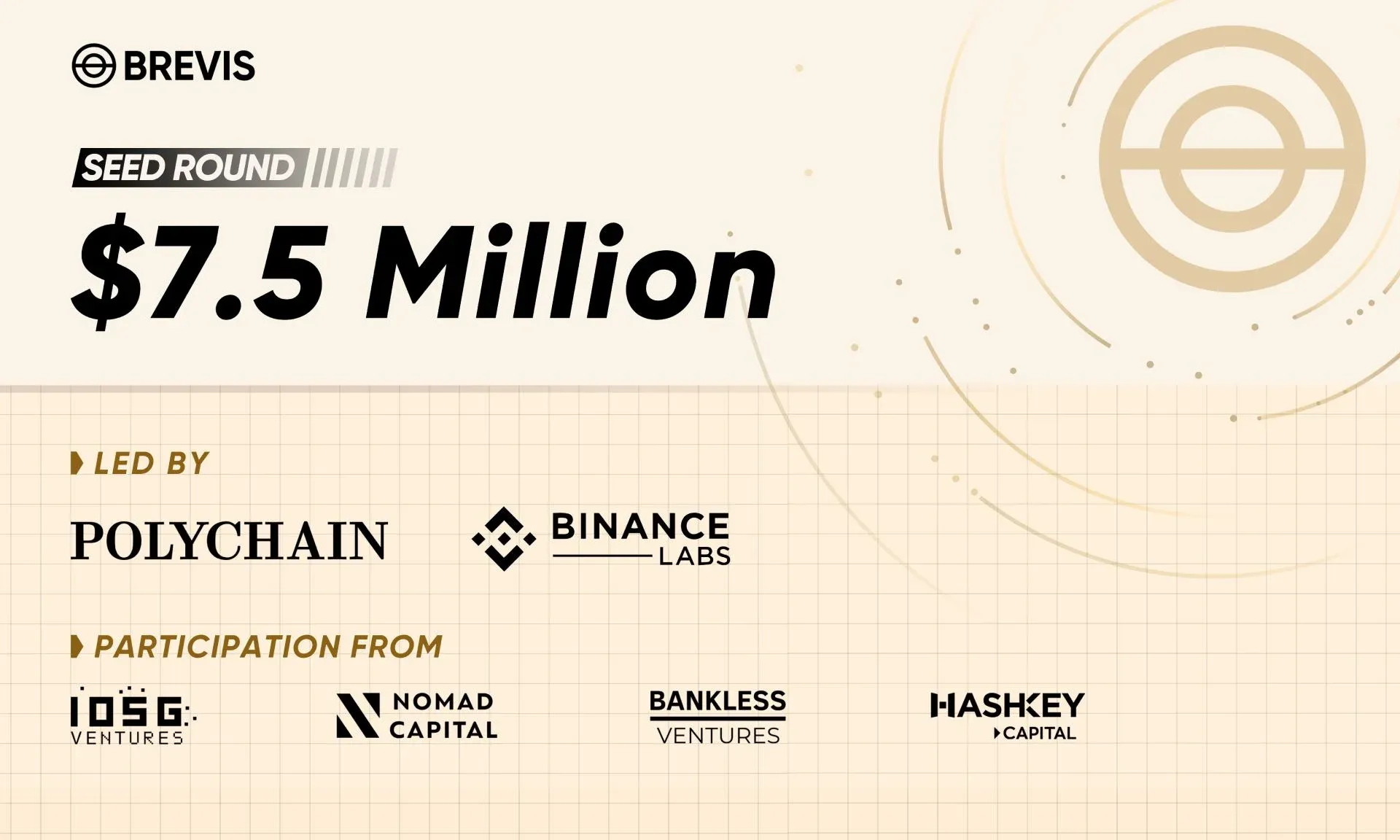
On November 12, 2024, Brevis announced the close of a $7.5 million seed round. The round was co‑led by Polychain Capital and Binance Labs, with participation from IOSG Ventures, Nomad Capital, Bankless Ventures, and HashKey Capital, among others. (U.S. investors who wish to engage with Binance‑related services should use Binance.US, as the global Binance platform is not available to U.S. residents.)
Vision
Today’s Web3 dApps can only read the current state of a blockchain; they lack a native way to fetch the complete historical record, which limits functional possibilities. Brevis’s goal is to become a ZK full‑chain data computation and verification platform that allows dApps to access, compute, and leverage arbitrary cross‑chain data—such as asset transfers, contract function calls, event logs, and state roots—in a fully trust‑less manner. This capability unlocks the extraction of valuable signals like asset ownership, user activity summaries, social graphs, and financial relationships.
Key Characteristics of the Brevis Network
Brevis V2’s Alpha mainnet introduces the following core improvements:
- Historical Data Access – Developers can directly query and compute on‑chain historical data, expanding the functional horizon of their dApps.
- Off‑Chain Computation – Heavy calculations are performed off‑chain; only a succinct zero‑knowledge proof is submitted back on‑chain, dramatically reducing gas fees and latency.
- Cross‑Chain Interoperability – All EVM‑compatible chains are supported, enabling seamless data exchange between Ethereum and other networks.
Supported Application Scenarios
Brevis’s feature set underpins a variety of sectors, with particularly strong relevance to DeFi and decentralized identity (DID) solutions:
- DeFi Loyalty Programs – Reward distribution driven by users’ historical transaction activity.
- Decentralized Identity Verification – Securely accessing past records to improve verification efficiency while preserving privacy.
- Historical Oracles – Supplying trustworthy past‑state data to protocols that require it.
Value Proposition for Developers
Brevis provides a unified cross‑chain API, a comprehensive SDK, and thorough documentation, allowing developers to integrate zero‑knowledge proofs and multi‑chain data access quickly. This accelerates project scalability and reduces the complexity typically associated with cross‑chain logic.
Brevis Features and Architecture
Main Features
- High Performance at Scale
Leveraging state‑of‑the‑art ZK cryptographic algorithms and massive parallel processing, Brevis can complete complex calculations for large batches of transactions in a short time, satisfying dApps that demand near‑instant response speeds.
- Versatility
The SDK supports multiple programming languages, enabling developers to read historical states, transactions, and contract events, and to plug in custom computation logic that fits a wide range of business models.
- Omni‑Chain
A single, consistent user experience delivers fast, trust‑less data access and computation across many blockchains, allowing developers to build truly cross‑chain applications while end‑users enjoy seamless interactions.
Architectural Overview
Brevis’s core architecture consists of three major components: zkFabric, zkQueryNet, and zkAggregatorRollup. Together they form a complete zero‑knowledge multi‑chain data proof system.
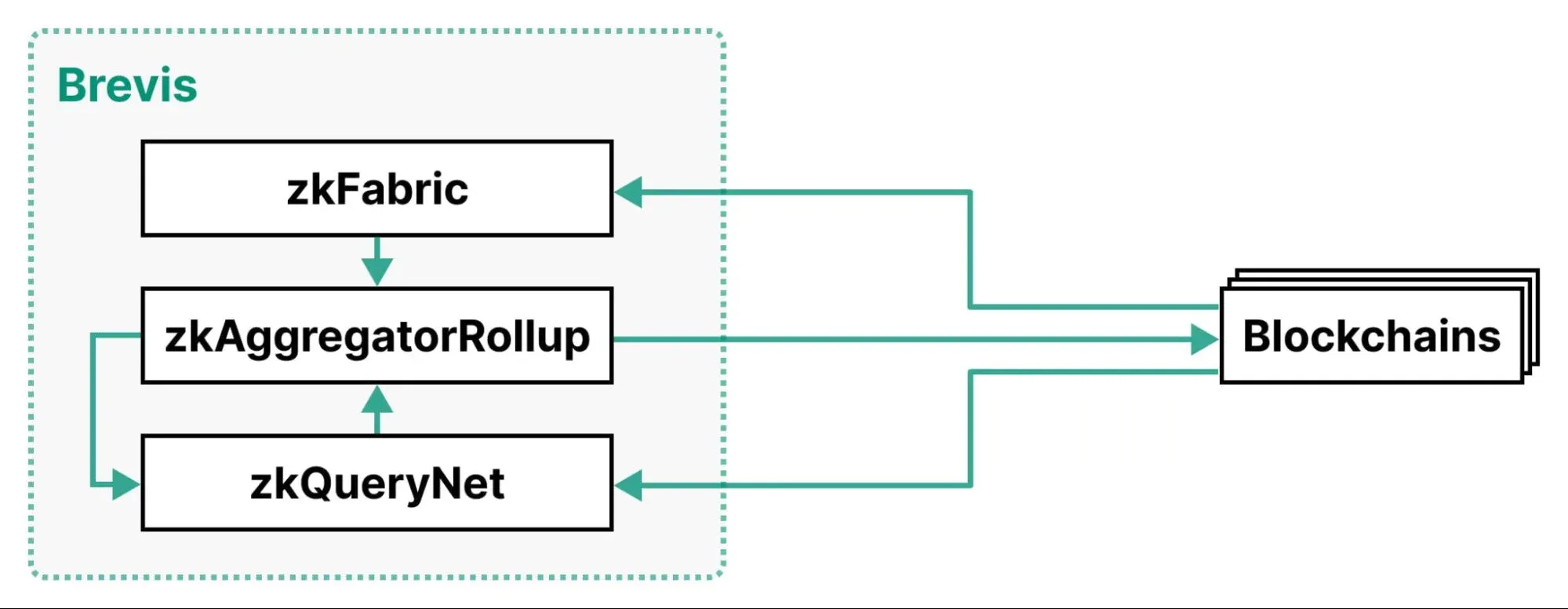
1. zkFabric: Zero‑Knowledge‑Based Multi‑Chain Interoperability Layer
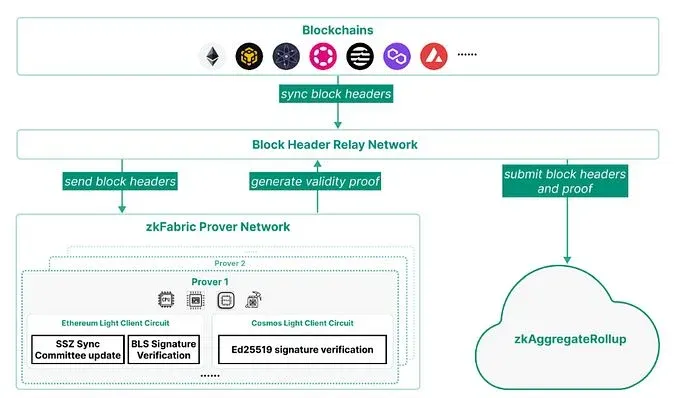
zkFabric synchronizes block headers from every connected chain and produces ZK Consensus Proofs that attest to the validity of those headers, thereby enabling trust‑less cross‑chain state access. Its workflow can be likened to a courier service:
- Block Header Sync – The relay network periodically gathers block headers from each chain and, after a security confirmation, selects the valid ones.
- Submit Headers – The selected headers are forwarded to the zkFabric prover network.
- Generate Validity Proofs – Provers employ chain‑specific ZKP circuits (light‑client protocols) to create zero‑knowledge proofs of header correctness.
- Return Proofs – The proofs travel back to the relay network.
- Rollup Submission – The relay network packages the block headers together with their proofs and submits them to the zkAggregatorRollup.
These zero‑knowledge “receipts” can be recursively verified inside zkAggregatorRollup, achieving a single verification step that re‑uses proofs across multiple chains and greatly improves cross‑chain efficiency.
For example, on Ethereum’s Proof‑of‑Stake (PoS) system, zkFabric first computes the sync committee commitment, then validates the BLS signatures, finally producing a zero‑knowledge proof that is bundled with the header and posted to the rollup, ensuring both safety and completeness of the cross‑chain data.
2. zkQueryNet: Open ZK Query Engine Network
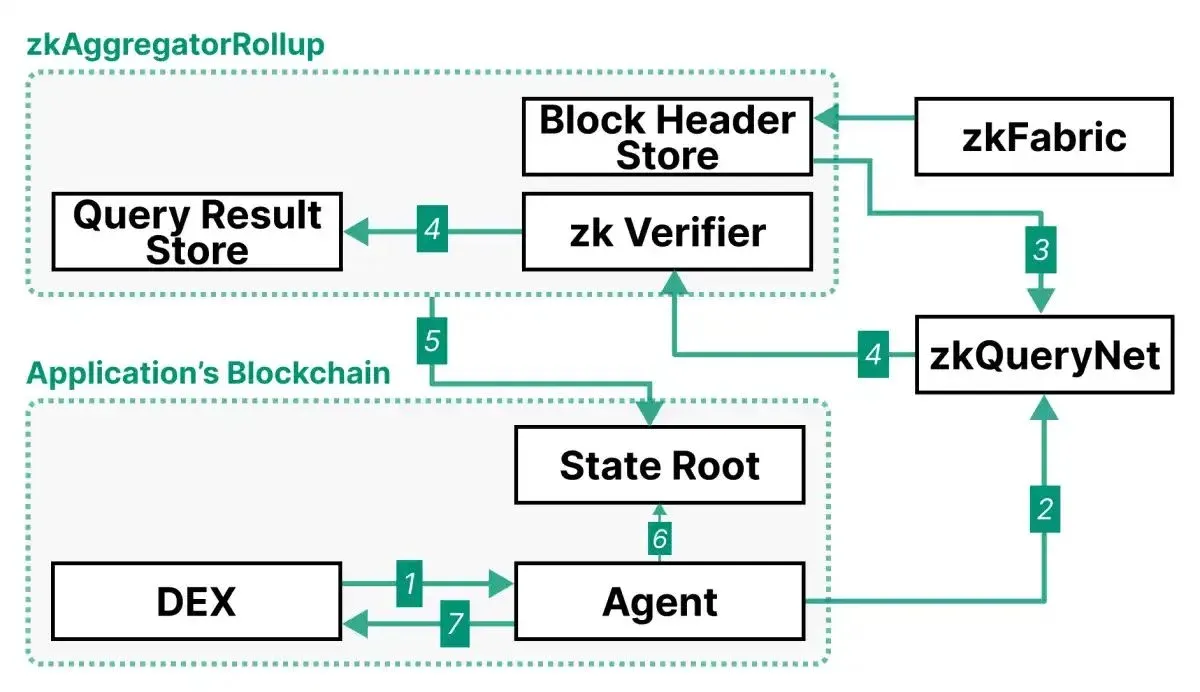
zkQueryNet operates as a decentralized query marketplace that converts multi‑chain data query results into zero‑knowledge proofs, delivering trustworthy and privacy‑preserving query services. Its process is as follows:
- Receive a query request from a dApp.
- Parse the request and execute the computation within the appropriate ZK Query Engine.
- Produce the query result together with a zero‑knowledge proof.
- Return the proven result to the calling smart contract.
Through zkQueryNet, developers no longer need to rely on centralized intermediaries to access cross‑chain data. For instance, a decentralized exchange (DEX) could query a user’s total trading volume across several chains, generate a proof, and automatically adjust liquidity‑mining rewards on‑chain without exposing raw data.
3. zkAggregatorRollup: Aggregation Layer for Cross‑Chain Proofs
zkAggregatorRollup aggregates and stores the zero‑knowledge proofs generated by zkFabric and zkQueryNet, then commits the validated state roots to every connected chain. Its design purpose is to act as a trust‑less “data hub,” reducing cross‑chain communication costs by submitting a single batch while still guaranteeing data integrity and security.
Technically, zkAggregatorRollup employs efficient data structures such as Verkle trees for fast lookup and proof generation. Its robust verification logic ensures that each submitted proof undergoes rigorous ZK validation before being accepted.
Typical Use Cases for Brevis
- Data‑Driven DeFi – Zero‑knowledge proofs enable DeFi protocols to reference historical transaction data for reward distribution, risk assessment, and other analytics‑heavy scenarios.
- zkBridges (Zero‑Knowledge Cross‑Chain Bridges) – Brevis‑powered bridges can facilitate end‑to‑end secure asset transfers between ecosystems like Cosmos and Ethereum, delivering both efficiency and verifiability.
- zkDID (Zero‑Knowledge Identity) – In identity systems, users can prove attributes or actions without revealing underlying personal data, paving the way for fine‑grained social or financial interactions that respect privacy.
Potential Exchanges for Listing Brevis
| Exchange | Description |
|---|---|
| **Binance** | The world’s leading digital‑asset exchange, serving over 190 countries and regions. (U.S. users should use **Binance.US**.) |
| **Huobi** | A well‑known digital‑economy firm with a full‑stack blockchain ecosystem. |
| **OKX** | Offers a unified trading account, the MetaX multi‑chain wallet, and a broad suite of DeFi products. |
| **Gate.io** | Formerly “Zima Open Door,” combines centralized and decentralized modes with years of operational experience. |
| **Bitget** | Supports trading of more than 500 virtual assets and holds multiple regulatory licenses worldwide. |
| **Bybit** | Provides spot, derivatives, and copy‑trading functionalities for both novices and professionals. |
| **XT.com** | Seychelles‑registered platform delivering spot, margin, and derivatives services across diverse markets. |
Important Reminder: Some exchanges require users to complete registration before they can claim any referral or rebate rewards. Please consult each platform’s official links for the most up‑to‑date details.
Closing Remarks
Brevis achieves efficient, secure, and trust‑less full‑chain data access and computation through its three core components—zkFabric, zkQueryNet, and zkAggregatorRollup. The platform has already been deployed in several innovative domains, including DeFi, cross‑chain identity verification, and liquidity management. In the coming months, Brevis plans to launch a new ZK Coprocessor architecture that will further boost computational performance and cross‑chain compatibility. At the same time, the team will continue to refine the SDK, lower ZK computation costs and latency, and deliver a more developer‑friendly experience.
*Please note that cryptocurrency gains may be subject to taxation in your local jurisdiction; consult a tax professional for guidance.*
The above content is a systematic compilation by the Bitaigen editorial team of Brevis’s project details, financing background, core features, and founding team, intended to help readers gain a deeper understanding of the initiative.
Related Reading
- Brevis ZKP Powers Secure Cross‑Chain Data Sharing
- Multi-Chain Era: Cross-Chain Bridges Unite Blockchain Assets
- How to Look Up a Blockchain Contract Address Quickly
💡 Register on Binance with referral code B2345 for the maximum trading fee discount. See Binance complete guide.



