
 Bitaigen Research
 In the crypto space, TRON (TRX), a public blockchain that aims to enable decentralized content distribution, has drawn both controversy and attention in recent years. Its native token TRX serves multiple functions within the ecosystem: it acts as fuel for transaction fees, a tool for governance, a means to acquire network resources, and more. Below we systematically examine TRX from the perspectives of concept, technology, ecosystem, historical price performance, and investment risk.
The Bitaigen editorial team has compiled the core concepts of the TRON chain, the multiple functions of TRX, and the ecosystem layout, and provides an in‑depth analysis of its technical advantages and potential risks. This article combines historical price data with industry trends to help you comprehensively assess TRX’s investment value. Later sections also contain price‑trend forecasts—please continue reading.
What Is TRX? The Positioning of the TRON Chain
Tron is a cross‑chain content‑sharing platform similar to Bitcoin and Ethereum, where creators can deliver digital content directly to users without going through centralized channels such as the Apple Store, Google Play, Spotify, or YouTube.
TRX, as the native token of the TRON chain, has the following core functions:
- Paying Transaction Fees: When transferring tokens, invoking DApps, issuing new tokens, and other on‑chain actions, a small amount of TRX is consumed as fuel.
- Governance and Voting: Holders can freeze (stake) TRX to obtain “Super Representative” voting rights and participate in decisions regarding network security and reward distribution.
- Value Anchor and Trading Pair: TRX serves as the value benchmark for the TRON ecosystem; many TRON‑issued tokens (e.g., USDT) use TRX as a trading pair.
- Resource Leasing: By staking TRX, users can acquire “Energy” and “Bandwidth,” enabling fee‑free on‑chain operations—particularly useful for high‑frequency users.
Before the mainnet launched in June 2018, TRX existed as an ERC‑20 token on Ethereum. It later migrated to the TRC‑20 standard, becoming an independent mainnet token.
Technical Features and Controversies
TRON uses a Delegated Proof‑of‑Stake (DPoS) consensus mechanism, with 27 Super Representatives responsible for block production. This design yields a relatively high TPS (transactions per second) ranging from roughly 1,000 to 2,500 and extremely low fees. The platform also supports Java as a development language and offers a leasing model to reduce user costs.
However, these purported technical advantages are similar to those of projects such as EOS and NEO. Some media outlets have noted that TRON’s early whitepaper overlaps heavily with Filecoin (FIL) in content; founder Justin Sun explained the similarity by saying “the original was in Chinese and details were lost in translation.”
The table below is taken from Mitrade’s comparison of seven points listed for Justin Sun (for reference only):
| Project | Programming Language | Scalability | TPS | Token Burn | Fees | Development Rewards | User Base |
|---|---|---|---|---|---|---|---|
| TRON | Java | Strong | 1,000‑2,500 | Yes | 0 | $1 billion | 100 million |
| ETH | Solidity | Medium | 25 | No | High | None | Limited |
Overview of the TRON Ecosystem
The TRON ecosystem is among the more active sectors in the current blockchain industry and consists of four major components:
1. Public Chain and Virtual Machine
TRON’s core is its public‑chain architecture. The TRON Virtual Machine (TVM) is compatible with Ethereum’s EVM, allowing developers to migrate existing smart contracts directly. The DPoS consensus ensures fast transaction confirmation and low cost.
2. Decentralized Finance (DeFi)
- Native Token TRX: Used for payments, governance, and DeFi interactions.
- Decentralized Exchange SunSwap: Similar to Uniswap, it enables free swapping of TRC‑20 tokens and supports liquidity mining.
- Lending Platform JustLend: The largest lending protocol on TRON, supporting deposits and collateralization of assets such as TRX, USDT, and USDC.
- Other Financial Tools: Staking, yield farms, liquidity mining, and a variety of other services.
3. NFT and GameFi
TRON also supports NFT issuance and trading; the APENFT Marketplace provides creators with a dedicated trading venue. At the same time, GameFi projects built on TRX and TRC‑20 tokens continue to emerge, forming an on‑chain gaming economy.
4. Cross‑Chain Bridge – BTTC
BitTorrent Chain (BTTC) is TRON’s official cross‑chain bridge, designed to enable asset and data interoperability among TRON, Ethereum, Binance Smart Chain (BSC), and other networks.
Project Team and Founder
From a technical perspective, TRON’s team appears thinner than those of other public chains such as Solana or Avalanche. Technical director Chen Zhiqiang, who joined in 2017, previously worked at Tencent, NetEase Youdao, and other traditional internet firms; most subsequent members also lack dedicated blockchain experience, which to some extent limits the project’s technical innovation.
In contrast, the operational side—particularly founder Justin Sun—carries significant influence. Sun holds a bachelor’s degree in History from Peking University and a Master of Laws from the University of Pennsylvania. He previously served as the chief representative for Ripple (XRP) in Greater China. Sun is known for high‑profile marketing tactics, including lunching with Warren Buffett, sponsoring events, and acquiring Huobi, among others.

Historical Price Performance Review
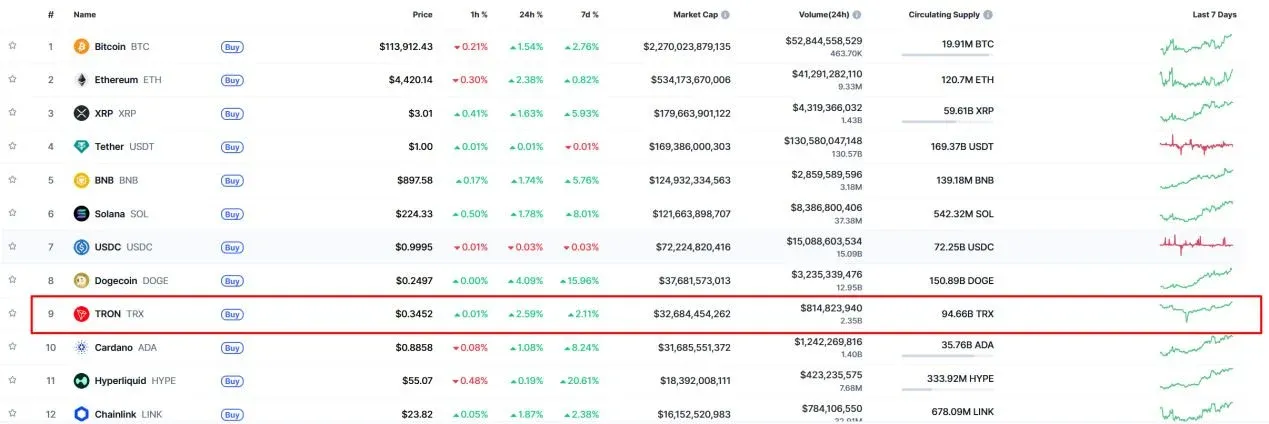
As of the time of writing, TRX’s market capitalization is approximately $32.68 billion, representing 0.83 % of the total crypto market and ranking 9th globally.
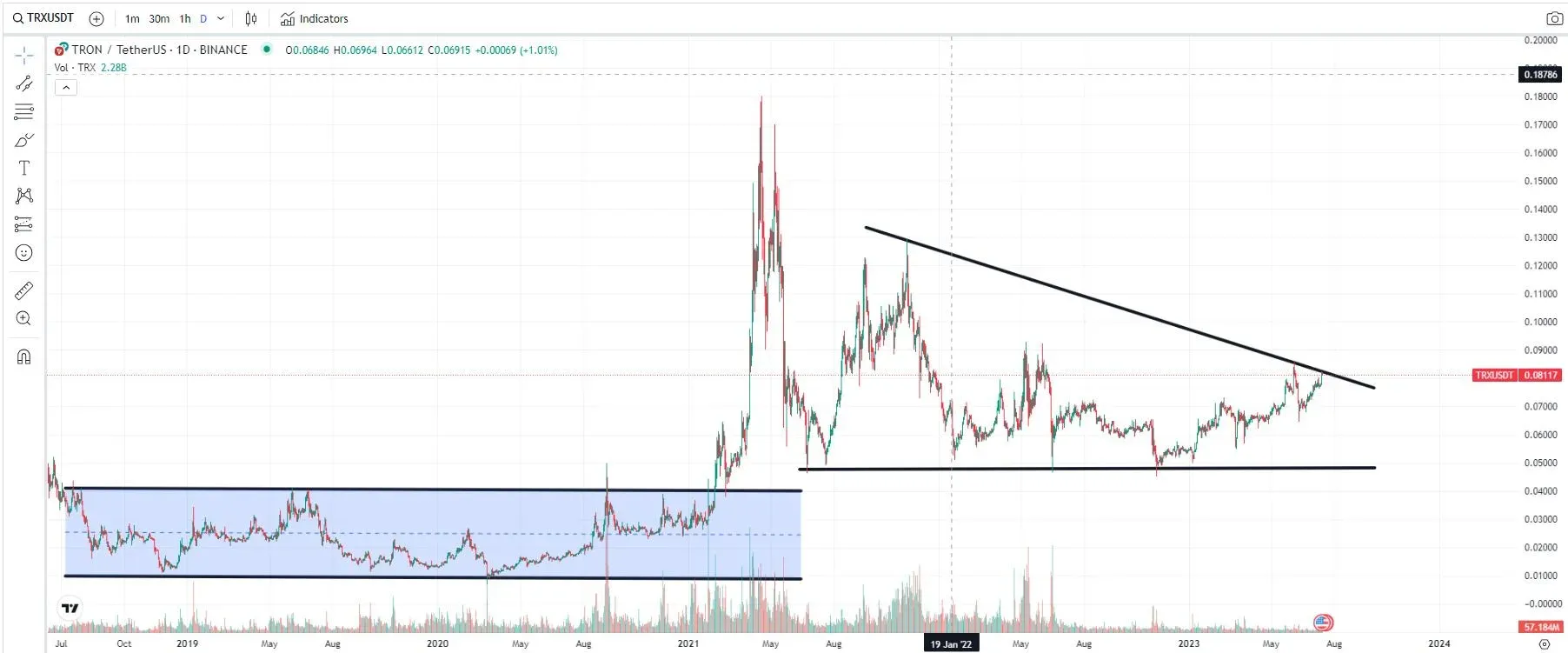
- 2018‑2020: During the previous bear market, TRX traded in a narrow band of $0.01‑$0.04.
- 2021: In April, the price peaked at $0.18, a rise of roughly 1,700 % (about 17‑fold) from the $0.01 low. While this outperformance lagged behind Bitcoin and Ethereum, it marked a clear breakout from the previous range.
- 2022‑2023: A correction followed, with the price falling to a low of $0.04 before rebounding multiple times, forming a descending‑triangle pattern. All four dips respected the $0.04 floor, indicating continued buying pressure at that level.
- 2024: Market sentiment improved, and TRX briefly surpassed $0.30. Decentralized governance (DAO) activity and heightened DApp usage were cited as key drivers of the upward move.
- 2025‑Present: The token has stabilized in the $0.25‑$0.32 range, representing clear growth compared with five years earlier.
Price‑Forecast Outlook
The following forecasts are generated by a model simulation and are for reference only; they should not be interpreted as investment advice.
| Year | Low‑End Forecast (USD) | Mid‑Point Forecast (USD) | High‑End Forecast (USD) |
|---|---|---|---|
| 2026 | 0.137055 | — | 0.303998 |
| 2027 | 0.13194 | 0.239273 | 0.346607 |
| 2028 | 0.238113 | 0.410663 | 0.583213 |
| 2029 | 0.523065 | 1.12 | 1.72203 |
| 2030 | 0.444845 | 0.865511 | 1.28203 |
| 2031 | 0.525944 | 0.850039 | 1.17203 |
| 2032 | 0.802814 | 1.49 | 2.17203 |
| 2033 | 1.86 | 3.83 | 5.80 |
| 2034 | 1.49 | 2.42 | 3.35 |
| 2035 | 1.77 | 2.86 | 3.95 |
| 2036 | 2.93 | 5.56 | 8.19 |
| 2037 | 7.62 | 13.59 | 19.55 |
For example, the model suggests that in 2026 TRX could fluctuate between $0.137055 and $0.303998, representing a potential overall increase of roughly 4.57 % under the most optimistic scenario.
Key Factors Influencing TRX Price
- Regulatory Environment – Government policies toward crypto assets directly shape the scope of activities within the TRON ecosystem, thereby affecting TRX demand.
- Overall Market Sentiment – TRX is highly correlated with major coins such as Bitcoin and Ethereum; it typically rises in bull markets and faces pressure in bear markets.
- Technical Upgrades and Ecosystem Expansion – Improvements in transaction speed, fee optimization, cross‑chain bridge maturity, and the breadth of DeFi/DApp offerings are critical for long‑term value creation.
- On‑Chain Activity and TVL – Higher usage frequency, transaction volume, and larger total value locked (TVL) in DeFi contracts can boost market confidence in TRX.
Investment Risks and Controversies
Online discourse often labels “TRX as a scam.” While the token itself is not a fraud, several factors contribute to its negative perception:
- Founder‑Related Controversy – Justin Sun’s flamboyant marketing and repeated accusations of overstating project capabilities have caused some investors to question the project’s professionalism.
- Plagiarism Allegations – Early whitepapers and portions of the codebase have been accused of resembling Ethereum, IPFS, and other projects, fueling critical commentary.
- Aggressive Marketing Leading to Volatility – Frequent hype cycles can trigger sharp price swings, leaving retail participants caught in high‑price positions and earning the “cutting the grass” label.
- Regulatory Risk – In 2023, the U.S. SEC filed a lawsuit against Justin Sun and the TRON Foundation alleging market manipulation and illegal securities offerings; the case remains pending.
In recent years, Sun’s marketing intensity has softened, shifting toward ecosystem development such as issuing stablecoins, expanding global adoption, building NFT markets, and acquiring Huobi. These moves provide a more pragmatic foundation for TRX’s long‑term value. Nevertheless, investors should monitor the founder and foundation’s actions closely, as they continue to exert a material influence on price dynamics.
How to Purchase TRX on Binance
Binance is the most widely used exchange platform for global users. Below are two common purchasing methods, adapted for an international audience (U.S. residents should use Binance.US).
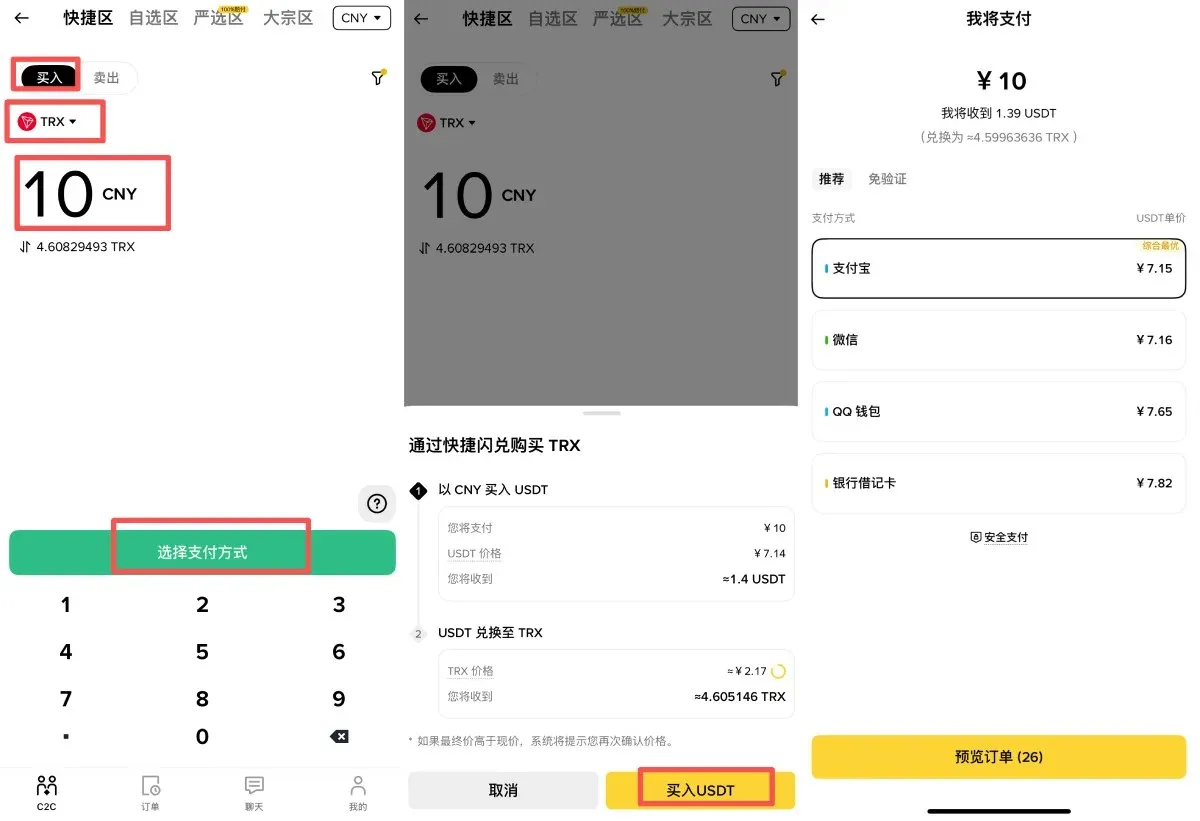
Method 1: Instant Buy (Beginner‑Friendly)
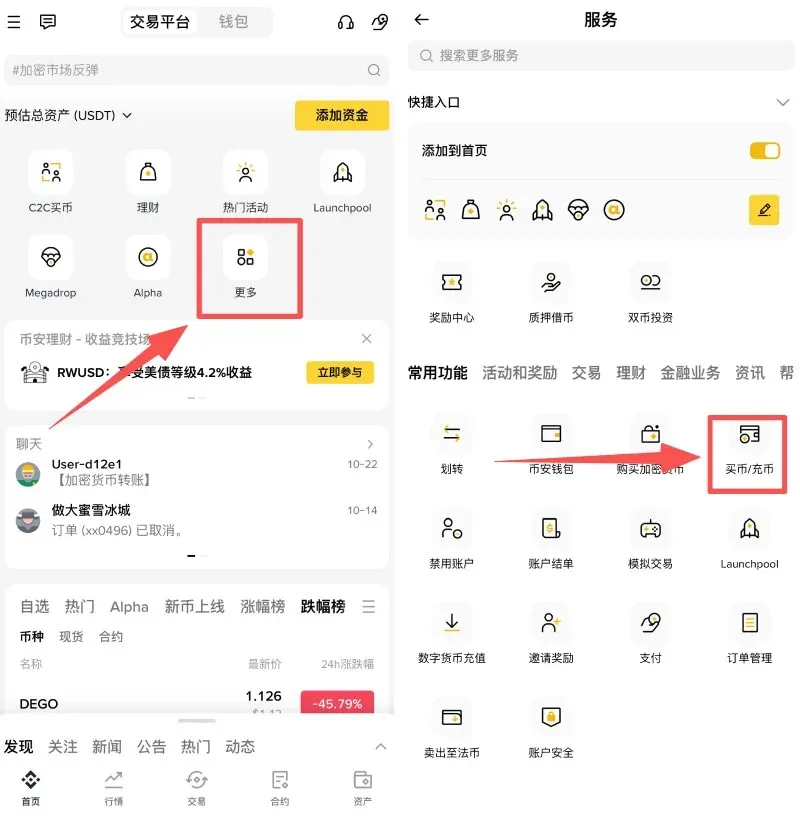
- Log in to the Binance homepage, click More → Buy Crypto to open the instant‑buy page.
- On the “Buy” screen, select a fiat currency (e.g., USD) and locate TRX in the list of available assets.
- Enter either the amount you wish to spend or the quantity of TRX you want to receive, then choose a payment method—options include SEPA transfer, SWIFT, credit/debit card, or other local e‑wallets depending on your region.
- Review the order details, input your account password or two‑factor code, and click Confirm to complete the transaction.
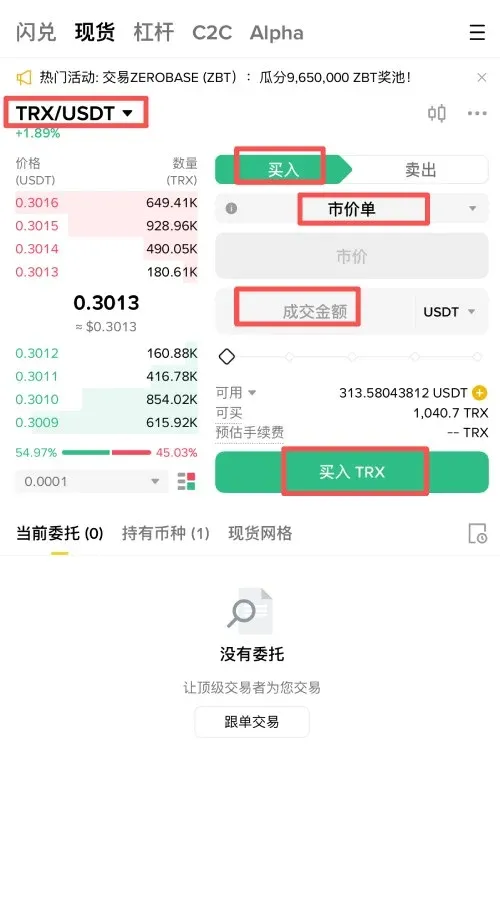
Method 2: Convert Fiat to USDT, Then Trade Spot (For Experienced Users)
- Deposit fiat (USD) into your Binance account via SEPA, SWIFT, or another supported method, and convert it to USDT.
- Navigate to the Spot Trading page and search for the TRX/USDT trading pair.
- In the buy section, select either a Market Order (instant execution) or a Limit Order (set your own price), then specify the amount of USDT you wish to spend.
- Confirm the order and click Buy TRX to finalize the trade.
Closing Remarks
Like Dogecoin (DOGE), TRX’s price is highly susceptible to individual actions and public sentiment, making it more suitable for short‑term or aggressive traders. Community jokes such as “to play Sun’s coin you need two hearts” serve as a reminder to conduct thorough risk assessments before participation. If you favor short‑term strategies, consider platforms that offer low fees and leverage options (e.g., Mitrade) and stay aware of any promotional offers they may launch.
This article has dissected “What Is TRX? Risk Analysis and Price‑Trend Forecast for TRX”. For additional information, search for Bitaigen or continue reading the related articles below. Thank you for your attention.
Related Reading
- TRON (TRX) 2025‑2030 Price Outlook, Concept and Technical Overview
- What Is a Stablecoin? Principles, Benefits & Real-World Use Cases
- OKB Utility Token: Benefits, Trading & Staking Overview
💡 Register on Binance with referral code B2345 for the maximum trading fee discount. See Binance complete guide.



