
 Bitaigen Research
 Standing at the dawn of 2026, XRP finds itself at the intersection of a massive wave of institutionalization and a heated debate over decentralization. We have observed that the widespread adoption of spot ETFs is driving its transformation from a simple payment utility into a strategic reserve asset. However, technical skepticism regarding its underlying architecture continues to persist. This article provides an in-depth analysis of the logic behind the entry of institutional capital and, combined with core on-chain data, aims to clear the market fog and reveal the true evolution and potential trajectory of this legacy asset within a complex ecosystem.
2026 XRP In-Depth Perspective: Institutional Maneuvers, On-Chain Realities, and the Decentralization Debate
In the first quarter of 2026, XRP has once again become the eye of the storm in the cryptocurrency market. Although institutional capital inflows have reached historic highs, a fierce debate regarding whether its underlying architecture—the XRP Ledger (XRPL)—is truly decentralized has caused significant tremors across social media. This state of coexistence between institutional fervor and technical scrutiny forms the highly complex backdrop of XRP's current market position.

Institutional Entry: Evolution from Payment Token to Reserve Asset
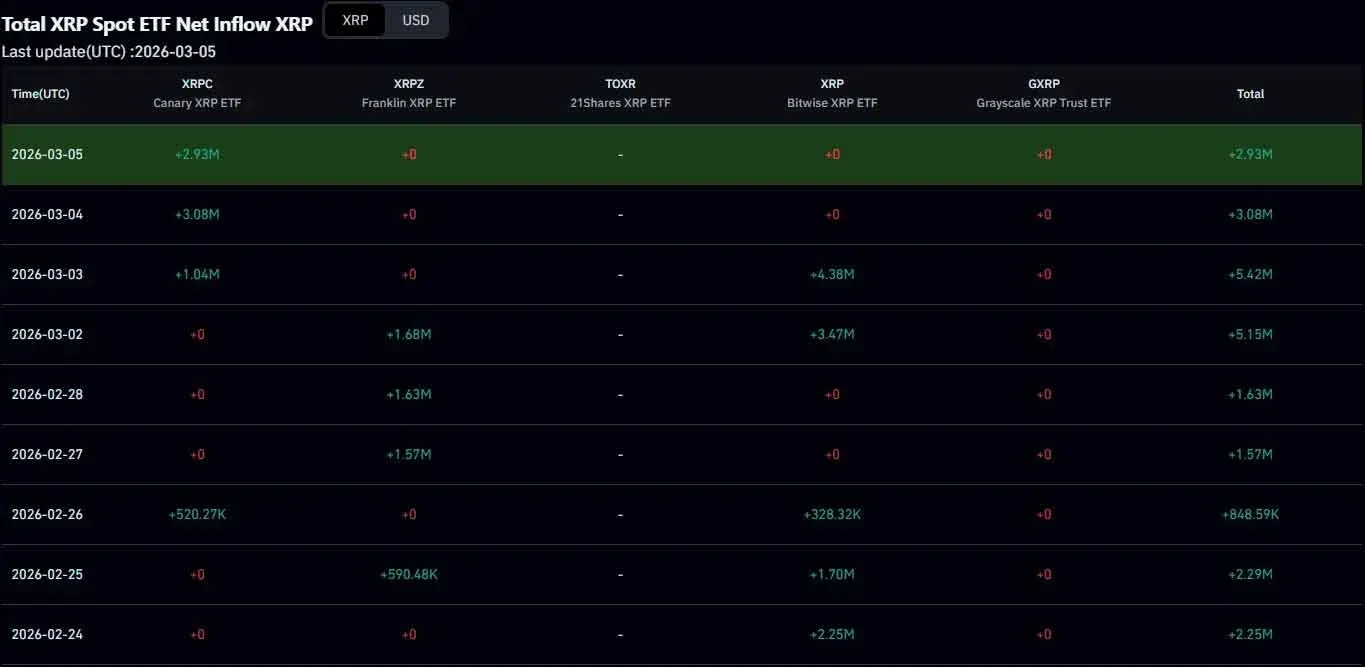
Unlike previous market cycles driven primarily by retail investors, the core narrative for XRP in 2026 centers on institutionalization. Since the sequential approval of US spot XRP ETFs starting in late 2025, the market landscape has undergone a qualitative shift.
- 21Shares launched TOXR
- Grayscale launched GXRP
- Franklin Templeton launched XRPZ
As of February 2026, the total assets under management (AUM) for these ETF products reached $1.1 billion USD. Notably, while Bitcoin ETFs experienced periodic capital outflows, XRP ETFs recorded 18 consecutive days of net inflows in November 2025. Furthermore, increased regulatory compliance has brought XRP into the sights of government entities. A bill passed in Arizona listed it as a potential state reserve asset, and its status as a candidate for a federal-level crypto reserve has also garnered significant attention.
For users in the United States, it is important to note that accessing these assets often requires regulated platforms; while global users may use the standard Binance platform, US residents must utilize Binance.US to comply with local regulations. Additionally, investors should be aware that capital gains from crypto assets are typically taxable under local jurisdictions, such as the IRS in the US or via SEPA/SWIFT-related reporting standards in Europe.
Supply-Demand Mismatch: Exchange Inventory Shortages and Price Volatility
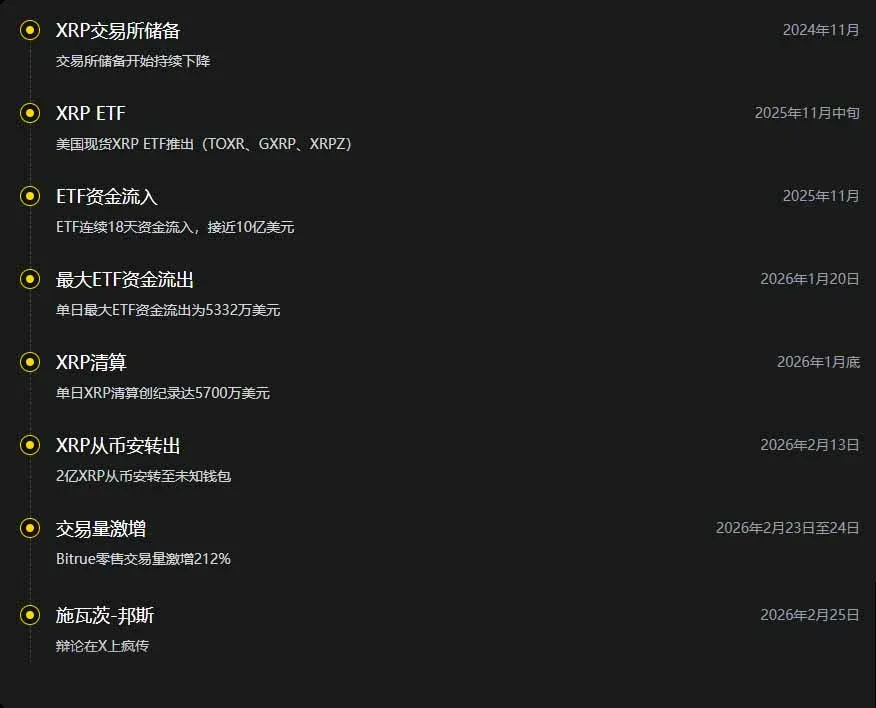
Driven by institutional buying pressure, the supply of XRP on exchanges has seen a dramatic reduction. Data shows that exchange reserves have plummeted from 3.76 billion tokens in October 2025 to approximately 1.66 billion to 1.7 billion tokens by February 2026—a reduction of roughly 700 million tokens.
Despite the continuous tightening of the supply side, price movements remain volatile. As of late February 2026, XRP was quoted at approximately $1.42 USD, a retracement from its interim peak of $2.12 USD in early January. Frequent "whale" activity has become a dominant factor in short-term price action:
- In mid-February, a massive transfer involving 200 million XRP (approximately $105 million USD) flowed from Binance to a private wallet, followed by a rapid 10% price surge to $1.55 USD.
- Retail enthusiasm was ignited in late February, with buying volume on the Bitrue platform surging by 212% within just two days.
The current market focus is concentrated on the $1.45 resistance level. If it can stabilize above $1.40–$1.42, it may challenge the $1.57 mark. Conversely, a drop below $1.37 could trigger a deeper correction.
The Core Controversy: The Unique Node List (UNL) and the Battle for Power
Despite its strong financial performance, the degree of decentralization of the XRPL remains a point of contention that the project cannot seem to shake. The core of the argument lies in the Unique Node List (UNL). In the XRPL consensus model, nodes achieve status consensus by trusting validators within the UNL.
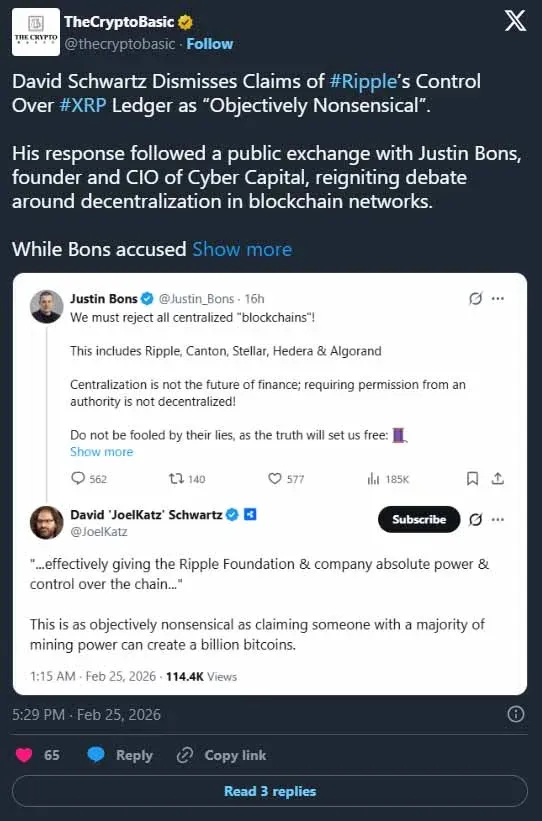
In February 2026, Justin Bons, Chief Investment Officer at Cyber Capital, and David Schwartz, former CTO of Ripple, engaged in a sharp debate:
- Justin Bons' Viewpoint: He argues that the XRPL is more akin to a "permissioned" Proof of Authority (PoA) system. Since Ripple publishes the default UNL used by the vast majority of nodes, this essentially grants Ripple "absolute control" over the ledger. He categorizes XRPL alongside projects like Stellar and Algorand as "centralized blockchains" with structured governance.
- David Schwartz's Rebuttal: He dismissed Bons' allegations as "objectively nonsensical." He emphasized that the XRPL was designed from the beginning to be decentralized, with no single entity capable of owning it. He argued that users have the right to choose their own UNL, which is logically consistent with how the Bitcoin community can abandon malicious miners by changing algorithms in the face of a 51% attack.
This debate remains unresolved, but it clearly reveals the cognitive gap in the market's definition of "decentralization": institutions value the certainty of governance, while crypto-natives adhere to the purity of decentralization.
Hidden Risks: On-Chain Activity and the Narrative Gap
The greatest challenge facing XRP currently is not price volatility, but rather the shaking of its "payment utility" narrative.
In early February 2026, the on-chain payment transaction volume on the XRPL rapidly contracted by 90% after reaching a peak. This implies that while ETF funds are driving up demand in the secondary market, the actual use of the network for real-world settlements has not grown in tandem. If the value of XRP is supported entirely by speculation and institutional allocation without the backing of genuine on-chain transaction utility, the sustainability of its long-term growth will be questioned.
Furthermore, the high-leverage characteristics of the market structure have increased risk. In late January 2026, XRP recorded a single-day liquidation record of $57 million USD. Such extreme volatility indicates that market pricing power is increasingly tilting toward large holders and institutional capital.
Technical Foundation: The Performance Advantages of XRPL
Controversies aside, from a technical standpoint, the XRPL remains one of the most efficient settlement layers in the industry. Its Federated Consensus protocol avoids the high energy consumption of Proof of Work (PoW), completing ledger confirmations every 3 to 5 seconds.
- Throughput: Capable of processing 1,500 transactions per second.
- Cost: The average transaction fee is a mere $0.0002 USD.
- Stability: As of February 2026, it has operated stably, closing over 70 million ledgers without any major outages.
Review of Key XRP Milestones (2024–2026)
Conclusion: Moving Forward Amidst Contradictions in 2026
XRP in 2026 stands at a peculiar crossroads. It leads the pack of altcoins in terms of regulatory compliance and institutional acceptance, yet it remains mired in controversy regarding its on-chain fundamentals and decentralized governance. For sophisticated investors, XRP is no longer a simple cross-border payment tool; it is a benchmark for measuring the conflict between "institutional consensus" and the "crypto vision." Whether institutional buying can sustain its valuation as on-chain payment demand weakens will be the core theme to watch in the coming years.
---
Frequently Asked Questions (FAQ) about XRP
1. What consensus mechanism does the XRPL use?
It uses a Federated Consensus protocol, where trusted validators reach consensus within seconds without relying on mining.
2. What is the Unique Node List (UNL)?
It is a list of validators that a node trusts when validating transactions. The default list provided by Ripple is currently adopted by most participants.
3. Why do some question its degree of decentralization?
Critics like Justin Bons argue that Ripple's control over the default UNL makes it function more like a permissioned Proof of Authority system.
4. How does David Schwartz respond to centralization allegations?
He maintains that the system is open, users are free to change their UNL, and ultimately, power lies with the community rather than a single corporation.
5. How has the supply of XRP changed in 2026?
Exchange reserves have significantly decreased, dropping from 3.76 billion in October 2025 to approximately 1.66–1.7 billion by February 2026.
6. Why is the on-chain payment volume causing concern?
In February 2026, payment volume plummeted by 90% from its peak, raising concerns about the gap between actual utility demand and speculative premiums.
💡 Register on Binance with referral code B2345 for the maximum trading fee discount. See Binance complete guide.



