
 Bitaigen Research
 We will deeply examine the core concepts of the Zephyr project, its usage methods, and the issuance mechanism and economic model of the ZEFY token in this article. By systematically outlining its technical positioning, ecosystem layout, and incentive structure, readers can grasp the project’s potential value and development trajectory. Subsequent sections will provide more detailed operational guidance and risk warnings.
ZEFY Token Sale and Economic Model
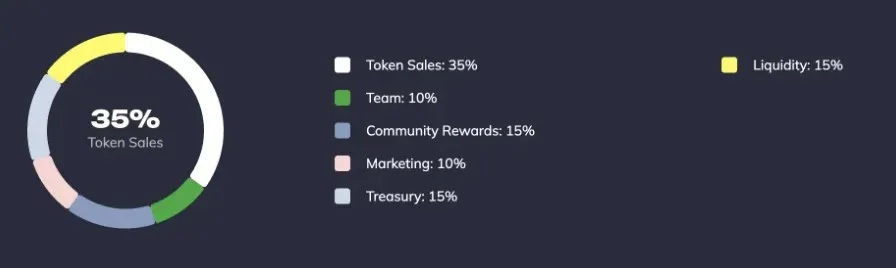
From August 19 to 26, 2024, Zephyr completed its first token public offering (IDO). Each ZEFY was priced at $0.0055 USD, and the total token supply was set at 1 billion units. The supply was allocated across community incentives, marketing, liquidity provision, the team, and the treasury, among other purposes.
In the multiple pre‑sale rounds that followed toward the end of 2024, the project raised over $1 million USD in total, with sale prices ranging from $0.005 to $0.0065 USD per token.
According to the official roadmap, the Token Generation Event (TGE) and listings on centralized exchanges are slated for 2026. At that point, ZEFY will enter a formal trading phase. Investors should monitor announcements from Zephyr and Bitget’s official channels for the precise timetable.
Within the token economics, 35 % of the supply is earmarked for public sale, 15 % is allocated to community rewards, the treasury, and liquidity, and an additional 10 % is split between team incentives and marketing. The team’s holdings are subject to a vesting schedule designed to reduce sell‑pressure immediately after the TGE.
Note on fiat on‑ramps: All fiat transactions mentioned in this article assume the use of USD, with SEPA or SWIFT transfers where applicable. Users residing in the United States should use Binance.US (rather than the global Binance platform) for any crypto‑fiat conversions.
Zephyr’s Positioning and Core Value
Zephyr is the first decentralized peer‑to‑peer prediction market built on Solana. It enables users to create or join prediction pools and “guess right, earn” on a wide range of subjects—including cryptocurrency assets, financial events, esports outcomes, political issues, and trending topics from both Web 2 and Web 3 realms. The project was incorporated in Seychelles in 2022 and focuses on prediction gameplay within the DeFi ecosystem. All processes are executed automatically by smart contracts, eliminating the need for traditional betting intermediaries.
Compared with existing platforms such as Polymarket, Zephyr leverages Solana’s high‑throughput blockchain to deliver near‑zero transaction fees and second‑level confirmation times. In addition, it incorporates AI‑generated prediction pools, ensuring that the topic library remains fresh, relevant, and aligned with current market sentiment.
Dual‑Token Mechanism: $USDZ and $ZEFY
Zephyr employs two distinct tokens, each serving a separate function:
- $USDZ – a soft‑pegged stablecoin used on the platform. Users employ $USDZ to enter prediction pools, pay any applicable fees, and receive rewards when their predictions are correct. $USDZ also powers a referral‑reward system; inviting new participants yields extra $USDZ for the referrer.
- $ZEFY – the governance and premium‑feature token. Holding and staking at least 10,000 ZEFY grants users a share of 50 % of the platform’s fee revenue, unlocks the ability to create pools, access VIP high‑risk pools, purchase weekly passes, and obtain voting rights on governance proposals.
Regarding transaction taxes on $ZEFY: an initial 2 % tax is applied at launch, decreasing to 1 % after six months, and becoming tax‑free after one year. Of the collected tax, 10 % is burned, while 50 % is redistributed to eligible stakers, establishing a profit‑sharing mechanism.
How Prediction Pools Operate
Users browse Zephyr’s catalog of events, stake a modest amount of $USDZ on either a “YES” or “NO” outcome, and submit their bet. Each prediction pool is governed by a smart contract; once the event concludes, the contract automatically distributes the pooled funds to participants who made the correct prediction, proportionally to their stakes.
The pool creator—whether an individual, a crypto project, or a key opinion leader (KOL)—receives 50 % of all fees generated within that pool, creating a direct economic incentive for content creators and community managers. Zephyr offers two pool categories:
- AI‑Generated Pools – the system automatically creates pools based on hot news, viral topics, and popular narratives from both Web 2 and Web 3. Users can join these pools at any time without having to design the pool themselves.
- Community‑Built Pools – any user, project, or marketing team can define a custom theme, choose between public or private visibility, and launch a pool. Private pools are especially suited for small‑group communities that want exclusive prediction experiences.
Complete Workflow for Using Zephyr
- Set Up a Solana Wallet – Zephyr is compatible with mainstream Solana wallets such as Phantom. Users who do not yet have a wallet can download one from the official website.
- Fund the Wallet with SOL – SOL is required to cover network fees. It can be purchased on any exchange and transferred to the user’s wallet.
- Acquire $USDZ – By visiting Zephyr’s official site (zephyr.digital) and using the built‑in swap function, users can exchange SOL (or other supported assets) for $USDZ.
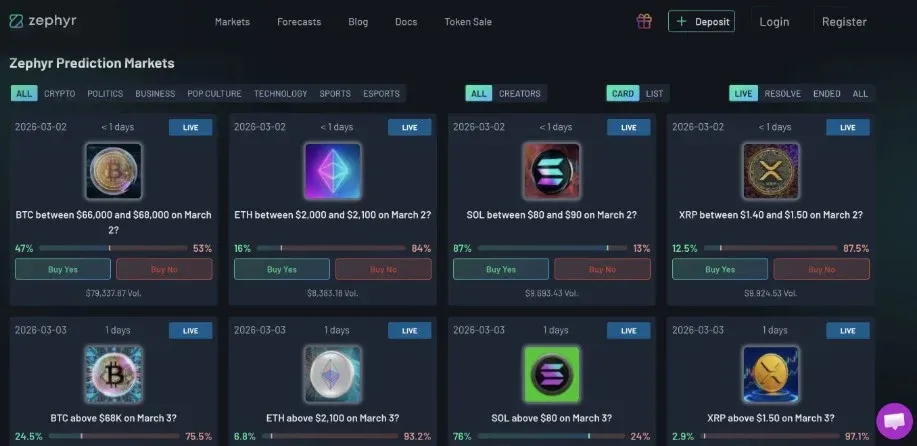
- Browse and Select Prediction Pools – The platform displays markets that span crypto price movements, esports results, breaking news, and more. Each pool shows odds, total bet volume, and remaining time.
- Place a Prediction – After choosing a pool, the user selects the direction (YES/NO), inputs the amount of $USDZ to wager, and confirms the transaction. The bet is recorded on‑chain instantly.
- Create a Custom Pool – If the user wishes to predict a specific event not already listed, they can use the pool‑creation tool to set rules, define resolution criteria, and decide whether the pool is public or private. The creator automatically earns 50 % of all fees collected in that pool.
- Stake $ZEFY – After the TGE, holders can lock their $ZEFY in the staking module for periods of 60, 180, or 365 days. Stakers receive a share of platform revenue, governance privileges, and additional premium benefits.
Tax reminder: Gains from crypto activities, including rewards earned on Zephyr, may be subject to taxation in the user’s jurisdiction. Participants should consult local tax regulations or a qualified professional.
Differentiating Advantages Over Polymarket
- Underlying Chain – Polymarket operates on Ethereum’s Polygon network, whereas Zephyr runs on Solana, resulting in transaction fees that are a fraction of a cent and faster block confirmations.
- AI‑Driven Pool Generation – Zephyr’s market catalog is continuously refreshed by artificial intelligence, allowing users to engage with the latest topics without manually creating pools.
- Social Copy‑Trading Feature – The platform offers a “Copy MVP” pass that lets newcomers mimic the strategies of top‑performing predictors, a capability not yet available on Polymarket.
- Creator Revenue Share – In Zephyr, pool creators obtain 50 % of the fee income generated by their pools, providing a powerful marketing and community‑building tool for projects and influencers.
Potential Risk Indicators
Although Zephyr presents an innovative concept and a technically competitive implementation, investors and users should remain aware of several risk factors:
- Token Supply Dynamics – With 35 % of the total supply allocated to public sale, a large influx of tokens into the market after the TGE could exert downward pressure on the price.
- Community Engagement – Recent data shows a decline of 29 members in the Telegram group, while the Discord community still exceeds 3,200 members. Fluctuations in community activity may affect platform vitality.
- Security Audit Status – As of now, Zephyr has not released a comprehensive public security audit report. Users are advised to start with modest amounts and stay updated on official security announcements.
Participants should evaluate these considerations against their personal risk tolerance and refrain from following trends blindly.
Frequently Asked Questions
What is the core functionality of Zephyr’s prediction market?
Zephyr, as the first decentralized peer‑to‑peer prediction platform built on Solana, allows users to freely join existing pools or create their own, covering a broad spectrum of events such as crypto movements, news headlines, esports outcomes, and more. Correct predictions are rewarded in $USDZ.
What specific roles does the $ZEFY token play?
$ZEFY serves both governance and premium‑access purposes. Holding and staking the token grants users a share of platform fees, the ability to launch community pools, entry into VIP high‑risk pools, purchase of analytical reports, and voting rights on protocol proposals.
How does Zephyr differ from Polymarket?
Beyond virtually zero transaction fees and sub‑second confirmations, Zephyr offers AI‑automated pool creation, a social copy‑trading mechanism, and a 50 % fee‑share model for pool creators, setting it apart from Polymarket’s current feature set.
When will ZEFY be listed on exchanges?
The Token Generation Event (TGE) and subsequent centralized exchange listings are planned for 2026. At present, the token remains in the pre‑sale stage.
How is security ensured on Zephyr?
Since a full audit has not yet been published, users should initially engage with small amounts, monitor official channels for security updates, and adopt standard best practices for wallet and private‑key management.
---
This concludes the comprehensive analysis of “What is Zephyr? How to use it? ZEFY token sale and tokenomics.” For deeper insights into Zephyr, readers can search the Bitaigen (比特根) archive or follow the related links provided below. Thank you for following Bitaigen’s coverage and support!

💡 Register on Binance with referral code B2345 for the maximum trading fee discount. See Binance complete guide.



