
 Bitaigen Research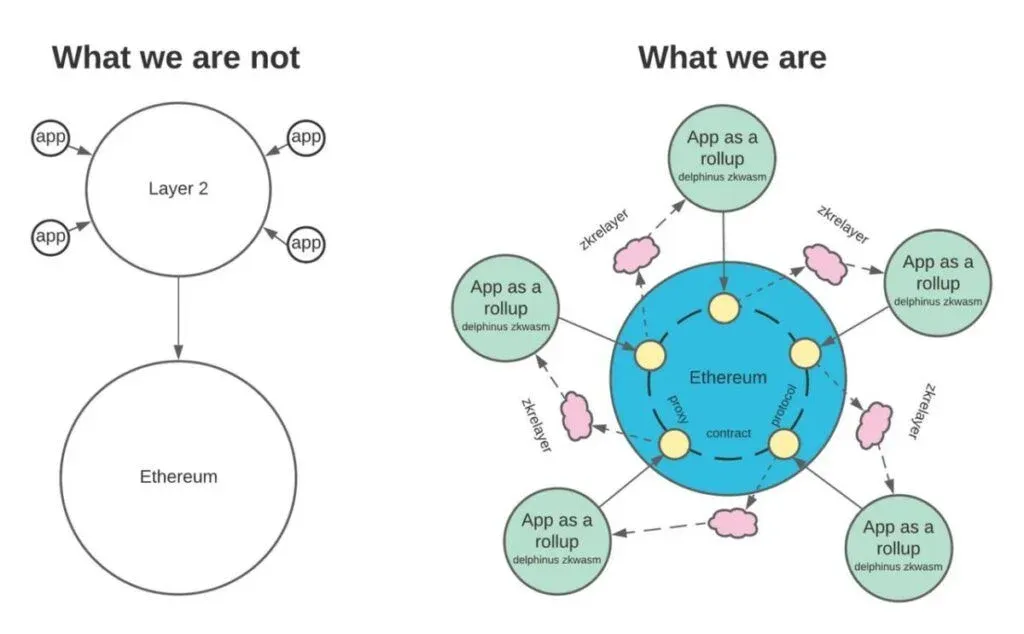
ZKWASM is the native utility token issued by Delphinus Lab, used on its Layer 2 infrastructure built on zero‑knowledge proofs and WebAssembly. The token serves validator staking, fee payment, and governance voting functions.
We analyze ZKWASM from both technical and ecosystem perspectives, explaining its innovative zero‑knowledge virtual machine mechanisms, the token’s role in governance and incentives, and its potential impact on Layer 2 development trends. This helps readers comprehensively assess its value and prospects. Subsequent sections will expand on the details and explore practical deployment possibilities in cross‑chain scenarios.
1. What is ZKWASM?
ZKWASM is a zero‑knowledge virtual machine developed by Delphinus Lab, built on the Substrate framework. It enables existing WASM applications to be plugged directly into a zero‑knowledge proof system. Its core idea is to map the entire WASM runtime into a ZK‑SNARK circuit, achieving an off‑chain execution / on‑chain verification model that provides a minimally trusted computation environment. Developers can obtain trustworthy, privacy‑preserving computation results without modifying their code.
2. Key Pain Points Addressed by ZKWASM
Delphinus Lab’s ZKWASM targets three major challenges:
- High development barrier: Traditional ZK‑Rollups require dedicated DSLs (e.g., Circom, Noir), which have steep learning curves.
- Difficulty verifying off‑chain computation: Large amounts of off‑chain logic are hard to verify efficiently on‑chain, limiting the complexity of Web3 applications.
- Poor cross‑platform compatibility: The lack of a universal compute platform makes it hard for Web2 developers to migrate to Web3.
By deeply fusing WebAssembly with zero‑knowledge proofs, ZKWASM delivers an efficient, secure, and verifiable off‑chain computation solution.
3. The Team Behind ZKWASM
Delphinus Lab was founded in 2021. Its members possess extensive experience in cryptography, ZKP, WASM, and blockchain virtual machines. The core vision is to build a ZKWASM technology stack that brings zero‑knowledge technology into mainstream development ecosystems.
The team has released the world’s first WebAssembly VM that supports zero‑knowledge proofs, enabling zk applications to be written in mainstream languages such as Rust and C++. This dramatically lowers development barriers and pushes the generality and programmability of zk‑Rollups to a new level.
4. Core Features and Advantages of ZKWASM
- ZKWASM technology stack: A zkVM compatible with WebAssembly, allowing developers to write zk programs in familiar languages.
- Auto Proof System: No need to hand‑craft proof logic; the system automatically generates ZK proofs.
- ZKLinker and ZKRunner frameworks: Provide a complete workflow for off‑chain compilation, debugging, proof submission, and on‑chain verification.
- Native cross‑chain support: The Layer 2 network built by Delphinus Lab, called zkWASM Chain, possesses inherent cross‑chain communication capabilities.
5. ZKWASM Tokenomics
5.1 Token Overview
ZKWASM is the native utility token launched by Delphinus Lab to serve its Layer 2 infrastructure powered by zero‑knowledge proofs and WASM technology. The token is primarily used to incentivize validators, pay network fees, participate in governance voting, and facilitate other ecosystem activities, acting as the primary medium of value flow throughout the ecosystem.
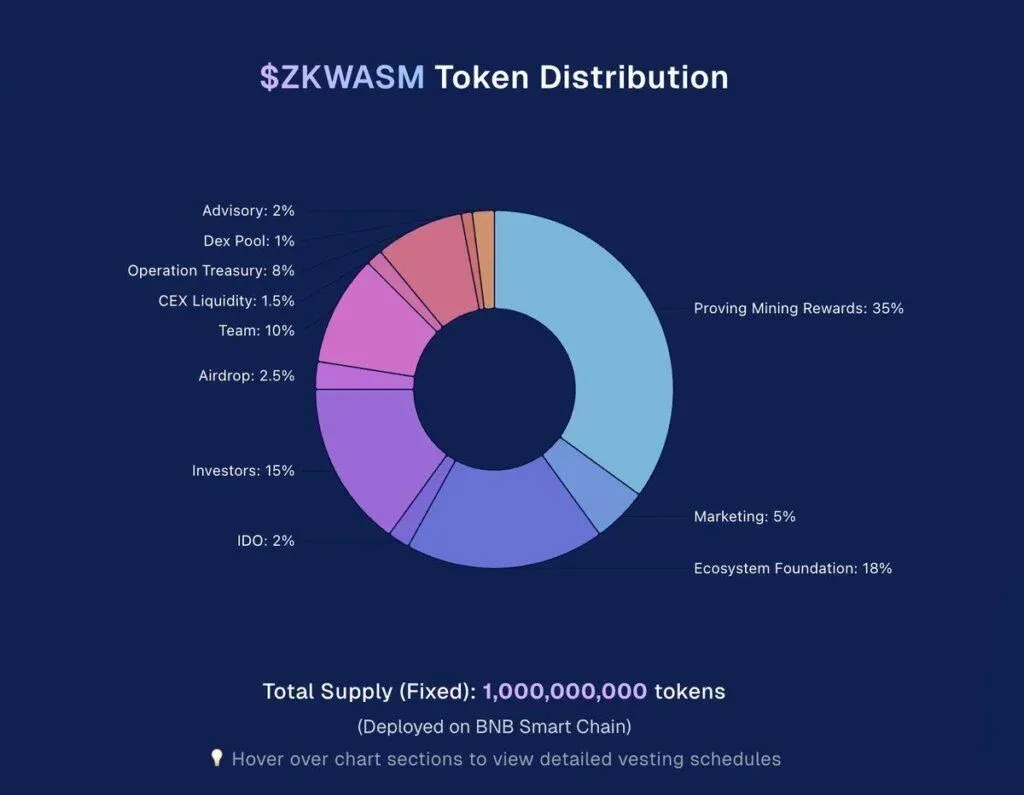
5.2 Token Supply and Allocation
- Total supply: 1 billion tokens (fixed)
- Allocation breakdown:
| Purpose | Percentage |
|---|---|
| Proof mining rewards | 35% |
| Ecosystem fund | 18% |
| Investors | 15% |
| Team | 10% |
| Operations treasury | 8% |
| Marketing | 5% |
| Airdrop | 2.5% |
| CEX liquidity | 1.5% |
| Advisors | 2% |
| IDO | 2% |
| DEX pools | 1% |
5.3 Token Utility
- Validator staking and incentives: Nodes in the Proof Network must stake ZKWASM and take part in zk‑computational tasks.
- Transaction fee payment: ZKWASM is used to pay fees when executing transactions on the zkWASM Chain.
- Community governance: Holders can vote on protocol parameter adjustments, upgrade proposals, and other governance matters.
- Developer incentives: Funds are allocated to support zkWASM application development and related research.
6. Competitive Landscape and Comparative Advantages
6.1 Main Competitors
- zkVM: Built on a RISC‑V architecture, supports C++, but has relatively few ecosystem partnerships.
- ZK‑LLVM: Compatible with the LLVM toolchain; developers must learn a new syntax.
- Polygon Miden: Focuses on ZK‑STARK proofs, which generally have longer verification times.
6.2 ZKWASM’s Core Strengths
- Support for mainstream languages (Rust, C++, Go), reducing learning overhead.
- Native WASM compatibility, facilitating integration with existing Web2 toolchains.
- Automatic proof generation, significantly lowering the development barrier.
- Decentralized proof network, offering strong scalability.
Overall, ZKWASM holds a distinct edge in the “developer friendliness + generality + network scalability” triad.
7. Future Development Outlook
ZKWASM is emerging as a key component of the zero‑knowledge infrastructure stack. By merging WASM with ZKP, it provides a trustworthy, verifiable bridge for traditional Web2 applications to transition to Web3. As demand grows for modular Rollups, off‑chain computation, and AI integration, ZKWASM’s broad applicability positions it for substantial upside, warranting ongoing attention.
8. ZKWASM Price Forecast (Reference Model)
The following forecast is based on an experimental model and is provided for reference only. It does not constitute investment advice.
| Forecast Year | Low End Price (USD) | High End Price (USD) | Remarks |
|---|---|---|---|
| 2026 | 0.000957 | 0.0061073 | Expected growth of 3.79% |
| 2027 | 0.000919 | 0.003262 | Potential decline of –44.55% |
| 2028 | 0.001739 | 0.006775 | Projected increase of 15.14% |
| 2029 | 0.005714 | 0.043535 | Anticipated rise of 639.87% |
| 2030 | 0.003260 | 0.027836 | Projected increase of 373.08% |
| 2031 | 0.004205 | 0.011572 | Expected growth of 96.63% |
| 2032 | 0.006166 | 0.027411 | Projected increase of 365.85% |
| 2033 | 0.023027 | 0.154373 | Expected rise of 2523.54% |
| 2034 | 0.011561 | 0.067586 | Projected increase of 1048.61% |
| 2035 | 0.015530 | 0.041027 | Expected growth of 597.25% |
| 2036 | 0.023319 | 0.117788 | Projected increase of 1901.78% |
| 2037 | 0.107785 | 0.547398 | Expected rise of 9202.89% |
*Note: Crypto gains may be taxable in your jurisdiction. Please consult a tax professional for guidance.*
9. Conclusion
Through the innovative combination of zero‑knowledge proofs and WebAssembly, ZKWASM tackles the core challenges of moving from Web2 to Web3. Its tokenomics and ecosystem incentive mechanisms provide a solid foundation for long‑term development. While technical iteration and competitive pressures are inevitable, ZKWASM’s first‑mover advantage, developer‑friendly design, and institutional backing position it to become a critical piece of next‑generation blockchain infrastructure, accelerating mass adoption of Web3.
This article has fully covered the definition, tokenomics, future outlook, and price forecast of the ZKWASM token. For more information, search for Bitaigen (比特根) articles or continue reading the related content below. We appreciate your continued interest and support.
Related Reading
- SKR Token 2026 Holding Value: Solana Mobile Analysis
- idOS ($IDOS) Token: Security, Staking, Governance & Roadmap
- RESOLV Coin Explained: Design, Benefits & Tokenomics
💡 Register on Binance with referral code B2345 for the maximum trading fee discount. See Binance complete guide.



