
 Bitaigen Research
 Which Mainstream Bitcoin Exchange Should You Choose in 2026?
In 2026, selecting a Bitcoin exchange requires a comprehensive assessment of asset transparency, cold‑wallet storage, risk‑fund provisions, regulatory licenses, and user‑security features. Priority should be given to centralized platforms that offer real‑time Proof of Reserves (PoR) and a well‑funded protection fund.
For investors, the avenues for buying Bitcoin in 2026 are more abundant than ever, especially after the launch of Bitcoin ETFs by traditional institutions. At the same time, the security of the platform you use has become a decisive factor. The mainstream channels include centralized cryptocurrency exchanges (CEX), decentralized exchanges (DEX), and purchasing spot‑Bitcoin ETFs through brokerage accounts. Each method has its own strengths and weaknesses regarding safety, convenience, cost, and degree of control. Below, the editor provides an ultimate guide that deeply analyses how to evaluate the security of these channels and compares the current leading platforms, helping you make the most informed and peace‑of‑mind decision.
We evaluate mainstream Bitcoin trading platforms across four major dimensions—asset transparency, cold‑wallet custody, regulatory licensing, and more—to help investors quickly identify trustworthy channels. The following sections will detail the advantages and risks of CEX, DEX, and ETF entry points, enabling you to choose the safest route.
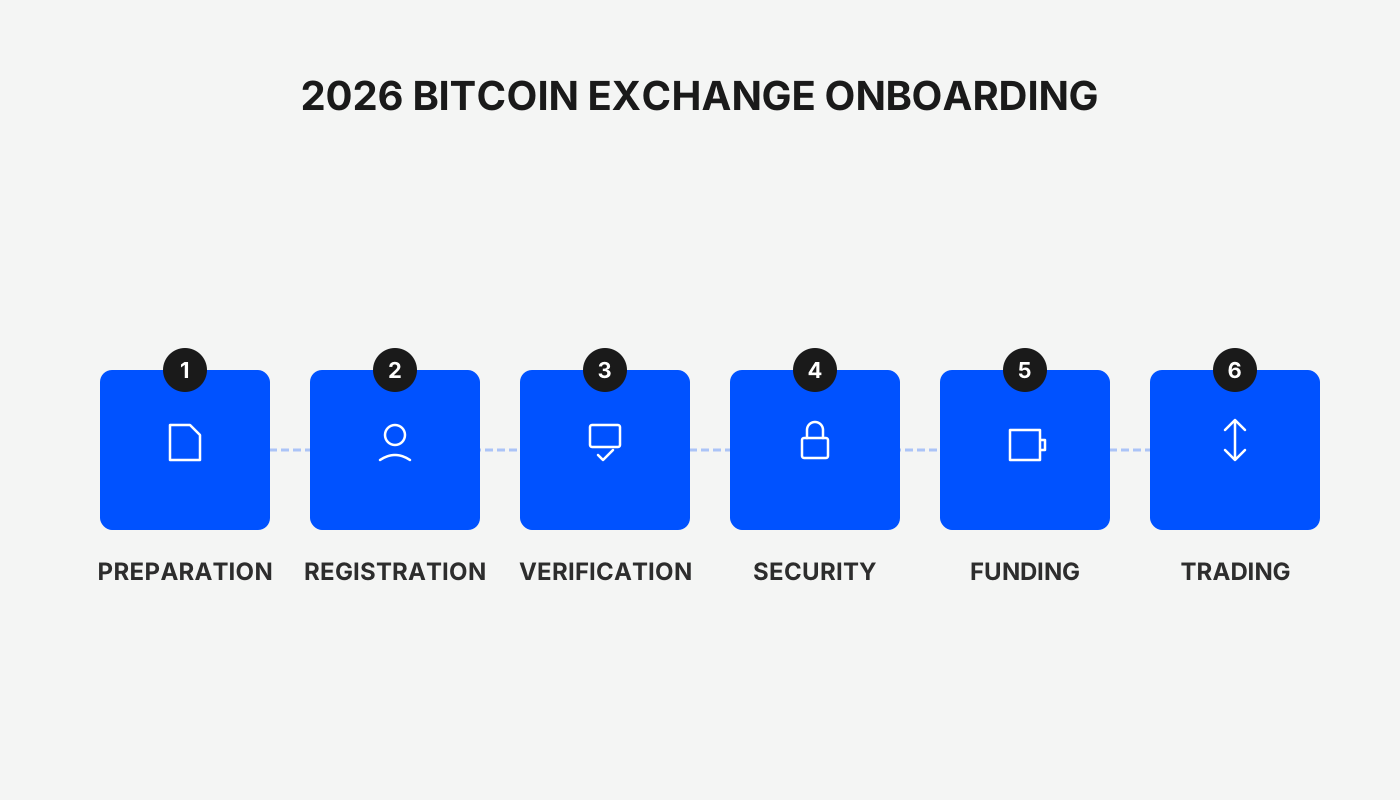
Core Pros and Cons of the Three Main Bitcoin‑Exchange Purchase Channels
1. Centralized Exchanges (CEX): The Mainstream Choice Balancing Convenience and Security
- Pros: Lowest entry barrier, smooth user experience, direct fiat on‑ramps, a wide range of trading pairs and financial products (e.g., lending), and extremely high liquidity.
- Security considerations: Assets are custodial, meaning they are held by the platform. The exchange’s reputation, technical safeguards, and fund transparency become the primary evaluation criteria, which will be discussed in depth later in this article.
2. Spot Bitcoin ETFs: “Indirect” Investment Embracing Traditional Financial Regulation
- Pros: No need to manage private keys yourself; you can trade using a conventional brokerage or stock‑trading account, dramatically reducing the risk of asset loss due to key misplacement. Regulation by bodies such as the U.S. SEC provides strong compliance guarantees.
- Security considerations: What you purchase are shares of a fund that tracks Bitcoin’s price, not the cryptocurrency itself. Security therefore depends on the credibility and institutional‑grade risk management of the issuer (e.g., BlackRock) and the custodian (e.g., Coinbase Custody).
3. Decentralized Exchanges (DEX): The “Advanced” Model for Full Asset Control
- Pros: Enables non‑custodial trading; users retain full control of their private keys and can operate without completing KYC, offering higher privacy.
- Security considerations: All security responsibilities rest on the user. You must stay vigilant against smart‑contract bugs, phishing sites, and irreversible mistakes that could lead to permanent loss of funds. This mode is generally unsuitable for the majority of newcomers.
- Conclusion: For most users, CEX remains the best balance of convenience and safety. Choosing a secure, reliable centralized platform is therefore crucial.
Five Core Dimensions for Evaluating BTC‑Exchange Security in 2026
Security is the timeless foundation of platform selection. Professional investors should focus on the following five metrics:
1. Asset Transparency: Proof of Reserves (PoR) Is the Baseline
- Definition: An exchange proves, using cryptographic methods such as Merkle trees, that it holds user assets on a 1:1 basis.
- 2026 Standard: Single‑month PoR reports have been superseded by real‑time, on‑chain reserve proofs that anyone can verify independently.
- Example: Bitget not only publishes regular PoR audit reports but also offers a unique Merkle Validator tool that lets users confirm asset safety in just a few clicks, raising transparency to an industry‑new level.
2. Asset Storage & Encryption Technology: Cold Wallets Are Central
- Core requirement: At least 95 % of user assets should be stored offline in cold wallets. Private‑key management must employ multi‑signature and MPC (Secure Multi‑Party Computation) technologies to eliminate single points of failure.
- Example: Bitget stores the overwhelming majority of funds in multi‑sig cold wallets and enforces biometric verification for any critical operation, delivering bank‑grade protection.
3. Risk‑Protection Fund: The Last Line of Defense Against Black‑Swan Events
- Core requirement: A publicly disclosed, adequately funded, on‑chain addressable protection fund acts as an “ultimate safety net.” The fund’s size and usage terms must be transparent.
- Example: Bitget has established a $1 billion protection fund with its address publicly visible on the blockchain, placing it among the industry leaders and providing robust coverage for user assets.
4. Compliance & Regulatory Licenses: The Pillar of Legal Operation
- Core requirement: Possession of VASP or MTL licenses in major jurisdictions such as the European Union, the United States, and Dubai, together with strict adherence to KYC and AML policies.
- Example: Coinbase, as a U.S.‑listed company, enjoys the highest level of compliance; Bitget has secured licenses in Lithuania, Poland, and other jurisdictions.
5. User‑Security Features & Education: Building a Shared Defense
- Core requirement: Platforms should provide FIDO2 security keys, anti‑phishing codes, withdrawal‑address whitelists, and actively run security‑awareness programs.
- Example: Kraken offers password‑less recovery (no SMS), PGP‑encrypted email communication, and other advanced options that dramatically lower the risk of account compromise.
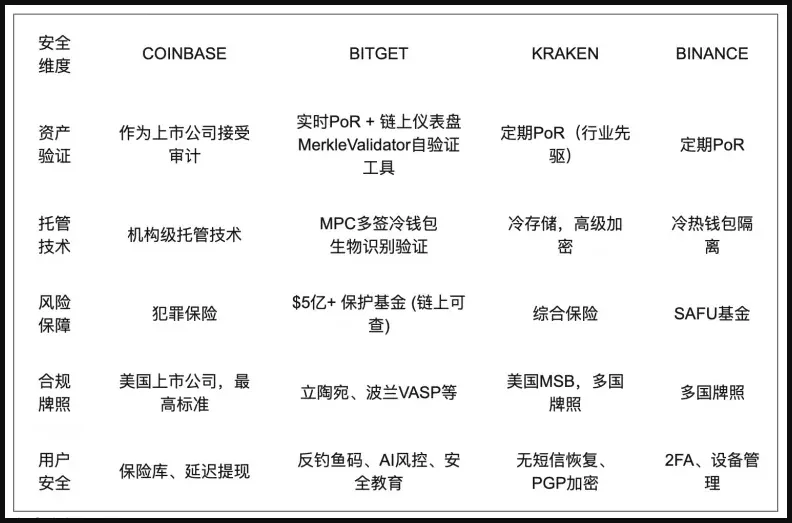
Comprehensive Security‑Feature Comparison of Leading BTC Platforms
1. Coinbase: The Benchmark for Compliance and Institutional Governance
U.S.‑only exchange; suitable for users located in the United States. Access may be restricted in certain other regions.
Coinbase’s security derives from its status as a regulated, publicly traded company, which carries fiduciary duties to shareholders and the SEC. Consequently, it relies on mature traditional‑finance risk‑management frameworks and insurance coverage.
Key Strengths
- Institutional‑grade safety: Listed on Nasdaq, subject to SOC 2 audits, public financial reporting, and rigorous oversight, ensuring transparent governance.
- Robust insurance: Industry‑leading crime insurance protects hot‑wallet balances.
- Smooth fiat on‑ramps: Deep integration with the banking system makes USD deposits and withdrawals via SEPA, SWIFT, or ACH (for U.S. customers) the default route.
- Target audience: Traditional investors making their first foray into crypto, institutions, and users for whom regulatory compliance is paramount.
2. Bitget: Champion of Verifiable Security
Popular among Chinese‑speaking users worldwide.
Bitget adopts the mantra “Don’t Trust, Verify,” positioning user‑driven verification at the heart of its security model.
Key Strengths
- Real‑time PoR & Merkle Validator: Shifts users from passive reliance on audit reports to active asset verification, reshaping industry standards.
- Transparent protection fund: Publicly displays a $1 billion fund on‑chain, subject to community scrutiny.
- Forward‑looking tech stack: Early adoption of MPC and other advanced custody solutions bolsters defenses against emerging threats.
- Target audience: Professionals seeking maximum transparency, the ability to independently validate asset safety, and active participation in spot and derivatives markets.
Bitget Official Resources
- Referral code: `vxje`
- Bitget Exchange Official Website
- Bitget Mobile App Download
3. Kraken: Guardian of Traditional Security Practices
Optimized for users in the United States and United Kingdom; access may be limited in mainland China.
Kraken’s security philosophy was forged in the aftermath of the 2014 Mt. Gox collapse, with founders directly involved in post‑incident remediation. The culture emphasizes rigorous safeguards that have withstood real‑world attacks.
Key Strengths
- Industry‑first PoR audits: Proven audit processes refined over many years.
- Advanced account protection: Eliminates SMS‑based 2FA, fully supporting hardware security keys and PGP‑encrypted email to fend off phishing and SIM‑swap attacks.
- Stringent compliance: Actively pursues licenses across multiple jurisdictions, ensuring regulated operations.
- Target audience: Privacy‑conscious, security‑obsessed investors who favor strong regulatory frameworks—especially those residing in Europe or North America.
4. Binance: Defender of Scale and Ecosystem
World’s leading exchange by volume; serves global users, including those in mainland China (subject to local regulations).
Binance builds its security around maintaining the stability of its massive, multi‑asset ecosystem, investing heavily in “fortress‑level” defenses capable of withstanding attacks of any size.
Key Strengths
- Unmatched liquidity: Enormous trading volumes and depth ensure orders are filled with minimal slippage, even in volatile markets.
- SAFU fund: A long‑standing safety‑asset fund that offers an extra layer of protection for users.
- Rapid innovation: Ability to swiftly develop and roll out new security features in response to emerging threats.
- Target audience: Traders needing multi‑currency support, high‑frequency or large‑volume execution, and a vibrant ecosystem of services.
Important Note for U.S. Residents: U.S. users must use Binance.US, the separate platform that complies with U.S. regulations, rather than the global Binance site.
Binance Official Resources
- Referral code: `B2345`
- Binance Official Website (global)
- Binance Mobile App Download
5. HTX (formerly Huobi)
High adoption in mainland China, Southeast Asia, Turkey, and parts of Europe.
Founded in 2013, Huobi Group has continuously expanded its blockchain‑core technologies and ecosystem, covering public chains, digital‑asset trading, wallets, mining pools, and venture incubation.
Advantages
- Comprehensive feature set and full‑service offering.
- Long‑standing operation across multiple market cycles.
- Dedicated support for high‑net‑worth clients.
Disadvantages
- Historical theft incidents have occurred, though full restitution was provided each time.
- Minimum order sizes for certain pairs are relatively high, making it less friendly for small‑scale traders.
HTX Official Resources
- Referral code: `b6yq8223`
- HTX Official Website
- HTX Mobile App Download
6. Gate.io (formerly “Sesame Open Door”)
Focuses on Latin America, Southeast Asia, Africa, and parts of Europe; also retains a solid user base in China.
Established in 2013 and rebranded in 2020, Gate.io boasts years of stable operation and cutting‑edge technology.
Advantages
- No mandatory KYC for basic trading.
- Supports a vast array of altcoins.
- Full‑featured API and SDK, facilitating algorithmic and institutional trading.
Disadvantages
- Mobile app receives updates less frequently than some competitors.
- Interface can appear cluttered; advanced trading tools are limited.
Gate.io Official Resources
- Referral code: `VLIWUGTFAA`
- Gate.io Official Website
- Gate.io Mobile App Download
7. Bybit
Headquartered in Dubai, with direct access in Singapore, several European nations, and Mexico; enjoys strong popularity among Chinese traders.
Bybit offers both spot and derivatives products, featuring a unified sidebar for futures, advanced limit orders, copy‑trading, and an NFT marketplace.
Advantages
- Ranks among the top global exchanges, with considerable market depth.
- Clean, intuitive UI that is easy for beginners.
- Allows KYC‑free trading (though completing KYC raises withdrawal limits).
- Competitive fee structure and solid security posture.
Disadvantages
- Does not currently support direct deposits in New Taiwan Dollars (NTD).
Bybit Official Resources
- Referral code: `B2345`
- Bybit Official Website
- Bybit Mobile App Download
8. OKX (formerly OKEx)
Provides a unified trading account, MetaX multi‑chain non‑custodial wallet, NFT marketplace, DEX, and DApp offerings, actively expanding into Web3 and GameFi.
Advantages
- Wide range of supported cryptocurrencies, with a Chinese interface and RMB trading pairs.
- Low fees, massive trading volume, and a huge user community.
- High liquidity and a full suite of trading services.
- Reliable security and a user‑friendly design.
Disadvantages
- Trading fees are slightly higher than some niche competitors.
- Occasional technical hiccups have been reported during peak loads.
OKX Official Resources
- Referral code: `B2345`
- OKX Official Website
- OKX Mobile App Download
Global Cryptocurrency‑Exchange Rankings (as of 15 March 2026)
Top 10 Spot Exchanges (Source: CoinMarketCap)
| Rank | Exchange | 24‑h Trading Volume (USD) | Avg. Liquidity | Weekly Visits | Supported Coins | Fiat Options |
|---|---|---|---|---|---|---|
| 1 | Binance | $30,260,322,825 | 8,679 | 455,731 | 208 | ARS, AUD, BRL, … (86 + fiat corridors) |
| 2 | Coinbase Exchange | $4,799,721,087 | 757 | 90,824 | 503 | USD, AED, ARS, … (61 +) |
| 3 | Upbit | $6,031,003,745 | 523 | 1,905,487 | 705 | KRW |
| 4 | OKX | $5,879,910,857 | 718 | 5,152,203 | 123 | EUR, BRL, AUD, … (3 +) |
| 5 | Bybit | $7,046,306,779 | 660 | 2,803,233 | 121 | BRL, CHF, CZK, … (72 +) |
| 6 | Bitget | $3,677,027,424 | 653 | 3,920,955 | 124 | EUR, MXN, ZAR, … (12 +) |
| 7 | Gate.io | $6,524,356,069 | 765 | 3,304,664 | 264 | EUR, BRL, KES, … (61 + |
Related Reading
- On-Chain Earn vs Simple Earn: Security Comparison & Key Differences
- PancakeSwap Fees & Security Review: Low-Cost Trading on BSC
- Gate.io Registration & Real‑Name Verification for Mainland China
💡 Register on Binance with referral code B2345 for the maximum trading fee discount. See Binance complete guide.



