
 Bitaigen Research
 Bitstamp is a European‑headquartered, regulated cryptocurrency exchange that supports users from Taiwan and Hong Kong, offers industry‑leading security measures, is not a scam platform, and has passed multiple regulatory audits.
Can Bitstamp be used in Taiwan & Hong Kong? How safe is it? Is it a scam?
This article will walk you through Bitstamp’s corporate background, global ranking, security assessment, fee structure, supported countries, key features, and a pros‑and‑cons analysis.
We examine Bitstamp from three angles—platform compliance, technical protection, and user experience. The article details its European operational background, availability for Taiwan and Hong Kong users, and the practical performance of its security mechanisms, while objectively listing functional highlights and potential shortcomings to help you quickly decide whether the exchange meets your needs.
1. Bitstamp Exchange Overview
- Founded: August 2011
- Company name: Bitstamp Ltd
- Website language: English
- Supported cryptocurrencies: Over 60
- Official website: <https://www.bitstamp.net>
Bitstamp was launched in 2011 and is the oldest and largest Bitcoin platform in Europe, as well as the first Bitcoin exchange to obtain a licensed permit in all 28 EU member states. It currently offers only spot trading and serves as a major gateway for fiat‑to‑crypto conversions in Europe, ranking as the world’s third‑largest Bitcoin‑USD/EUR market maker.
Bitstamp maintains offices in Luxembourg, the United Kingdom, Singapore, and the United States, serving users in more than 100 countries and regions, with a registered user base of 12 million. Although it suffered a hack in its early years, the incident was handled properly and did not result in any loss of customer assets. Users from Taiwan and Hong Kong can access Bitstamp after completing KYC verification, but the platform does not provide a Chinese language interface.
Platform Security Snapshot
- Google Two‑Factor Authentication (2FA)
- Multisignature transaction authorization
- 95 % of assets stored in offline cold wallets
- Identity verification (KYC)
- Whitelist and transaction confirmation
Fees
- Spot maker/taker rates: 0 %–0.5 % (based on monthly volume)
- Credit‑card purchase fee: 4 %
- Crypto withdrawal (BTC): 0.0005 BTC
- USDT withdrawal fee: 2.5 USDT
Deposit / Withdrawal methods
Debit cards, credit cards, PayPal, cryptocurrency transfers, international wire (SEPA/SWIFT).
2. Bitstamp Credibility and Platform Security
Bitstamp is Europe’s most veteran Bitcoin exchange and, despite several past incidents, continues to be regarded as one of the world’s most trusted crypto‑trading platforms.
1. Development History and Corporate Background
- August 2011 – founded in Slovenia by Bitcoin community figures Nejc Kodrič and Damijan Merlak.
- January 2013 – relocated to the United Kingdom; 2016 – moved again to Luxembourg.
- February 2014 – temporarily halted deposits and withdrawals due to a distributed‑denial‑of‑service (DDoS) attack.
- January 2015 – suffered a hack that stole 19,000 BTC (≈ US $5.1 million); the platform was offline for one week, then resumed operations with no user‑fund loss.
- 15 July 2017 – Swiss financial services firm Swissquote Bank partnered with Bitstamp to offer Bitcoin trading to more than 200,000 private and institutional investors on its platform.
- October 2018 – acquired by Korea’s NXC subsidiary and Belgian investment firm NXMH; founder Kodrič retained a two‑thirds stake and remained CEO until October 2020.
- October 2020 – Julian Sawyer (formerly Gemini’s Europe Managing Director) became CEO; the same month Bitstamp upgraded its matching engine to Nasdaq technology, becoming the first crypto exchange to use that engine.

2. Regulatory Licenses
Bitstamp holds roughly 50 licenses and registrations across major jurisdictions, and is subject to strict oversight in the United Kingdom, Luxembourg, the United States, Singapore, and Slovenia, among others. The company employs about 670 staff, including 180 dedicated compliance, regulatory, legal, risk‑management, security, and internal‑audit professionals to ensure lawful operation.
3. Asset Reserve Composition
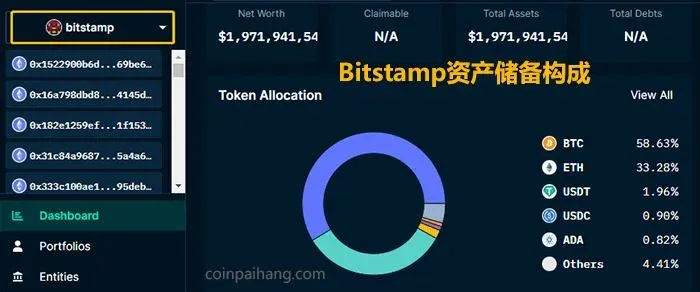
According to on‑chain data from Nansen (18 July 2023), Bitstamp’s total on‑chain assets were about US $1.9 billion, with BTC and ETH accounting for roughly 91 % of the holdings, indicating a portfolio heavily weighted toward mainstream coins and relatively low‑risk exposure.
4. Security Assessment
- February 2014 – Bitstamp received a ransom demand for 75 BTC; the founders refused to pay.
- January 2015 – after the hack, the platform immediately moved 90 % of its assets into offline cold wallets, limiting further loss, and covered all compensation internally without passing any cost to users. No major security incidents have been reported since.
Security Measures Overview
- Industry‑leading asset storage – 95 % of crypto assets are kept offline; the remaining 5 % supports instant user withdrawals.
- Transparent auditing – Annual external audits by one of the “Big Four” accounting firms since 2016, complemented by regular internal audits.
Security Best Practices
- Enable Google 2FA to block the majority of hacking attempts.
- Use a withdrawal whitelist to restrict outgoing transfers to pre‑registered addresses.
- Verify the website’s domain to avoid phishing sites.
- Never share login credentials with anyone, including support staff.
In summary, Bitstamp is not a scam platform; it is a regulated exchange operating under European supervision. Users should still stay vigilant against counterfeit websites.
3. Bitstamp Global Ranking, User Reviews, and Supported Countries
1. Global Ranking
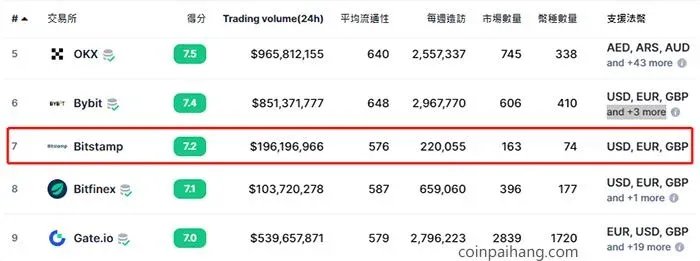
According to CoinMarketCap, Bitstamp ranks 7th among all cryptocurrency exchanges in overall evaluation, with a 24‑hour spot trading volume of approximately US $1.9 billion and a platform rating of 7.1. While its volume and visitor count trail behind Binance, it is still considered a large‑scale exchange.
2. Market Share
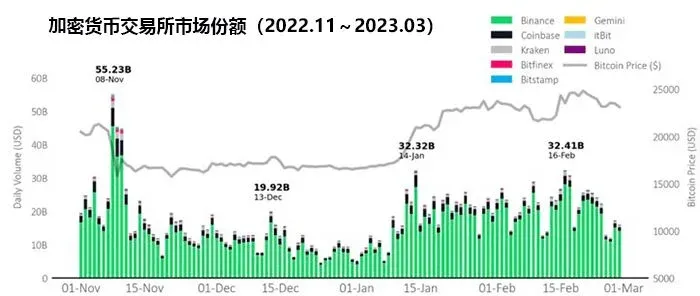
Due to regulatory constraints in Europe and North America, Bitstamp offers only spot trading and does not provide futures or other derivatives. CryptoCompare reports that more than 50 % of global exchange volume is concentrated on Binance, while Bitstamp’s share is under 5 %.
3. Countries / Regions Where Bitstamp Is Available
Bitstamp holds operating licenses in over 30 jurisdictions, including the United States, United Kingdom, EU, Australia, Canada, South Korea, Hong Kong, and Singapore. Services are also open to users in Taiwan, although the exchange does not possess a local Taiwanese license.
4. Platform Features, Fees, and User Feedback
1. Platform Features
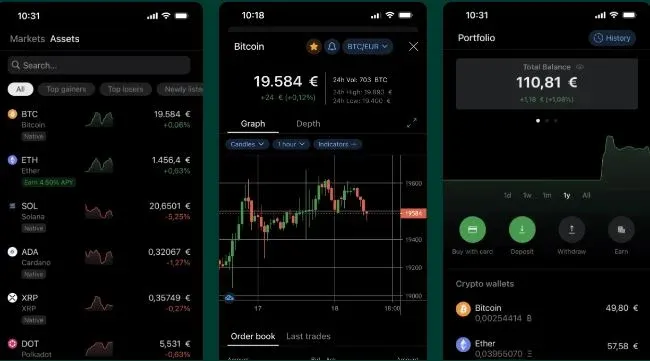
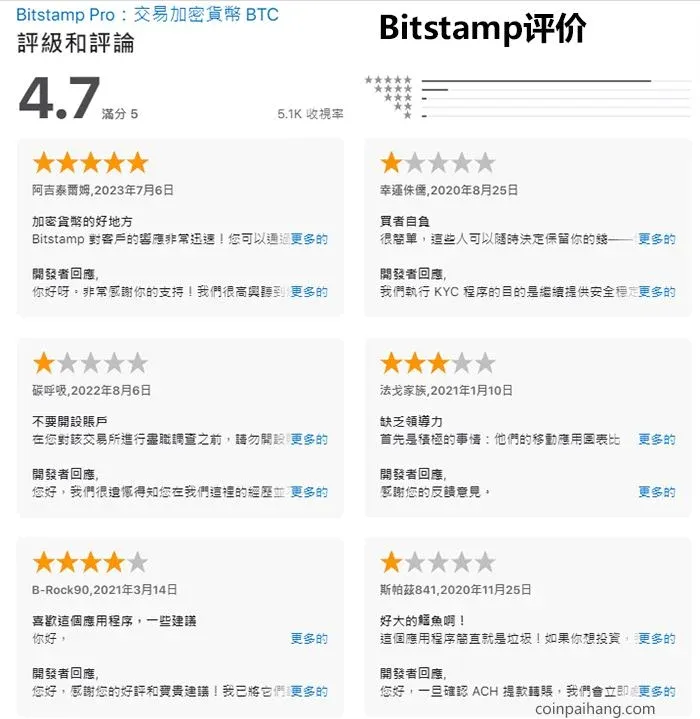
- Clean user interface – The mobile app mirrors the full website functionality and is available on the App Store and Google Play. It has earned 4‑star ratings from 11,000 Google Play reviews and 4.7‑star ratings from 100 Apple Store reviews.
- Professional trading terminal – The desktop version, Bitstamp Pro, supports four order types, real‑time charts, order‑book depth, and a suite of analytical tools.
- 24/7 customer support – One of the few crypto exchanges that offers round‑the‑clock email and phone assistance, complemented by an extensive FAQ.
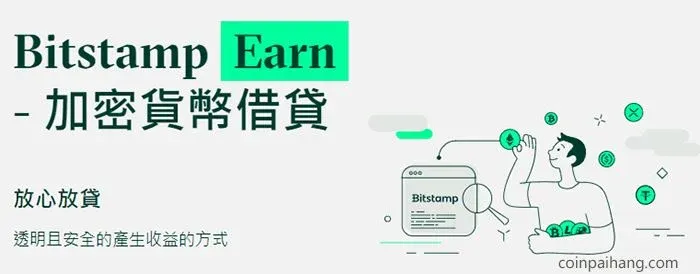
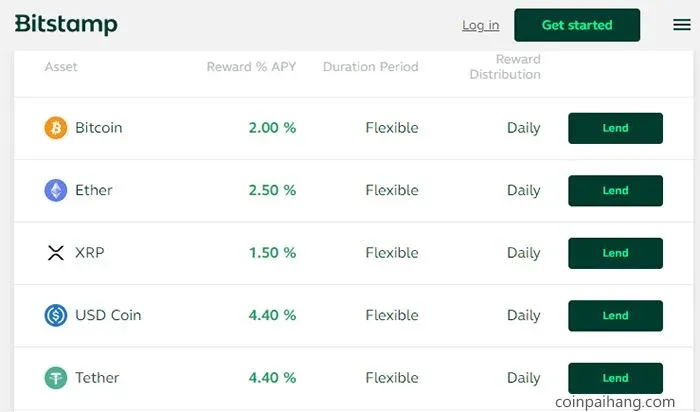
- Staking & lending services – In partnership with Finland‑regulated Tesseract, Bitstamp provides lending for BTC, ETH, USDC, USDT, XRP, APE and other assets. Sample annual yields: BTC 2 %, ETH 2.5 %, USDT/USDC 4.4 %.
2. Deposit / Withdrawal and Spot Trading Fees
- Deposit methods: credit cards, wire transfers (SEPA/SWIFT), PayPal, cryptocurrency. Credit‑card deposits incur the highest fee at 4 %.
- Wire transfer fees: roughly US $25 for incoming international wires; outgoing wires carry a US $50 fee.
- Cryptocurrency deposits: free; withdrawals (e.g., BTC) are charged at 0.0005 BTC per transaction.
Spot Trading Fee Schedule (based on 30‑day volume)
| 30‑day volume (USD) | Maker (limit order) | Taker (market order) |
|---|---|---|
| < 1,000 | 0 % | 0 % |
| 1,000‑10,000 | 0.3 % | 0.4 % |
| 10,000‑100,000 | 0.2 % | 0.3 % |
| 100,000‑500,000 | 0.1 % | 0.2 % |
| 500,000‑1,500,000 | 0.08 % | 0.18 % |
| 1,500,000‑20,000,000 | 0.06 % | 0.16 % |
| > 20,000,000 | 0.02 % | 0.1 % |
If your 30‑day volume is below US $1,000, trading fees are waived; otherwise the rates above apply. Overall, fees are higher than those on Binance (U.S. users must use Binance.US).
Note: Crypto‑related gains may be taxable in your jurisdiction; consult a local tax professional for guidance.
3. User Reviews
App ratings on Google Play and the Apple Store highlight the convenience of the mobile interface and the speed of deposits. However, users also criticize relatively high fees, a strict KYC process that can lead to account freezes, and the lack of Chinese language support.
5. Bitstamp Pros and Cons
Advantages ✅
- Regulated licenses; supports fiat deposits/withdrawals in USD, EUR, etc.
- 12 years of operation; strong reputation.
- Trading fees waived for 30‑day volume under US $1,000.
Disadvantages ❌
- Fees are relatively high compared with many competitors.
- Only spot trading pairs are available.
- KYC verification is stringent and can be time‑consuming.
- No Chinese language interface or Chinese‑language customer support.
Quick Takeaway
Bitstamp’s core strength lies in “fund security.” It is a long‑standing, regulated exchange that supports fiat on‑ramps and off‑ramps. Its drawbacks are a focus on European and North American markets, limited language options for Taiwan/Hong Kong users, and a comparatively cumbersome KYC process. Compared with Binance (U.S. residents should use Binance.US), Bitstamp lags in fee competitiveness, language support, and product variety. If you reside in Europe, the United States, Singapore, or another well‑regulated jurisdiction, Bitstamp may be a suitable choice. For users in Taiwan or Hong Kong, you might also consider locally regulated exchanges or Binance (with the U.S. caveat noted above).
This completes the comprehensive review of the Bitstamp exchange. For more information, follow Bitaigen’s related articles.
Related Reading
- OKX: Leading Crypto Exchange for Chinese Users in 2026
- How to Register on Bitstamp Exchange: Step-by-Step Guide
- Bybit Beginner Guide: KYC, Account Setup & First Deposit
💡 Register on Binance with referral code B2345 for the maximum trading fee discount. See Binance complete guide.



