
 Bitaigen Research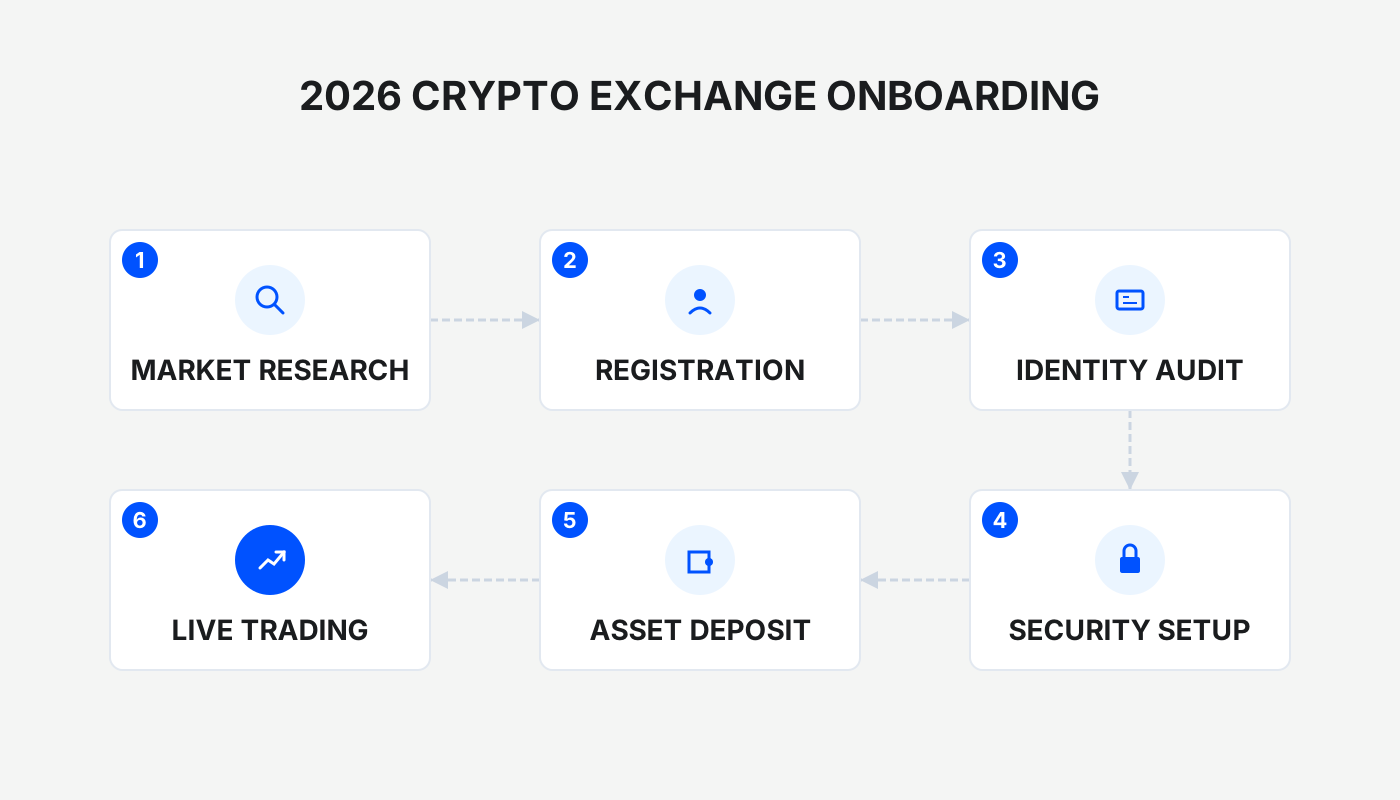
Stepping into the world of cryptocurrencies, the very first step is to pick a safe and reliable exchange. Yet, faced with a dazzling array of platforms—from the globally renowned Binance to Taiwan‑based MAX—newcomers often wonder: How should I choose a crypto exchange? Which platform offers the lowest trading fees? Which one is the safest and can avoid the risk of an exchange collapse?
In 2026, selecting an exchange should take into account security, fees, fiat on‑/off‑ramps, and platform reputation. This article provides rankings and key assessment points.
In this guide we outline the most trustworthy cryptocurrency exchanges for 2026, focusing on security safeguards, fee structures, and regulatory compliance. We also present practical rankings and selection recommendations to help beginners quickly locate the most suitable entry point. Later sections contain detailed side‑by‑side comparisons and operational tips, so read on carefully.
The 5 Key Metrics for Choosing an Exchange
Before committing any capital, spending time evaluating an exchange’s infrastructure and operating model is absolutely essential. The following five core metrics help you perform a comprehensive comparison.
1. Security and Regulation
Security is the top‑most consideration. Reliable platforms typically provide:
- Proof of Reserves (PoR) – an audit mechanism that demonstrates a 1:1 backing of user assets, preventing misappropriation. After the FTX incident, many exchanges began publishing PoR reports to boost transparency.
- Fund‑safeguard mechanisms – whether the majority of assets are stored in offline cold wallets and whether a user‑protection fund exists (e.g., Binance’s SAFU) to compensate users in extreme scenarios.
- Regulatory compliance – adherence to local laws. For example, Taiwanese platforms must file a “Anti‑Money‑Laundering Compliance Statement” with the Financial Supervisory Commission, while Hong Kong platforms need an SFC‑issued VASP licence. Regulated exchanges enjoy an extra layer of legal protection.
2. Fees
Fees directly affect investment costs and are generally broken down into:
- Maker / Taker rates – makers provide liquidity and usually pay a lower rate than takers. Most mainstream spot exchanges charge around 0.1 %.
- Deposit / withdrawal fees – fiat deposits may incur bank fees; blockchain withdrawals require network miner fees that vary by coin and congestion.
- Funding rates – the periodic charge applied to perpetual futures positions to balance long and short interest; this deserves separate attention.
Over the long term, fees become a sizable expense, so compare fee structures according to your expected trading frequency.
3. Fiat On‑/Off‑Ramp Options and Convenience
A smooth fiat gateway greatly improves user experience. Common methods include:
- Bank transfers – local exchanges such as MAX or ACE accept direct New Taiwan Dollar (TWD) deposits.
- Credit‑card purchases – convenient but typically carry a 2‑3 % surcharge, and some banks may block crypto transactions.
- C2C / P2P trading – the platform matches peer‑to‑peer trades and supports many payment methods, but you must choose reputable counterparties to avoid scams.
4. Number of Supported Coins and Liquidity
If you want exposure to a wide variety of altcoins, the breadth of listings and depth of order books are crucial. Large international exchanges like Binance and OKX list hundreds of trading pairs with deep liquidity, allowing you to execute orders at desired prices with minimal slippage.
5. Platform User Experience and Customer Support
A clean UI/UX makes trading more efficient. When you encounter deposit delays or account issues, fast‑responding, high‑resolution customer service is equally important. Check community forums such as PTT and Dcard for real‑world feedback on support quality.
Popular Cryptocurrency Exchange Rankings and Comparisons
The table below is compiled from CoinMarketCap data on trading volume, liquidity, website visits, and other dimensions, reflecting the latest rankings as of January 2026.
| Rank | Exchange | 24h Trading Volume (USD) | Avg. Liquidity | Weekly Visits | # Markets | Fiat Support |
|---|---|---|---|---|---|---|
| 1 | [Binance](https://accounts.binance.com/register?ref=B2345) *(U.S. users must use Binance.US)* | 82,688,877,048 | 925 | 9,573,887 | 220 | 762 |
| 2 | Coinbase Exchange | 11,948,080,214 | 795 | 23,988 | 484 | 366 |
| 3 | Upbit | 11,956,828,726 | 498 | 1,481,047 | 682 | 307 |
| 4 | [OKX](https://www.okx.com/zh-hans/join/B2345) | 9,823,537,562 | 778 | 5,235,657 | 101 | 336 |
| 5 | [Bybit](https://accounts.binance.com/register?ref=B2345) | 18,579,020,610 | 686 | 3,284,913 | 123 | 707 |
| 6 | [Bitget](https://www.bitget.org/zh-CN/referral/register?clacCode=NTBZAG9J) | 11,051,020,998 | 711 | 3,511,733 | 126 | 733 |
| 7 | Gate | 17,027,598,102 | 749 | 3,871,751 | 282 | 520 |
| 8 | KuCoin | 14,489,929,202 | 766 | 4,652,859 | 168 | 510 |
| 9 | MEXC | 19,621,893,914 | 711 | 4,520,695 | 312 | 419 |
| 10 | [HTX](https://accounts.binance.com/register?ref=B2345) | 14,188,248,148 | 423 | 850,448 | 902 | 692 |
Global Top Exchanges vs. Taiwan‑Local Exchanges vs. Hong Kong‑Compliant Exchanges
| Category | Representative Exchange(s) | Main Advantages | Main Disadvantages | Ideal Users |
|---|---|---|---|---|
| Global Top | Binance, OKX, Bybit | Vast coin selection, deep liquidity, diversified features (staking, Launchpad) <br> Relatively low fees | Some platforms lack Mandarin support, fiat on‑ramps can be cumbersome | Experienced traders seeking diversification and low‑cost execution |
| Taiwan‑Local | MAX, ACE | Direct TWD deposits/withdrawals, supervised by the Financial Supervisory Commission, localized customer service | Fewer listed coins, average liquidity, more basic trading functions | Crypto newcomers, users who prefer TWD‑centric operations |
| Hong Kong‑Compliant | OSL, HashKey Exchange | Fully licensed by the Hong Kong Securities and Futures Commission (SFC), high regulatory confidence | Targeted at professional investors, limited coin roster, higher account opening thresholds | Hong Kong residents, institutional investors, compliance‑focused participants |
In‑Depth Exchange Evaluations
Binance
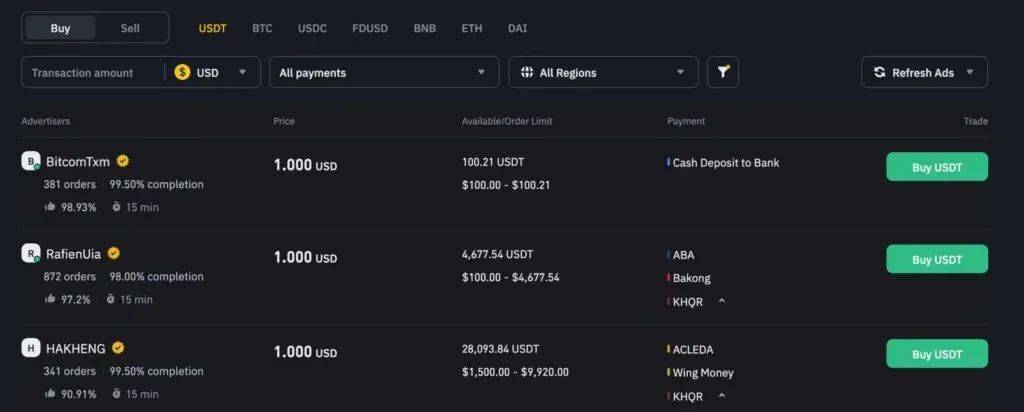
Binance is one of the world’s largest centralized exchanges and offers an extensive P2P marketplace. Users can filter sellers by payment method, country, exchange rate, and other criteria. The platform supports over 900 payment options (including local bank transfers, Skrill, MasterCard Send, etc.) and employs an escrow system to protect trades. U.S. residents cannot access the P2P service; they must use Binance.US instead.
Pros
- 800+ payment methods – high flexibility
- Rich customization tools for users with specific needs
- P2P trades are commission‑free, with transparent fees
- Offers spot, margin, futures, DeFi and other product categories
Cons
- No P2P access for U.S. customers
- Some sellers require additional KYC verification
OKX
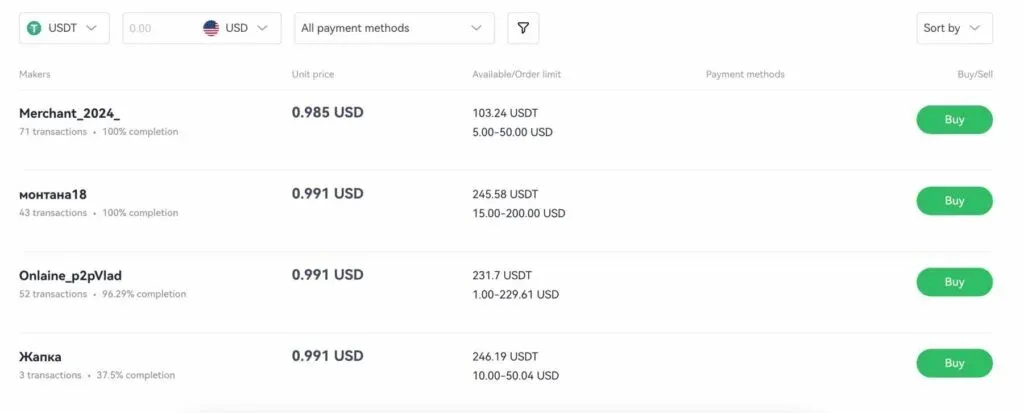
OKX also provides P2C (buyer) and C2C (seller) modes, supporting more than 100 fiat currencies and 900+ payment methods. The P2P service covers Bitcoin, Ethereum, USDT and USDC, and does not charge extra fees. Its “Quick Trade” function automatically matches the best rate, improving execution speed.
Pros
- Supports 100+ fiat currencies, broad payment coverage
- Zero extra fees for P2P transactions, keeping costs low
- Combines spot, perpetual contracts, structured products, lending, etc.
Cons
- No PayPal support
- Not all P2P sellers are officially certified by OKX
MAX Exchange
MAX is a veteran Taiwanese exchange backed by Far Eastern Bank, offering TWD‑trust custodial services. Its interface is straightforward, making it suitable for beginners, especially those who value smooth TWD on‑ and off‑ramps.
How Do PTT and Dcard Users Rate These Platforms?
On Taiwanese forums like PTT and Dcard, crypto enthusiasts post daily experiences. Here are some practical tips for extracting useful information:
- Focus on concrete issues such as “withdrawal bottleneck time”, “customer‑service response speed”, or “app crashes”.
- Distinguish FUD from shilling – Fear, Uncertainty, Doubt often originates from competitors or malicious actors; shilling is excessive praise. Seek neutral, fact‑based comments.
- Cross‑reference – Combine insights from PTT, Dcard, professional review sites, and overseas communities like Reddit for a fuller picture.
- Check recency – Older threads may no longer reflect current policies; prioritize recent discussions.
Community sentiment acts as a market temperature gauge, but final decisions should still be based on the five objective criteria listed above and your own research (DYOR).
Beginner’s Three‑Step Guide to Securely Buying and Selling Crypto
Step 1 – Register and Complete KYC
After creating an account, fulfill AML (Anti‑Money‑Laundering) requirements by submitting ID photos and completing facial verification. This protects your account and satisfies regulatory standards.
Step 2 – Deposit Funds and Purchase
Link a local bank account, transfer TWD into the exchange’s custodial wallet, and once the funds appear, navigate to the spot market (e.g., BTC/TWD or USDT/TWD). Enter the desired amount and price to execute the purchase.
Step 3 – Store Your Assets Safely
- Leave them on the exchange – convenient for frequent trading but exposes you to centralized risk.
- Transfer to a personal wallet – a hot wallet like MetaMask for daily use or a hardware wallet such as Ledger for long‑term storage. You retain full control of the private keys; be sure to back up the seed phrase securely, as loss is irreversible.
Tax reminder: Crypto gains may be subject to taxation in your jurisdiction. Consult a qualified tax professional to understand reporting obligations, whether you trade on a global platform or a local exchange.
Complete Analysis of Exchange Security and Risks
Spotting Scam Exchanges and Rug Pulls
- Unrealistic profit promises – statements guaranteeing returns or “no‑loss” outcomes.
- Lack of transparent information – missing team bios, company registration, or regulatory details.
- Easy deposits, hard withdrawals – prolonged or denied withdrawal requests.
- Rug Pull – on decentralized platforms, a project raises funds and the team disappears, rendering the token worthless.
Exchange Collapse Risk: Lessons from FTX
The FTX debacle underscored the principle “Not your keys, not your coins.” For assets you intend to hold long term, consider moving them to a personal cold wallet to mitigate the impact of a single exchange failure. Opt for platforms that provide Proof of Reserves and are overseen by reputable regulators (e.g., the Hong Kong SFC) to further enhance safety.
FAQ – Common Questions About Crypto Exchanges
Q1: Which crypto exchanges are legally operating in Taiwan?
As of 2026, locally regulated platforms that have filed the Financial Supervisory Commission’s AML compliance statement include MAX, ACE, Bitget, among others.
Q2: What are typical exchange fees?
Mainstream spot exchanges charge Maker and Taker fees ranging from 0.05 % to 0.20 %; volume‑based or native‑token‑holding users may enjoy tiered discounts. Credit‑card purchases usually incur a 2‑3 % surcharge.
Q3: Is it safe to keep money on an exchange? Could it go bankrupt like FTX?
No centralized exchange can guarantee 100 % safety. Diversify risk by moving long‑term holdings to a personal cold wallet, and prioritize exchanges that publish PoR and are under regulatory supervision to lower bankruptcy exposure.
Q4: Which exchange would you recommend for a Taiwanese beginner?
For newcomers, starting with a platform that supports direct TWD deposits/withdrawals and offers localized customer service—such as MAX or ACE—is advisable. Once you’re comfortable, you can open an account on an international exchange like Binance (or Binance.US for U.S. residents) to access a broader range of coins and financial products.
Conclusion
A “perfect” exchange does not exist; the optimal choice is the one that aligns best with your current needs. Beginners should prioritize security and fiat convenience, while seasoned traders may focus more on low fees and product diversity. Always test the platform yourself, consult multiple sources (especially authentic user feedback on PTT and Dcard), and maintain independent judgment (DYOR). We hope this guide helps you navigate the complex market and find a trustworthy trading partner.
*This is the full translation of “2026 加密货币交易所选择指南:安全性、手续费与 PTT 推荐排名全攻略”. For more related articles, follow Bitaigen (比特根).*
Related Reading
- 2025 Exchange Rankings: Scores, Size, Security & Liquidity
- BingX vs KuCoin: In‑Depth Crypto Exchange Comparison 2024
- 2026 Crypto Exchange Rankings: Security, Fees & Features
💡 Register on Binance with referral code B2345 for the maximum trading fee discount. See Binance complete guide.



