
 Bitaigen Research
OKX (formerly OKEx) contract fees are divided by user tier. The maker (order‑placement) fee is roughly 0.02 % ~ 0.015 %, while the taker (order‑taking) fee ranges from about 0.03 % ~ 0.05 %. The exact rates depend on the amount of OKB held or the trading volume over the most recent 30 days.
OKX is a globally leading digital‑asset service platform that offers spot trading, contracts, ETT portfolios, OTC, and a variety of other services. It supports major cryptocurrencies and can be accessed via web, mobile, or desktop applications.
New user registration:
- Official sign‑up link: https://www.okx.com/zh-hans/join/B2345
- Official download page: https://www.bitaigen.com/binance/download
In this article we systematically break down OKX contract fee structures, analysing how user tier, OKB holdings, and recent trading volume influence maker and taker fees. We also provide practical calculation methods so readers can quickly grasp cost‑assessment essentials. Subsequent sections include the fee tables and a FAQ; the material is worth a careful read.
How are contract trading fees calculated?
OKX classifies users into regular and professional categories based on trading volume. Regular users are tiered according to OKB holdings, while professional users are tiered according to total asset size and 30‑day trading volume. Each tier determines the next‑day contract fee, with separate rates for maker (order‑placement) and taker (order‑taking) actions.
If a user meets different tier conditions across multiple product lines (spot, perpetual contracts, delivery contracts, options, and spread strategies), the system applies the highest tier discount. For example, if a user’s spot trading volume qualifies for VIP 2, perpetual contracts qualify for VIP 3, options qualify for VIP 1, spread strategies qualify for VIP 2, and total assets qualify for VIP 4, the user will receive VIP 4 rates across all product lines.
1. Fee calculation formulas
- Regular user (lv1): taker fee 0.05 %, maker fee 0.02 %
- Coin‑denominated contracts
- Opening fee = contract value × number of contracts opened ÷ opening price × fee rate
- Closing fee = contract value × number of contracts closed ÷ closing price × fee rate
- USDT‑denominated contracts
- Opening fee = contract value × number of contracts opened × opening price × fee rate
- Closing fee = contract value × number of contracts closed × closing price × fee rate
Example
- Coin‑denominated BTC contract, opening price 10,000 USDT, quantity 100 contracts, tier 1 (taker). Fee = 100 × 100 ÷ 10,000 × 0.0005 = 0.0005 BTC.
- USDT‑denominated BTC contract, opening price 10,000 USDT, quantity 100 contracts, tier 1 (taker). Fee = 100 × 0.01 × 10,000 × 0.0005 = 5 USDT.
2. Fee rates (perpetual contract example)
Below are fee details for a selection of popular perpetual contracts (for reference only):
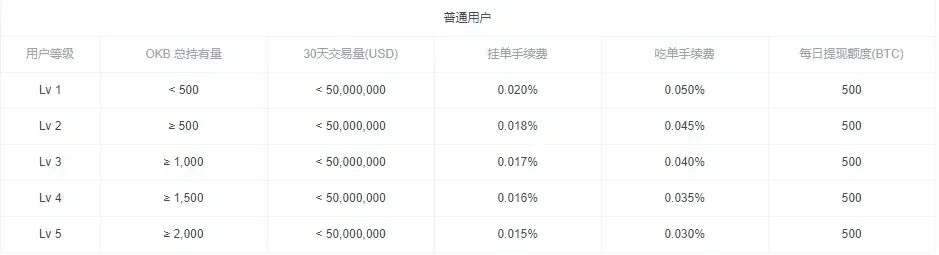
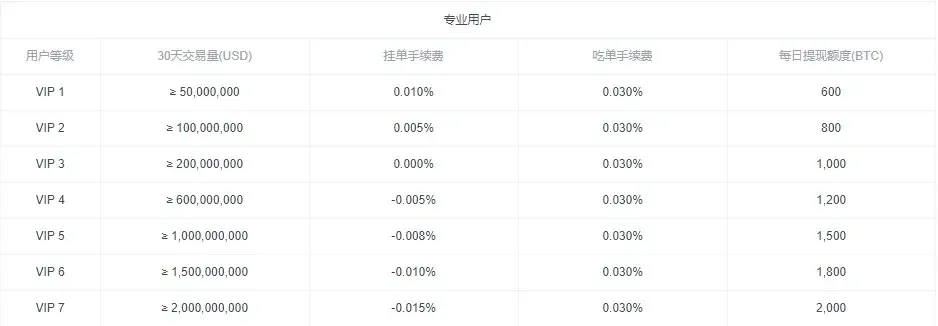
For the complete and up‑to‑date fee schedule, visit: Fee details
3. Key concept definitions
1. Total OKB holdings
When calculating this metric, include OKB balances held in the main account, sub‑accounts, spot wallets, and margin wallets. Assets held in “Earn”‑type products are not counted.
2. Parent‑child account explanation
The parent‑account tier is determined by the cumulative 30‑day trading volume of all its sub‑accounts together with the parent’s OKB holdings. A newly created sub‑account inherits the parent’s fee tier after 24:00 (Hong Kong Time) on the day of creation.
3. 30‑day trading volume
Contract trading volume is first converted to BTC using the prevailing USD‑BTC price, then converted to USD using the daily BTC/USD mid‑price ((open + close) / 2). The system settles at 00:00 UTC each day and aggregates the most recent 30 days.
4. Maker vs. taker
- Maker: An order placed at a specific price that does not execute immediately; it waits for a counter‑party to match it, incurring a maker fee.
- Taker: An order executed instantly at market price or against an existing maker order, incurring a taker fee.
5. Liquidation fee
Charged at the user’s current taker fee rate.
6. Daily withdrawal limit
The platform calculates a daily USD withdrawal allowance based on the user’s fee tier. All cryptocurrency withdrawals are converted to USD at the prevailing exchange rate and must not exceed this allowance. The limit is also subject to KYC/verification level.
Example
A user’s daily withdrawal cap is 300 USD. They have already withdrawn 250 USD + 25 USD (OMG) + 15 USD (XRP) = 290 USD, leaving 10 USD remaining. If they then request an additional 20 USD worth of XRP, the system will reject the request.
7. Historical fee algorithm (reference)
- Perpetual contract maker fee: 0.02 % ~ 0.015 %; taker fee: 0.05 % ~ 0.03 %.
- Funding fee is charged every 12 hours (10:00 UTC and 22:00 UTC) with the formula: Funding fee = contract value × number of contracts × funding rate.
Realised / unrealised P&L formulas for contracts
- Realised P&L (long):
\[(contract value ÷ settlement reference price – contract value ÷ average closing price) × quantity closed\]
- Realised P&L (short):
\[(contract value ÷ average closing price – contract value ÷ settlement reference price) × quantity closed\]
- Unrealised P&L (long):
\[(contract value ÷ settlement reference price – contract value ÷ latest mark price) × position size\]
- Unrealised P&L (short):
\[(contract value ÷ latest mark price – contract value ÷ settlement reference price) × position size\]
OKX contract trading tutorial
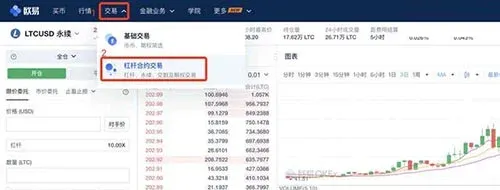
- Log in to OKX (official website), then click Trade → Derivatives.
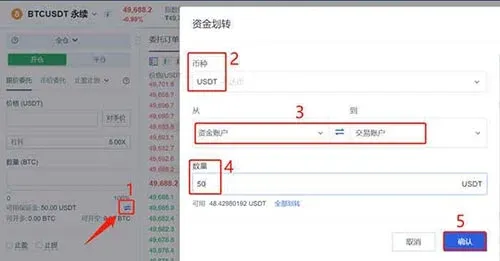
- Transfer funds: move the desired cryptocurrency from Funding Account to Trading Account, enter the amount, and confirm.
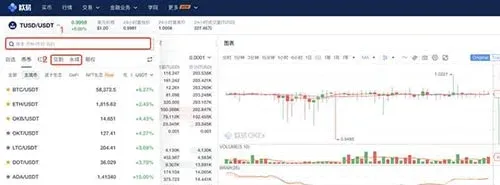
- In the market search bar, locate and select the target pair, then choose the contract type.
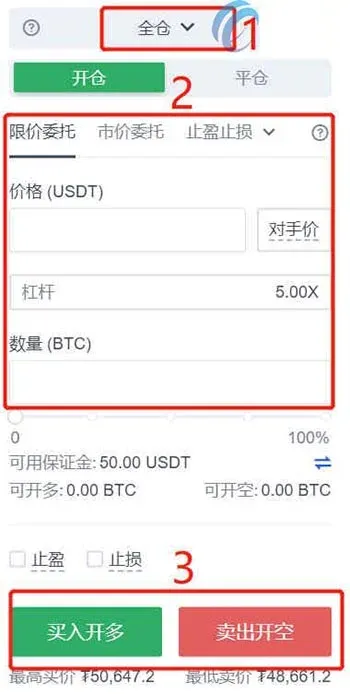
- Choose Cross or Isolated margin, fill in the order details, and execute Buy Long or Sell Short.
- After opening a position, you can view the order in the Positions tab; once profit targets are met, you may close the position.

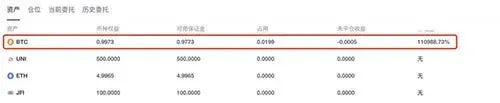
- While the position is open, click Assets to monitor margin ratios and other metrics.
How are spot trading fees calculated?
Trading‑pair categories
- USDT‑denominated pairs
- Stablecoin / Crypto / Fiat pairs
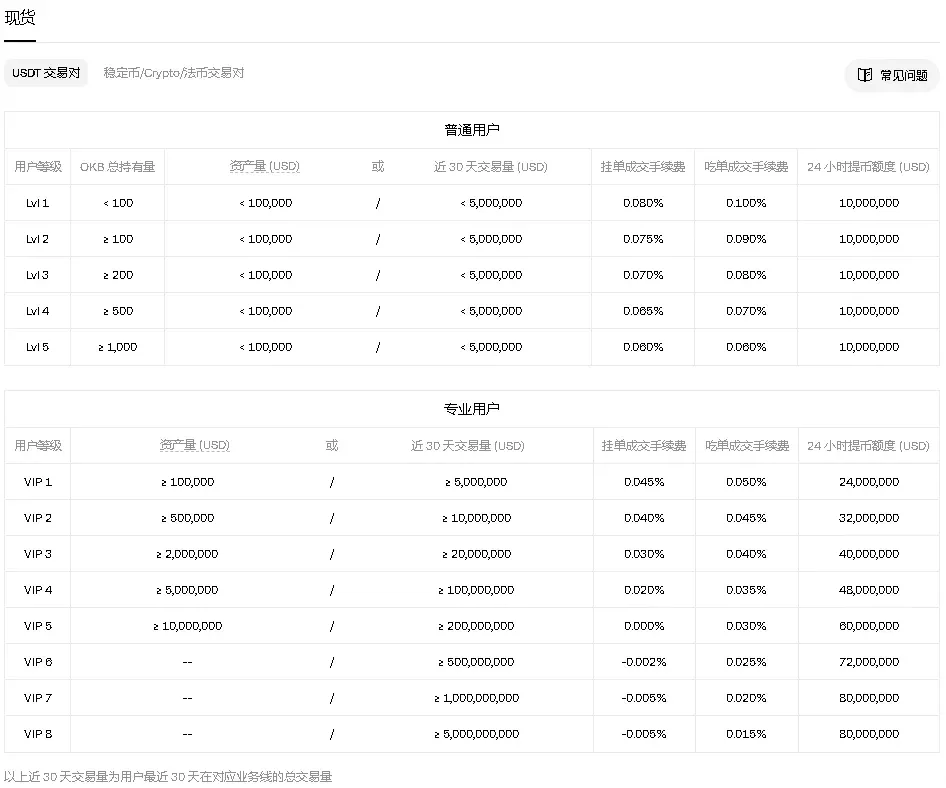
Total OKB holdings (spot)
Refers to the aggregate amount of OKB held across a user’s main and sub‑accounts in funding, trading, and financial wallets (excluding “Earn”‑type products).
Parent‑child account explanation (spot)
The parent‑account tier is based on the cumulative 30‑day trading volume of all sub‑accounts together with the daily asset snapshot, combined with OKB holdings. A sub‑account inherits the parent’s fee tier after 24:00 (UTC+8) on the day it is created.
30‑day trading volume (spot)
Spot trading volume is also converted to BTC using the USD‑BTC price, then to USD using the daily BTC/USD mid‑price. The system settles at 00:00 (UTC+8) each day.
Asset amount (spot)
At 00:00 (UTC+8) each day the platform snapshots the user’s holdings of each cryptocurrency, converts each to BTC using the USDT price, then to USD via the BTC/USD mid‑price. The higher of the 30‑day average asset amount and the current snapshot is used as the final asset amount.
Maker vs. taker (spot)
- Maker: Place an order at a chosen price and wait for a counter‑party to fill it; a maker fee is charged upon execution.
- Taker: Execute immediately at market price or a better price; a taker fee is charged.
Fee collection rule (spot / margin)
Fee = fee rate × quantity of the asset bought or sold at the moment of trade.
Example (BTC/USDT)
- Maker fee 0.08 %, taker fee 0.10 %. If Alice buys 1 BTC at market price (taker), she pays a fee of 0.001 BTC, receiving 0.999 BTC net.
- If Alice sells 1 BTC using a limit order (maker), she pays 16 USDT in fees, receiving 19,984 USDT net.
Negative maker fee rebate: When the maker fee rate is negative (e.g., ‑0.002 %), the system rebates that proportion to the maker side using the same calculation method.
24‑hour withdrawal limit (USD)
Every day at 00:00 (UTC+8) the platform calculates a user’s withdrawal ceiling for the next 24 hours based on the fee tier. All withdrawals, after conversion to USD at the prevailing rate, must stay within this ceiling. The limit is also bound by the user’s verification level.
Fee‑tier update schedule
The platform typically refreshes fee tiers between 04:00 and 06:00 (UTC+8) each day.
---
Note for U.S. residents: When accessing Binance‑related services, use Binance.US rather than the global Binance platform to remain compliant with U.S. regulations.
Tax reminder: Cryptocurrency transactions, including trading fees and realized gains or losses, may be subject to tax in your jurisdiction. Users should consult a qualified tax professional to understand their local obligations.
This completes the comprehensive explanation of how OKX contract fees are calculated and provides the detailed fee breakdown. For more Bitcoin and digital‑asset resources, follow Bitaigen (比特根) and explore its other articles.
Related Reading
- Top 10 Online Bitcoin Trading Platforms for 2024
- How to Play Bitcoin for Profit: Earn Money with Crypto
- Huobi Review: Security, Credibility & Regulatory Risks
💡 Register on Binance with referral code B2345 for the maximum trading fee discount. See Binance complete guide.



