
 Bitaigen Research
 Does Playing a Blockchain Game Count as Mining? Legality and Risks
In China, “mining” activities embedded in blockchain games are not classified as the virtual‑currency mining covered by the 2021 *Notice on Rectifying Virtual Currency “Mining” Activities*. Consequently, they are not outright prohibited, but developers and players must still guard against illegal fundraising and other legal hazards.
In this article we outline the concept of mining within blockchain games, differentiate between traditional cryptocurrency mining and liquidity mining, and analyze their legality and potential compliance risks in light of current regulations. Read on to make more informed decisions when engaging with play‑to‑earn titles and to obtain practical references for real‑world operations.
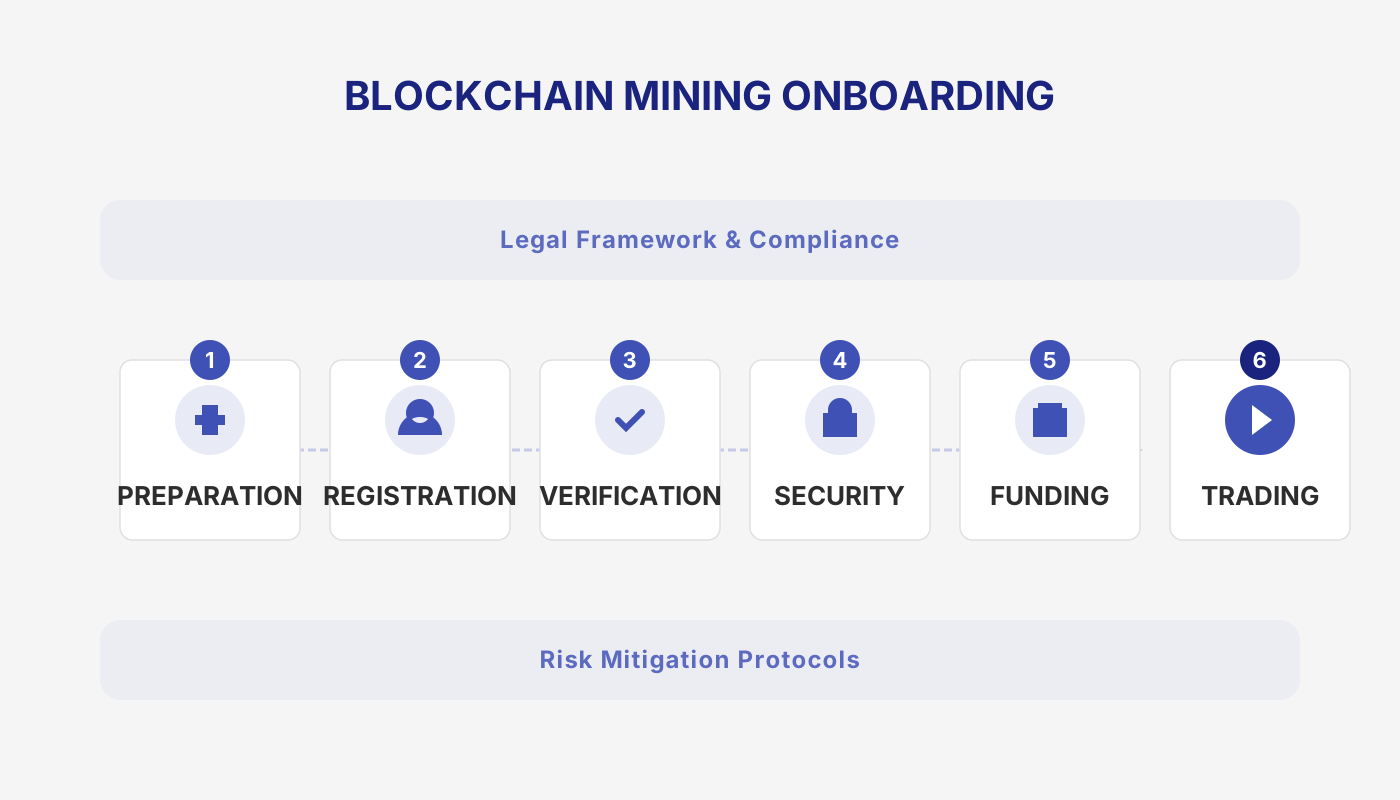
Is Playing a Blockchain Game Considered Mining?
Before diving in, it is essential to clarify the two distinct notions of cryptocurrency mining and liquidity mining.
1. What Is Cryptocurrency Mining?
- Definition: In a blockchain network, miners validate transactions and bundle them into blocks to preserve data integrity. In return, the protocol rewards them with native tokens such as Bitcoin. This process is commonly referred to as “mining.”
- Essence: It is a Proof‑of‑Work (PoW) mechanism that consumes substantial computing power and electricity.
2. What Is Liquidity Mining (Yield Farming)?
- Definition: Within the decentralized finance (DeFi) ecosystem, users supply token assets to a liquidity pool and receive the platform’s governance token or a share of transaction fees in return.
- Mechanism: It works similarly to depositing money in a bank to earn interest, except the “interest” is paid out in token rewards.
Example: A user deposits tokens on Compound and earns COMP tokens as an incentive; a user provides liquidity on PancakeSwap, receives LP (liquidity provider) tokens, and stakes those LP tokens for additional yield.
3. How Blockchain Game Mechanics Relate to Mining
The majority of blockchain games adopt a “pay‑to‑play” (often called “krypt‑gold”) model:
- Players create a wallet (e.g., MetaMask) and, on an exchange—Binance.US for U.S. residents, or any global exchange supporting SEPA/SWIFT for fiat deposits—purchase USD‑pegged stablecoins such as USDT.
- Those stablecoins are swapped for game‑specific tokens or in‑game items.
- Through activities like leveling up, battling, breeding, or completing quests, players earn additional game tokens.
- The earned tokens can be sold on secondary markets, enabling a “play‑and‑earn” loop.
In practice, this flow supplies liquidity to the game's ecosystem and therefore represents a variant of liquidity mining rather than traditional PoW mining.

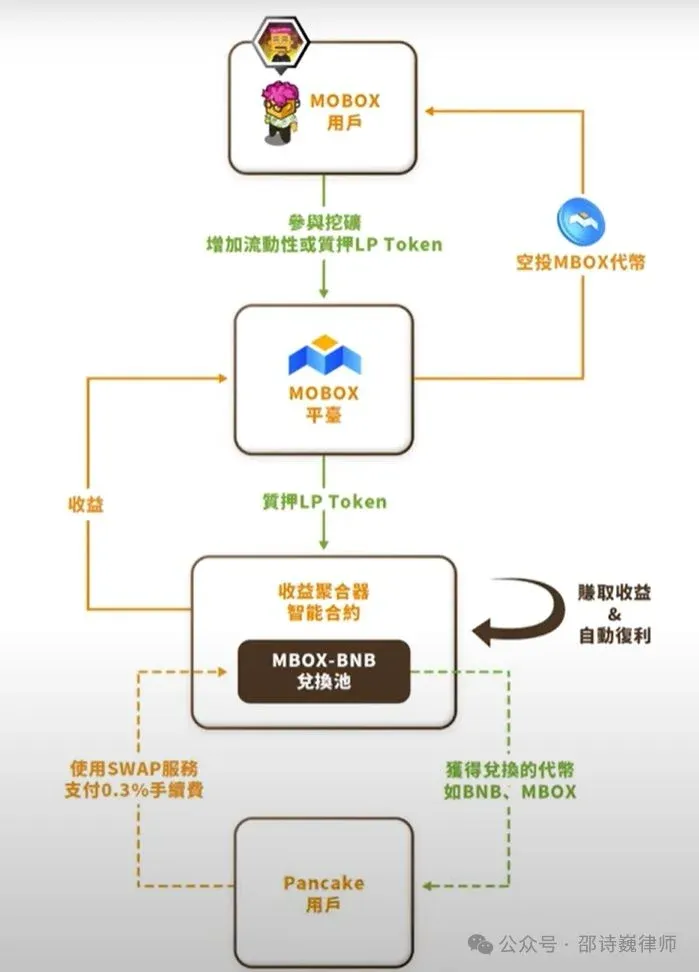
Case Study: Mobox
- Founded: 2020
- Core Gameplay: Users provide liquidity for the MOB‑BNB pair on PancakeSwap, receive LP tokens, and then stake those LP tokens on the Mobox platform to claim airdropped MBOX tokens.
Legal Risks for Domestic Developers of Blockchain Games
1. Does the 2021 *Notice* Apply?
The 2021 *Notice on Rectifying Virtual Currency “Mining” Activities* targets hardware‑based cryptocurrency mining that requires massive hash power and electricity consumption. Since blockchain games and liquidity mining do not entail significant power usage, they fall outside the scope of that regulatory document.
2. High‑Frequency Risk Categories
| Risk Type | Primary Legal Basis | Key Points |
|---|---|---|
| Illegal gambling | Relevant articles of the Criminal Law | Prevent game mechanics from being classified as gambling |
| Illegal fundraising | Criminal Law provisions on illegal public deposits and fundraising fraud | Focus on the four elements: **illegality**, **incentive**, **publicity**, **non‑specificity** |
(1) Crime of Illegal Public Deposit
- Illegality: Platforms must not act as a bridge for direct exchange between legal tender and tokens.
- Incentive: Promotional material must avoid promises of capital protection, guaranteed returns, or fixed yields.
- Publicity & Non‑Specificity: Even if an invitation‑code system is used, courts typically treat the activity as publicly soliciting funds from an indefinite pool of users.
(2) Crime of Fundraising Fraud
- Conducted with the intent of illegal enrichment, diverting raised funds to personal use, illicit activities, or evading repayment obligations.
- Although blockchain games leverage decentralization, private‑chain or consortium‑chain implementations can still enable collusion between organizers and participants, exposing them to fraud allegations.
3. Compliance Recommendations
- Marketing and Game Design: Refrain from using terms such as “principal‑protected,” “high‑return,” or other inducements that could be interpreted as guarantees.
- Internal Governance: Have partners sign shareholder or operating agreements that clearly delineate profit sharing, risk allocation, and decision‑making authority.
- Regulatory Liaison: If the project involves token issuance, consult the relevant financial regulator or a specialized law firm in advance to ensure the token does not fall under the prohibited categories enumerated in the *Announcement on Preventing Illegal Activities Involving Virtual Assets*.
Closing Remarks
In summary, the “mining” mechanisms embedded in blockchain games are not the cryptocurrency mining targeted by the 2021 *Notice*, so they are not directly restricted by that policy. Nevertheless, developers must vigilantly mitigate illegal fundraising and fundraising fraud risks. By adopting compliant promotional language, designing economically sound gameplay, and establishing robust internal governance structures, the blockchain gaming ecosystem can evolve within a lawful and sustainable framework.
Related Reading
- Secure Blockchain Games: Multi‑Signature Wallets & ZK Proofs
- Binance Launchpool GUN: $100M Funding Boosts Gaming
- Top Cryptocurrency Investing Strategies for 2026
💡 Register on Binance with referral code B2345 for the maximum trading fee discount. See Binance complete guide.



