
 Bitaigen Research
 As the cryptocurrency ecosystem continues to evolve, new financial tools are reshaping how traders earn yields and participate in blockchain security.
Liquid Staking Tokens (LSTs) are tradable tokens that represent staked assets; holders can enjoy staking rewards while freely using or trading the token, and it can also serve as collateral.

In this article we outline the core concepts and operating mechanisms of liquid staking tokens, helping newcomers quickly understand how LSTs balance yield and liquidity, and highlighting their primary use cases in DeFi. Continue reading to grasp the practical essentials of this emerging tool.
Note for U.S. readers: Access to many liquid‑staking services typically requires using Binance.US rather than the global Binance platform.
When converting between fiat and crypto, transactions are generally settled in USD using SEPA or SWIFT channels for cross‑border transfers.
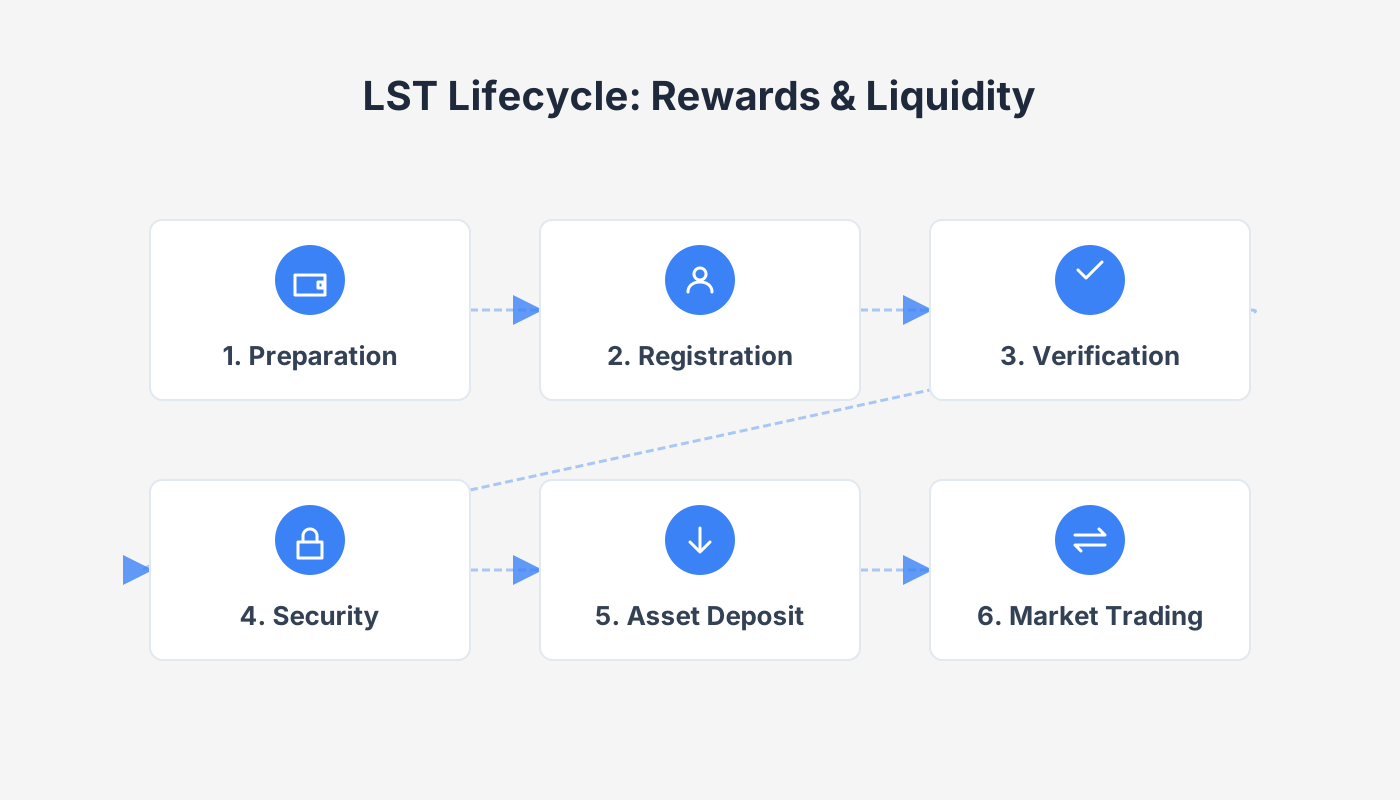
What Is Liquid Staking?
Staking involves locking cryptocurrency in a blockchain network to support security and earn rewards—a common practice on proof‑of‑stake (PoS) networks such as Ethereum, Solana, and Cosmos. Traditional staking usually comes with a lock‑up period, limiting asset liquidity and preventing the funds from being used in other trades or investment opportunities during that time.
Liquid Staking solves the liquidity problem by issuing tokenised receipts that represent the staked assets. After staking, users receive a Liquid Staking Token (LST), which can be freely traded, borrowed, or used as collateral in DeFi while still earning the underlying staking rewards in the background.
What Is a Liquid Staking Token (LST)?
A liquid staking token is a synthetic or derivative token that corresponds to your staked assets. When you stake, the protocol mints the appropriate LST, and the holder can utilise it on secondary markets or within DeFi protocols.
Examples:
- Staking ETH through Lido yields stETH.
- Staking ETH via Rocket Pool yields rETH.
- Staking ETH on Coinbase yields cbETH.
These tokens can be traded or used as collateral across numerous DeFi platforms, achieving “liquidity without sacrificing staking rewards.”
How Liquid Staking Works (Step‑by‑Step)
- Stake: The user deposits the native token (e.g., ETH) into a liquid‑staking protocol.
- Delegate: The protocol delegates the assets to a PoS blockchain, participating in block validation and earning rewards.
- Issue LST: The protocol mints the corresponding liquid staking token (e.g., stETH) and sends it to the user.
- Reward Distribution: While holding the LST, the user automatically accrues staking rewards; the LST can be traded, lent, or employed in other DeFi strategies at any time.
Main Benefits for Traders
- Liquidity on Demand: No need to wait for an unbonding period; LSTs can be bought or sold instantly on exchanges or DeFi protocols.
- Compound Profit Opportunities: While earning staking rewards on the LST, you can also deploy it into yield farms, lending markets, or liquidity pools, stacking multiple layers of passive income.
- Capital Efficiency: Active traders can dynamically allocate assets using LSTs, reducing idle holdings and boosting overall returns.
- DeFi Interoperability: Major platforms such as Aave, Curve, Uniswap, and Balancer all support LSTs, offering strong compatibility and expanding trading and yield scenarios.
Liquid Staking vs. Traditional Staking
| Feature | Traditional Staking | Liquid Staking |
|---|---|---|
| Lock‑up period | Yes (must wait for unbonding) | No |
| Flexibility | Low | High |
| Use in DeFi | Not supported | Fully usable |
| Reward accumulation | Limited to staked asset | Staked asset + LST can be reused |
| Liquidity access | Only after unbonding | Tradeable as soon as you hold the LST |
Risks and Considerations
- Smart‑contract risk: Liquid‑staking protocols rely on complex code that may contain vulnerabilities or be exposed to attacks.
- Price‑gap risk: The market price of an LST can sometimes fall below the net value of its underlying asset, resulting in a discount.
- Centralisation risk: Some providers have validator node distributions that are uneven, potentially weakening decentralisation.
- Protocol limitations: Fee structures, reward mechanisms, and integration capabilities differ across platforms; always read the official documentation and perform your own risk assessment before using a service.
Please note that crypto gains may be taxable in your local jurisdiction; consult a tax professional for guidance.
Overview of Leading Liquid Staking Platforms
- Lido: Offers stETH, widely adopted across the Ethereum DeFi ecosystem.
- Rocket Pool: Issues rETH, emphasising a decentralised validator network.
- Frax: Introduces sfrxETH, combining staking with a stablecoin‑like mechanism.
- Coinbase: Provides exchange‑backed cbETH.
- Marinade: Targets Solana with mSOL, the primary liquid‑staking solution in the Solana ecosystem.
Each platform differs in technical implementation, fees, and reward models. Users should select the option that best matches their asset holdings, risk tolerance, and target network.
---
Liquid staking tokens are redefining how traders interact with proof‑of‑stake networks. They unlock asset liquidity without sacrificing staking rewards, improve capital efficiency, and open new avenues for advanced yield strategies.
This article constitutes the complete guide “What Is a Liquid Staking Token? How Does It Work? A Beginner’s Guide.” For more information on liquid staking, search for past articles from Bitaigen or continue browsing the related posts below. Thank you for your continued interest and support of Bitaigen!
Related Reading
- Top 10 Unlaunched Stablecoin Projects for Payments, DeFi & RWA
- AI-Track Web3 Projects: DeFi, Gaming & MCP Tech
- Liquidity Mining vs Staking: Differences, Benefits & Risks
💡 Register on Binance with referral code B2345 for the maximum trading fee discount. See Binance complete guide.



