
 Bitaigen Research
 If the stablecoin sector has already seen ten highly‑watched projects that have not yet launched, they are Plasma, Noble, OpenEden, CapMoney, Coinshift, AUSD, Perena, LevelUSD, FalconStable and Yala.
We have compiled the most promising yet‑unreleased stablecoin projects currently in the market, focusing on three core use‑cases—payments, DeFi and real‑world assets (RWA). The analysis breaks down their technical approaches and business logic, helping readers grasp the next wave of innovation in the industry. To learn how these projects aim to achieve low‑cost on‑chain remittances, profit distribution and asset tokenisation, keep reading.
1. Stablecoins Across Three Major Scenarios: Payments, DeFi and RWA
Payments: Traditional cross‑border payment systems (e.g., SWIFT) are slow, costly and often opaque, making them ill‑suited for the digital age. Stablecoins, with near‑zero transaction fees, 24/7 availability and programmable features, deliver a disruptive “dimensionality‑reduction” blow to legacy infrastructure. The integration of stablecoins by mainstream payment providers such as Stripe, PayPal and Visa validates their commercial viability. Stablecoins are rapidly evolving from a pricing and settlement unit on native crypto exchanges to a global‑scale payment and settlement instrument.
DeFi: Leading stablecoins (USDC, USDT) suffer from capital‑efficiency shortcomings—holders earn no interest while issuers deploy the reserve assets (primarily U.S. Treasury bonds) into risk‑free markets and capture the full yield, effectively turning users into free capital providers. Yield‑bearing stablecoins embed mechanisms such as U.S. Treasury yields, DeFi lending and arbitrage directly into the token design, allowing holders to automatically receive returns.
RWA: Tokenisation of real‑world assets (RWA) is regarded as the core engine that could push DeFi into the trillion‑dollar arena. The concept hinges on bringing real assets with stable cash flows—especially U.S. Treasury bonds—on‑chain, thereby furnishing DeFi with sustainable, low‑risk real‑world yields and attracting institutional capital. If DeFi injects “efficiency” into stablecoins, RWA contributes “value” and “scale,” unlocking imagination for a trillion‑dollar market.

2. Introduction to Ten Unreleased Stablecoin Projects
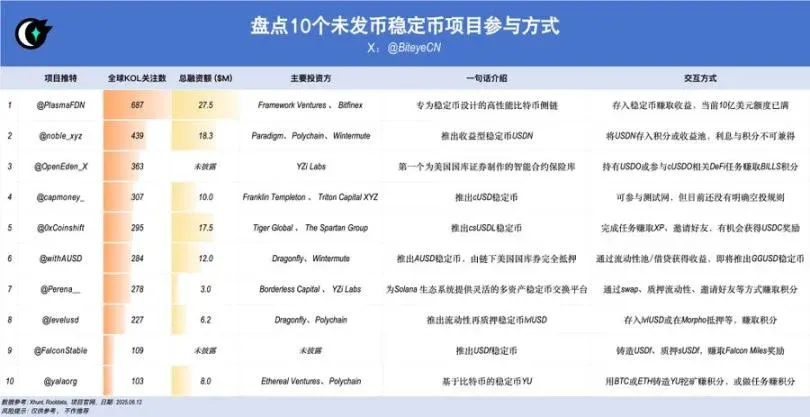
2.1 @PlasmaFDN
Overview: Plasma is a high‑performance blockchain built specifically for stablecoins. It aims to solve the high fees, transaction failure rates and feature gaps that legacy chains exhibit when handling stablecoins. The network is powered by the PlasmaBFT consensus protocol and the Reth execution engine, delivering fast finality and broad compatibility. Plasma accepts fee payments in assets such as USDT or BTC, offers zero‑fee USDT transfers, and is developing confidential transaction capabilities.
How to Participate: Users deposit assets into audited vault contracts that allocate funds to Aave and Maker to earn yield. After the lock‑up period, the assets are uniformly converted into USDT. Participation requires completing KYC, jurisdictional screening and other compliance steps on the Echo Sonar platform. The current deposit cap of $1 billion is fully allocated; observers should watch for any future capacity extensions.
Link: <httpshttps://app.plasma.to/>
2.2 @noble_xyz
Overview: USDN operates on the M⁰ architecture and is collateralised by short‑term U.S. Treasury bonds, targeting an annualised return of roughly 4.31%. The token supports cross‑chain transfers and is suited for multi‑chain development environments. Users may lock USDN in the Points Vault to earn “points,” or place it in the Boosted Yield Vault to obtain higher yields denominated in U.
How to Participate: The USDN points‑incentive campaign has 23 days remaining. Users bridge USDC to the Noble chain, swap it for USDN, and then choose either the points pool (foregoing interest in exchange for points) or the yield pool (receiving a 14.8 % annualised return). Points are claimable after a minimum 30‑day stake; longer lock‑ups increase the points multiplier, and additional rewards are unlocked when total value locked (TVL) milestones are reached.
Link: <https://points.noble.xyz/>
2.3 @OpenEden_X
Overview: OpenEden delivers on‑chain U.S. Treasury yield products. Its issued TBILL token is backed by short‑term Treasuries and the U.S. dollar, and the platform has launched two yield‑bearing stablecoins: USDO (daily accrued yield) and cUSDO (net‑asset‑value‑increasing). Both are underpinned by short‑term Treasuries and repurchase agreements, guaranteeing principal stability while continuously generating returns.
How to Participate: Holding USDO or taking part in cUSDO‑related DeFi activities—such as providing liquidity on Curve, staking on Morpho, or depositing into strategy vaults—earns BILLS points. Different tasks carry distinct multipliers, allowing participants to boost their rewards.
Link: <https://portal.openeden.com/b
---
Global Context Note: All fiat references are expressed in USD; cross‑border transfers may use SEPA, SWIFT or comparable networks. Users residing in the United States should access Binance‑US rather than the global Binance platform. Crypto gains can be taxable in many jurisdictions; participants should consult local tax regulations for compliance.
Related Reading
- AI-Track Web3 Projects: DeFi, Gaming & MCP Tech
- Liquidity Mining vs Staking: Differences, Benefits & Risks
- Cross-Chain Bridges Explained: Solving Asset Islands in DeFi
💡 Register on Binance with referral code B2345 for the maximum trading fee discount. See Binance complete guide.
⚠️ Risk Disclaimer: Crypto prices are highly volatile. This is not investment advice.



