
 Bitaigen Research
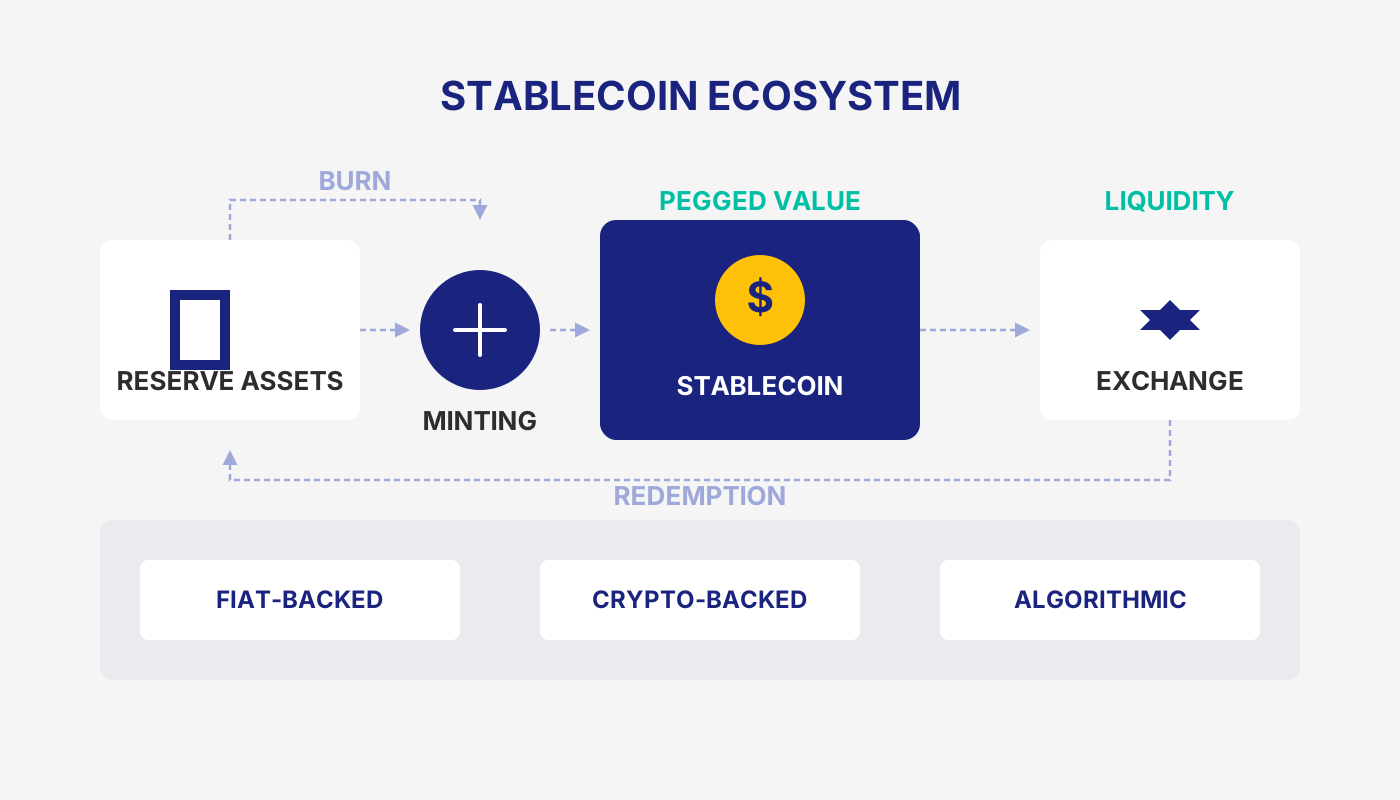
Stablecoins are a class of cryptocurrency that are anchored to assets with relatively stable value—such as fiat currencies, commodities, or other crypto assets—and maintain a 1:1 peg to the reference value through either reserve holdings or algorithmic mechanisms.
In this article we will systematically outline the core principles of stablecoins, their main categories, and their practical roles in decentralized finance (DeFi) and everyday payments. Readers will gain insight into the sources of value, key risk considerations, and the evolving industry landscape. A reference framework for assessing the security of different models is also provided.
What Is a Stablecoin?
A stablecoin is essentially a cryptocurrency equipped with an “anchoring” property, aiming to stay on parity with an off‑chain asset. To achieve price stability, stablecoins generally employ one of two approaches:
- Reserve‑backed collateral – fiat currency, commodities, or other crypto assets are held in off‑chain accounts to back the token.
- Algorithmic regulation – smart contracts automatically adjust the circulating supply in response to market demand.
According to governance structure, stablecoins can be classified as centralized or decentralized:
- Centralized stablecoins store fiat reserves in banks or trust institutions, requiring users to trust the custodian. Transparency can be enhanced through solutions such as Chainlink Reserve Proof. Some centralized tokens also permit on‑chain crypto collateral with an over‑collateralization ratio typically ≥150 %.
- Decentralized stablecoins have open‑source protocol code that anyone can audit, with collateral ratios visible on‑chain and governance power distributed among token holders, resulting in higher transparency.
A special form is the central bank digital currency (CBDC). Issued directly by a sovereign central bank, a CBDC does not need a fiat‑backed off‑chain account; it is a legal tender that can be used for large‑scale retail payments and inter‑bank settlement.
How Do Stablecoins Operate?
Mainstream stablecoins maintain their value through several anchoring mechanisms:
1. Collateralized Debt Position (CDP)
MakerDAO’s DAI uses an over‑collateralized model: users lock crypto assets in a smart contract, which then generates an equivalent amount of DAI. The system’s stability fee (interest rate) automatically adjusts the supply. When DAI drifts away from the $1 target, the changing fee incentivizes borrowers to either repay or add more collateral, restoring the peg.
2. Arbitrage Basket
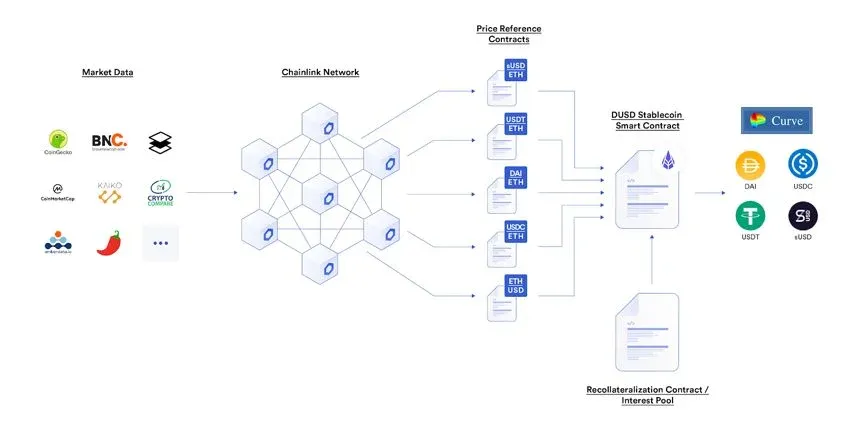
DeFiDollar (DUSD) aggregates multiple stablecoins (DAI, USDC, USDT, sUSD) and keeps its index price at $1 through arbitrage. If any component token trades above $1, the contract sells that token and buys DUSD, pulling the index back down. Chainlink oracles supply real‑time price data that drive the balancing logic.
3. Elastic Supply (Rebasing)
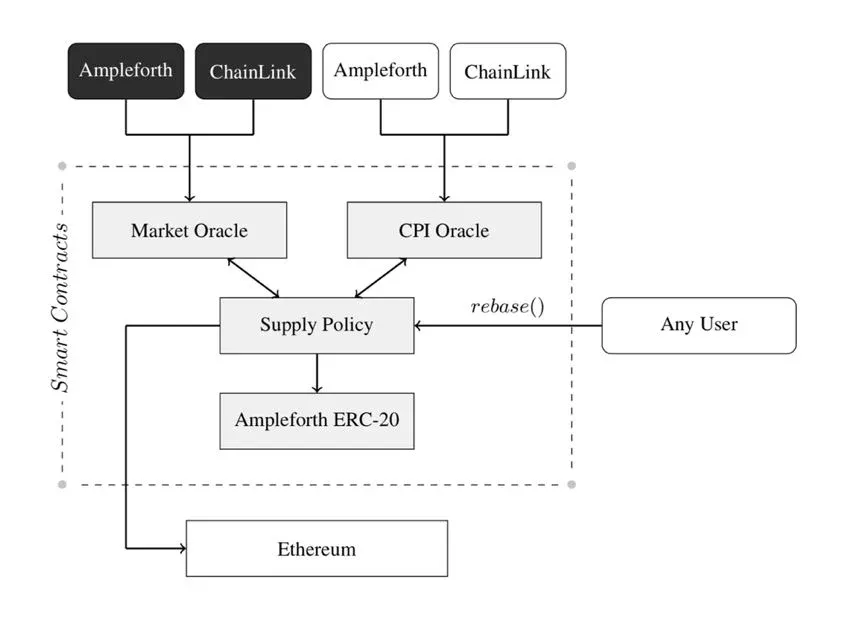
Ampleforth (AMPL) is an algorithmic stablecoin that targets the Consumer Price Index (CPI) using an elastic‑supply mechanism. When AMPL’s market price exceeds the target, the protocol “expands” holders’ balances; when the price falls below the target, balances are “contracted.” Daily supply adjustments and CPI/VWAP data are delivered to the protocol by Chainlink oracles.
Differences Between Stablecoins and Other Cryptocurrencies
| Dimension | Stablecoin | Typical Crypto Asset (e.g., Bitcoin) |
|---|---|---|
| Price volatility | Usually < 0.01 USD | Frequently > 10 % intraday swings |
| Primary use case | Transfers, payments, DeFi collateral | Store of value, speculation, hedging |
| Trust model | Trust in reserves or algorithmic code | Trust in code and network consensus |
| Link to traditional finance | Bridged via fiat or commodity reserves | Operates largely outside the traditional system |
Price Behavior
Stablecoins exhibit minimal price fluctuation, making them suitable as an intermediate layer for daily transactions and value preservation. By contrast, assets like Bitcoin experience large swings and are generally used for long‑term investment or wealth storage.
Role in Financial Transactions
Stablecoins often act as a digital bridge for moving value between crypto assets or obtaining exposure to USD without leaving the blockchain, providing low‑cost, near‑instant settlement.
Connection to Traditional Finance
Fiat‑backed stablecoins (e.g., USDC, USDT) are underwritten by companies or custodians that hold actual dollars or short‑term government securities. Users must trust the authenticity of those reserves. Transparent audits and Chainlink Reserve Proof can improve confidence.
Trust Mechanism
Decentralized stablecoins derive trust from code and protocol design; centralized tokens additionally rely on the issuer’s asset‑management capabilities. Governance structures and audit frequency directly affect user perception of stability.
How Do Stablecoins Keep Their Price Stable?
1. Reserve‑Based Support
- Price below the peg: Arbitrageurs buy the stablecoin at a discount and redeem it for the underlying fiat, creating upward pressure.
- Price above the peg: The issuer mints new tokens at $1 each and sells them, increasing supply and pulling the price down.
This feedback loop depends on users’ confidence in the reserve’s existence. If that confidence erodes, the peg can break.
2. Algorithmic Management
- Price decline: The system removes or burns tokens, reducing supply.
- Price rise: The system automatically mints new tokens, expanding supply.
The model resembles central‑bank interest‑rate policy, with the crucial factor being users’ trust in the algorithmic rules.
Key stability drivers:
- Incentives and arbitrage: Economic motives trigger corrective actions whenever the price deviates.
- High liquidity: Deep order books on major exchanges make arbitrage efficient.
- Trust layer: Whether based on reserves or code, users must be convinced the system can honor its obligations over time.
Types of Stablecoins
Fiat‑Collateralized
- Issuer holds an equivalent amount of USD, EUR, or short‑term sovereign bonds.
- Typical examples: USDC, USDT.
- Core requirements: reserves must be genuine, auditable, and sufficiently liquid.
Commodity‑Collateralized
- The token is pegged to physical commodities such as gold or oil.
- Examples: PAX Gold (PAXG), Tether Gold (XAUt).
- Prices move with the underlying commodity market but retain low intra‑day volatility.
Crypto‑Collateralized
- Other crypto assets are over‑collateralized (e.g., 150 % collateral ratio).
- Representative protocols: DAI, MKR‑related systems.
- Real‑time liquidation mechanisms maintain solvency.
Algorithmic Stablecoins
- No tangible collateral; stability is achieved solely through supply adjustments and incentive schemes.
- Examples: Ampleforth (AMPL), the now‑defunct TerraUSD (UST).
- Reliability hinges on users’ confidence in the algorithm and on the regulatory environment, which is still evolving.
Stablecoin Applications Integrated with Chainlink Oracles
DeFi protocols need real‑time, tamper‑proof price feeds and collateral‑ratio data to keep anchoring mechanisms functional. Chainlink supplies this through a decentralized oracle network:
- Exchange‑rate feeds: Provide accurate USD rates for tokens such as USDT, USDC, DAI.
- Collateral‑ratio monitoring: For instance, TrueUSD (TUSD) connects to Chainlink to display the sufficiency of off‑chain fiat reserves in real time.
- Reserve‑proof: Chainlink Reserve Proof feeds on‑chain, verifiable reserve data to smart contracts, mitigating single‑point‑of‑failure risk and custodian fraud.
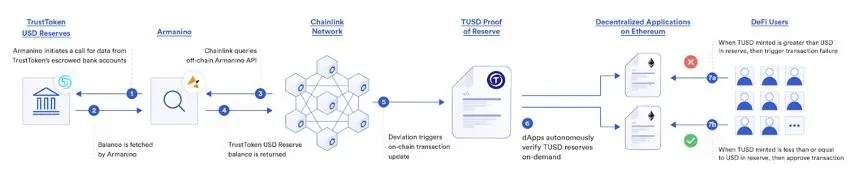
TrustToken employs Chainlink Reserve Proof to give on‑chain evidence of TUSD’s off‑chain fiat backing. The mechanism writes off‑chain asset balances onto the blockchain via decentralized oracles, allowing DeFi protocols to automatically monitor collateral ratios and trigger risk‑mitigation actions when thresholds are breached.
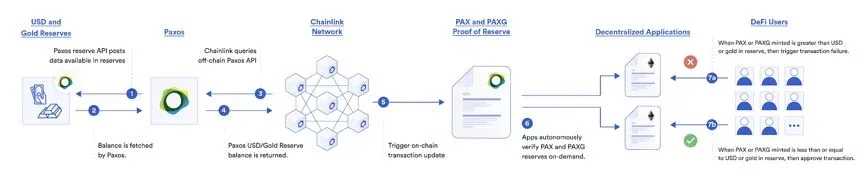
Paxos also integrates Chainlink for PAX (USD‑backed) and PAXG (gold‑backed), delivering tamper‑resistant price feeds and reserve proofs that boost confidence in on‑chain trading.
Neutrino USD (USDN) continuously pings Ethereum contracts and a Waves‑chain off‑chain API via Chainlink, updating its reserve proof in real time. If the balance deviates beyond a preset threshold, an alert is automatically generated.
CBDCs may also rely on Chainlink to obtain trustworthy price inputs for any anchoring assets, ensuring that the issued digital fiat remains price‑stable.
Factors Influencing Stablecoin Price Stability
| Factor | Primary Impact |
|---|---|
| Reserve quality & transparency | High‑quality, auditable assets raise trust; lack of audits weakens the peg. |
| Regulatory environment | Clear compliance rules and supervisory frameworks improve long‑term sustainability. |
| Market confidence | Historical redemption performance and public disclosures shape collective belief. |
| Liquidity & adoption | Deep liquidity creates arbitrage opportunities, preventing isolated events from distorting price. |
| Technical robustness | Smart‑contract security, on‑chain throughput, and oracle availability determine system resilience. |
Summary
Stablecoins achieve a 1:1 correspondence with their reference assets through either reserve‑backed or algorithmic pathways. Chainlink supplies secure, decentralized price feeds and reserve proofs that markedly enhance transparency and trust, thereby supporting healthier growth of the DeFi ecosystem.
*Note:* Crypto transactions, including those involving stablecoins, may generate taxable events in many jurisdictions. Users should consult local tax regulations or professional advisors to understand potential obligations.
For U.S. residents, stablecoin trading on Binance must be conducted via Binance.US rather than the global Binance platform. International users can typically move fiat via SEPA (for EUR) or SWIFT (for USD) transfers when depositing or withdrawing from exchanges.
This concludes the article. For deeper analyses of stablecoins, search for previous Bitaigen (比特根) publications or continue reading related articles below. Thank you for your interest and support!
Related Reading
- Savings USDD (SUSDD): Interest‑Bearing Stablecoin Explained
- United Stables (U) Coin: Stablecoin with AI Payments & Yield
- USDT vs USDT0: Issuance, Cross‑Chain & Liquidity Differences
💡 Register on Binance with referral code B2345 for the maximum trading fee discount. See Binance complete guide.



