
 Bitaigen Research
 We examine the core differences between USDT and the emerging decentralized version USDT0 from three major perspectives: issuance mechanism, cross‑chain implementation, and liquidity architecture. By deeply interpreting their backing methods and technical roadmaps, readers can quickly grasp how each token impacts real‑world usage and obtain reference points for subsequent on‑chain asset allocation.
Overview of USDT and USDT0
USDT is a fiat‑backed stablecoin issued centrally, whereas USDT0 is a decentralized cross‑chain version built on LayerZero. The two differ fundamentally in issuance mechanism, cross‑chain capability, and liquidity‑pool structure.
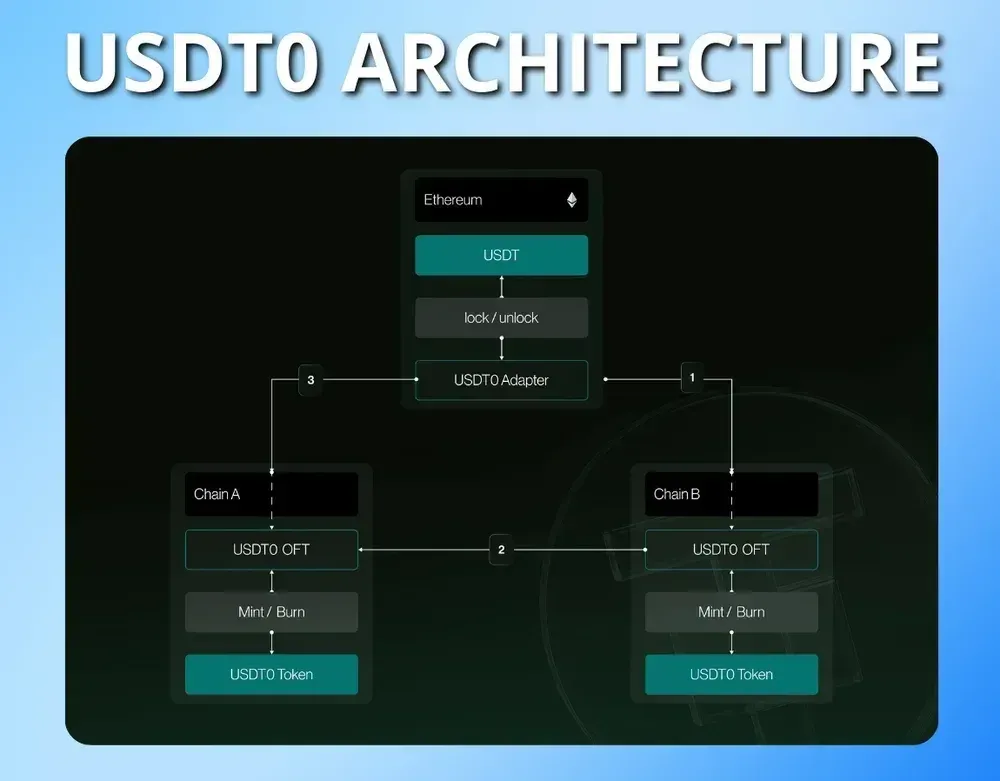
USDT has, since its launch in 2014, become the market‑dominant and most liquid dollar‑pegged stablecoin thanks to the fiat reserves held by Tether Limited. USDT0 was released by Everdawn Labs in 2025, utilizes LayerZero’s cross‑chain technology to eliminate liquidity fragmentation, creates a single unified liquidity pool across all supported chains, and maintains a 1:1 backing through USDT locked on Ethereum.
| **Feature** | **Tether (USDT)** | **USDT0** |
|---|---|---|
| **Issuer** | Tether Ltd. | Everdawn Labs |
| **Launch Year** | 2014 | 2025 |
| **Market Share** | Leading | Emerging |
| **Backing Mechanism** | Fiat reserves (U.S. Treasury bonds, cash equivalents) | USDT locked on Ethereum, maintaining a 1:1 peg |
| **Asset Portability** | Requires manual bridging or transfer via centralized exchanges | Native cross‑chain transfer, no third‑party bridge needed |
| **Token Standard** | ERC‑20, TRC‑20, SPL, etc., chain‑specific versions | Unified omnichain token (OFT) standard usable on all networks |
| **Liquidity Access** | Separate ecosystems per chain, leading to fragmented liquidity | Single global liquidity pool accessible from any supported chain |
| **Minting Source** | Issued directly by Tether | Collateralized by USDT locked on Ethereum |
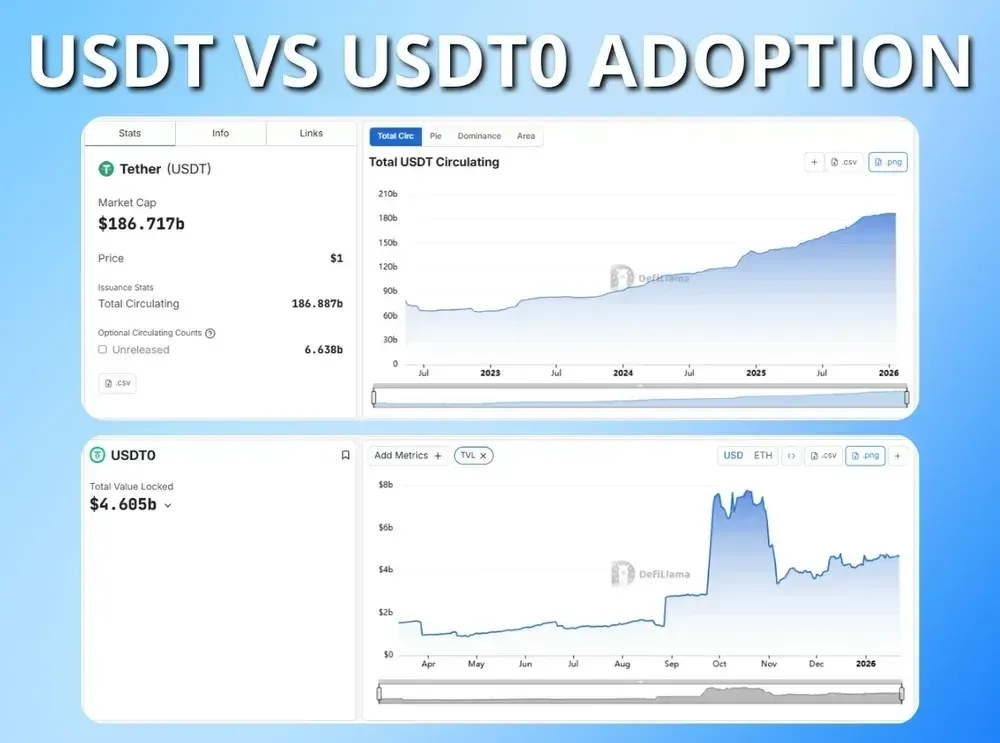
| **Market Capitalization (2026)** | Approximately **$187 billion** | Approximately **$4.7 billion** |
| **Control Logic** | Centralized fund management by the issuing entity | Decentralized protocol governed by smart contracts |
What Sets USDT0 Apart From USDT?
USDT’s reserves are held in centralized banks, and the issuer can manually freeze wallets that appear on a blacklist. USDT0, by contrast, employs a decentralized locking mechanism that places the original USDT into an Ethereum vault, providing collateral support for the cross‑chain version.
- Liquidity Migration Capability – Standard USDT can only circulate on its native chain and must rely on external bridges for other networks. USDT0, built on LayerZero, enables frictionless native cross‑chain transfers, reducing bridge‑related risk.
- Technical Architecture – USDT uses centralized fund management; USDT0 relies on automated smart contracts that support a unified liquidity pool, allowing users to tap deep liquidity on any compatible chain directly.
Networks Supporting USDT and USDT0
According to DefiLlama data, USDT is deployed on more than 100 blockchains, while USDT0 currently focuses on roughly 12 high‑performance networks to deliver faster transaction speeds and lower fees.
Networks Supported by Tether (USDT)
- Ethereum Mainnet – Core of the DeFi ecosystem; gas fees are relatively high.
- Tron – Preferred for low‑cost, fast retail payments.
- Solana – Near‑instant confirmation with ultra‑low fees.
- BNB Smart Chain – Low‑fee entry point within the Binance ecosystem.
- Arbitrum & Optimism – Layer‑2 solutions for Ethereum that combine security with efficiency.
- Polygon (PoS) – Very low‑cost sidechain suitable for small, rapid transfers.
- Avalanche (C‑Chain) – High‑throughput finality, supporting large‑scale financial apps.
- Others – TON, Near, Celo, Tezos, Algorand, EOS, Liquid, Statemine, Gnosis and dozens of emerging chains.
Networks Supporting USDT0
- Ethereum (Collateral Layer) – Base layer where the original USDT is locked.
- Base (Coinbase L2) – Fast, low‑fee L2 geared toward consumer applications.
- Arbitrum One – High‑capital‑density Ethereum Layer‑2 hub.
- Optimism (OP Mainnet) – L2 focused on speed and low transaction costs.
- Polygon zkEVM – Zero‑knowledge proof tech that enhances security and scalability.
- Mantle Network – Modular L2 designed to eliminate transaction bottlenecks.
- Linea (Consensys) – ZK‑Rollup fully compatible with Ethereum tooling.
- Others – Scroll, zkSync, Mode, Manta Pacific, Taiko, and additional LayerZero‑connected networks.
Security Comparison Between USDT and USDT0
USDT relies on a centralized buffer mechanism, holding more than $6.8 billion in excess reserves to absorb market volatility. Its security also depends on the issuer’s ability to manually freeze blacklisted wallets.
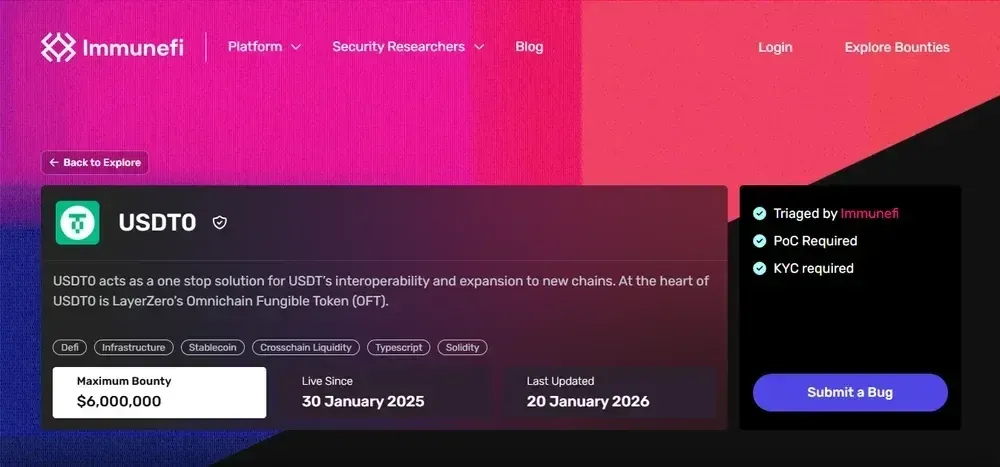
USDT0 leverages LayerZero’s decentralized validator network, raising security to the protocol layer and preventing unauthorized minting. Each token is underpinned by locked Ethereum USDT, and the system includes a $6 million bug‑bounty program together with an OpenZeppelin audit, reducing smart‑contract risk.
Regulatory Landscape for USDT and USDT0
USDT operates under a global regulatory framework, strictly complying with AML and KYC requirements, and holds multiple licences:
- Virtual Asset Service Provider – Registered in the British Virgin Islands.
- FinCEN MSB – Listed as a Money Services Business with the U.S. Financial Crimes Enforcement Network.
- FSRA Approval – Authorized by the Abu Dhabi Global Market Financial Services Regulatory Authority to expand in the Middle East.
USDT0, as a decentralized protocol, does not directly custody fiat but still faces compliance pressures from the EU’s MiCA (Markets in Crypto‑Assets) regulation and emerging U.S. stable‑coin rules. Its “OAdapter” contract embeds a permissioned freeze function to satisfy cross‑chain compliance obligations.
Fee Comparison Between USDT and USDT0
- USDT – Fees are primarily the gas costs of each underlying chain; Ethereum is the most expensive, while Tron and Solana typically stay below $0.01 per transaction. Institutional minting/redemption incurs a 0.1 % fee.
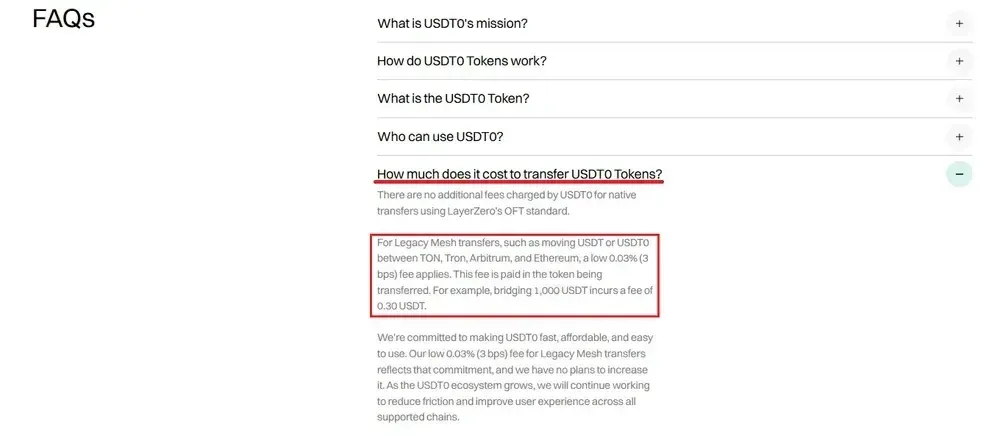
- USDT0 – Native transfers using the OFT standard are fee‑free at the protocol level; cross‑chain “Mesh” transfers (e.g., to TON or Tron) charge 0.03 %, meaning a $1,000 cross‑chain move costs roughly 0.30 USDT.
Where Can I Obtain USDT and USDT0?
- USDT – Centralized exchanges remain the dominant entry points. Platforms such as Bybit, Bitget, OKX, and MEXC offer fiat‑to‑crypto pairs with low slippage. U.S. residents should use Binance.US or other U.S.-regulated exchanges to stay compliant with local regulations.
- USDT0 – Available on decentralized exchanges (DEXes) like Hyperliquid and Uniswap, or via the USDT0.to conversion tool that swaps Ethereum‑based USDT for the omnichain version.
After purchase, it is advisable to store the tokens in self‑custody wallets such as MetaMask, Phantom, or hardware wallets like Ledger, ensuring you retain private‑key control while benefiting from the unified liquidity infrastructure for fast cross‑chain transactions.
Note: Crypto gains may be taxable in many jurisdictions. Users should consult local tax authorities or a qualified tax professional to understand obligations related to USDT or USDT0 transactions.
Adoption Metrics for USDT and USDT0
| Metric | **USDT** | **USDT0** |
|---|---|---|
| **Market Capitalization** | ~**$187 billion** | ~**$4.65 billion** |
| **Daily Trading Volume** | ~**$10.7 billion** | ~**$431 million** |
| **Supported Chains** | 100+ | ~18 |
| **Cumulative Daily Trades** | Millions per day | Over **487,000** trades |
| **Bridge Efficiency** | Requires manual bridging | ~40 seconds native cross‑chain |
| **DeFi Yield** | Aave ~3.37 % APY | Plasma network attracted **$5.9 billion** in two days |
| **Active Users** | Millions of retail users worldwide | ~90,000 advanced DeFi participants |
| **Historical On‑Chain Volume** | ~**$35 trillion** in 2025 | ~**$63 billion** in its first year |
Is USDT Better Than USDT0?
The answer depends on your specific use case. If you prioritize deep liquidity on centralized platforms and the widest possible acceptance of a dollar peg, USDT remains the preferred choice. If you frequently move assets across multiple chains and value low‑friction, high‑speed cross‑chain experiences, USDT0 offers distinct advantages.
Final Thoughts
- Users who need to execute large trades on major exchanges and are concerned about price impact and long‑term storage will find USDT’s mature market depth advantageous.
- Users who operate in a multi‑chain ecosystem and require rapid, low‑cost fund transfers should consider the native cross‑chain capabilities of USDT0.
Choosing between the two ultimately comes down to whether you value USDT’s extensive market coverage or USDT0’s technological speed. For deeper insights, stay tuned to upcoming articles from Bitaigen.
Related Reading
- USDT Explained: How to Safely Purchase the Digital Dollar
- USAT vs USDT 2026: Which Tether Stablecoin Is Right for You?
- Enso (ENSO) Token Economics & Cross-Chain Innovation Explained
💡 Register on Binance with referral code B2345 for the maximum trading fee discount. See Binance complete guide.



