
 Bitaigen Research
 What Is an RWA?
Real‑World Assets (RWA) encompass tangible and intangible value items that exist in everyday life, such as real estate, bonds, commodities, cash, securities, artworks, and intellectual property. Through blockchain technology, these assets can be “tokenized,” meaning the off‑chain ownership or income rights are mapped onto the chain, enabling more efficient trading, transparent supervision, and broader application scenarios.
---
In this article we outline the concept of Real‑World Assets (RWA) and their tokenization pathways on blockchain, analyze why DeFi, after reaching a mature stage, urgently needs a connection to the real economy, and, through case studies and trend analysis, help readers grasp the key drivers that RWAs provide to the Web3 ecosystem while revealing the possible innovation opportunities and risk considerations.
1. The Historical Inevitability of DeFi Breaking the Dimensional Wall
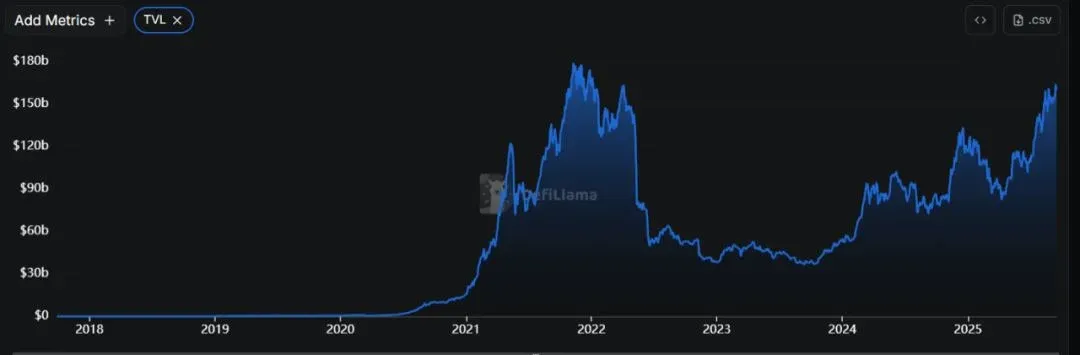
Since 2020, when Compound and Uniswap sparked the DeFi boom, the entire crypto ecosystem entered a rapid expansion phase. The variety and scale of on‑chain assets experienced a swift cold‑start within the native‑asset loop, generating exponential growth. According to DeFiLlama data, at the time of writing the total value locked (TVL) across all DeFi protocols exceeds $160 billion, approaching the historical peak of roughly $178 billion recorded in November 2022.
Within this massive value network, lending and staking protocols such as Aave, MakerDAO, and Lido contribute the bulk of capital, forming the critical infrastructure that countless DeFi “Lego‑style” protocols rely on for survival. It can be said that the credit systems of the overwhelming majority of decentralized exchanges and derivatives platforms are built on top of these foundational lending protocols.
Early DeFi depended on an “internal loop” of native crypto assets, which both satisfied the seed‑fund requirement for ecosystem launch and spurred innovations aimed at improving capital efficiency. However, this model gradually exposed two major limitations:
- Asset Homogenization: Collateral is heavily concentrated in a handful of mainstream tokens, causing systemic risk to amplify with price swings of those core assets and making cascade liquidations more likely.
- Growth Ceiling: DeFi’s scale is bounded by the overall market cap and volatility of the native crypto market, making it difficult to break through its own capacity limit.
Consequently, relying solely on the internal circulation of native assets can no longer sustain further scale expansion. To inject more robust value anchors into DeFi, the focus must shift toward Real‑World Assets—this is the backdrop against which the RWA narrative emerged. RWAs aim to migrate physical assets such as real estate, U.S. Treasury bonds, consumer credit, U.S. equities, and artworks onto the blockchain via tokenization, unlocking liquidity and enhancing transaction efficiency.
Objectively, although DeFi’s total size still lags behind traditional finance, the advent of RWA tokenization offers a new pathway for Web3 to step into a trillion‑dollar‑level market and marks a necessary transition from an “internal loop” to an “external loop” for DeFi’s continued evolution.
---
2. Adding Fuel to the Fire: RWA Practices from Gold to U.S. Equities
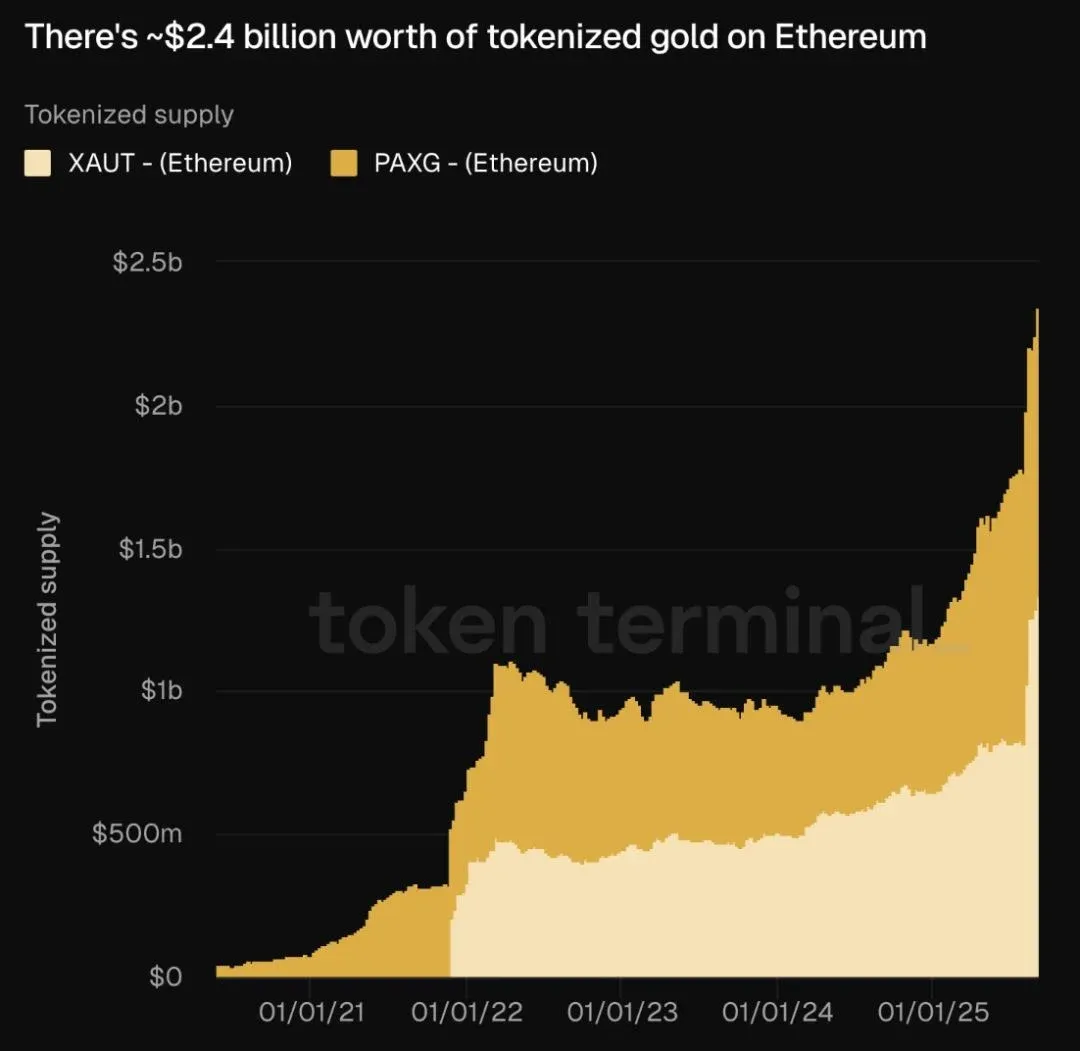
Against the backdrop of mounting demand for RWAs, the market already showcases several concrete implementations, with tokenized gold representing the most mature example. Data from Token Terminal indicate that roughly $2.4 billion worth of gold tokens (including XAUT and PAXG) already exist on Ethereum, and supply has doubled year‑to‑date. This not only reflects user appetite for on‑chain safe‑haven assets but also validates the feasibility of the RWA model.
Traditional financial institutions are accelerating their own involvement as well. The *Financial Times* reported that the World Gold Council (WGC) is actively exploring an officially recognized digital gold standard, aiming to create a unified digital layer for gold so that future financial products can be built atop it. If successful, this could have profound implications for the $900 billion physical gold market centered in London. While tokenized gold remains in its infancy compared with the $231 billion gold‑ETF market and the $27.4 trillion total physical gold valuation, its growth potential should not be underestimated.
Beyond gold, tokenizing U.S. Treasury bonds, U.S. equities, and other conventional financial assets is rapidly becoming a hot spot on the RWA track. Take Ondo Finance as an example: the project has already brought short‑term U.S. Treasury yields onto the chain, offering crypto users a compliant and relatively stable income stream. Simultaneously, tokenized U.S. stocks are expanding quickly—from on‑chain trading of Apple, Tesla and other tickers to 24/7 global participation. Projects such as Robinhood, MyStonks, and Ondo Finance are actively building this infrastructure. Mainstream Web3 wallets are beginning to support these assets; for instance, imToken now allows users to hold and manage stock tokens issued by Ondo Finance, with the tokens’ value anchored to real shares and custodianship provided by top‑tier institutions like J.P. Morgan, ensuring regulatory compliance and security.
Whether it is the already‑scaled gold tokens or the nascent stock tokens, RWAs have moved from peripheral experiments to a mainstream narrative, becoming a fresh growth engine for the DeFi ecosystem.
---
3. RWA: Crypto’s Historic Express Train
From a data‑driven perspective, RWAs are regarded as the most promising “blockchain‑plus” direction for the next decade. Statistics from the RWA research platform rwa.xyz show that the current RWA market size is approaching $30 billion, and BlackRock forecasts that the market cap of tokenized assets could reach $10 trillion by the 2030s. In other words, within the next seven years the RWA narrative could potentially expand by over 300×.
These forecasts rest on a solid foundation: the total global value of Real‑World Assets—real estate, equities, bonds, credit, etc.—runs into the hundreds of trillions of dollars. Even if only a tiny fraction of this pool becomes tokenized, the resulting inflow would represent an unprecedented injection of value into blockchain ecosystems.
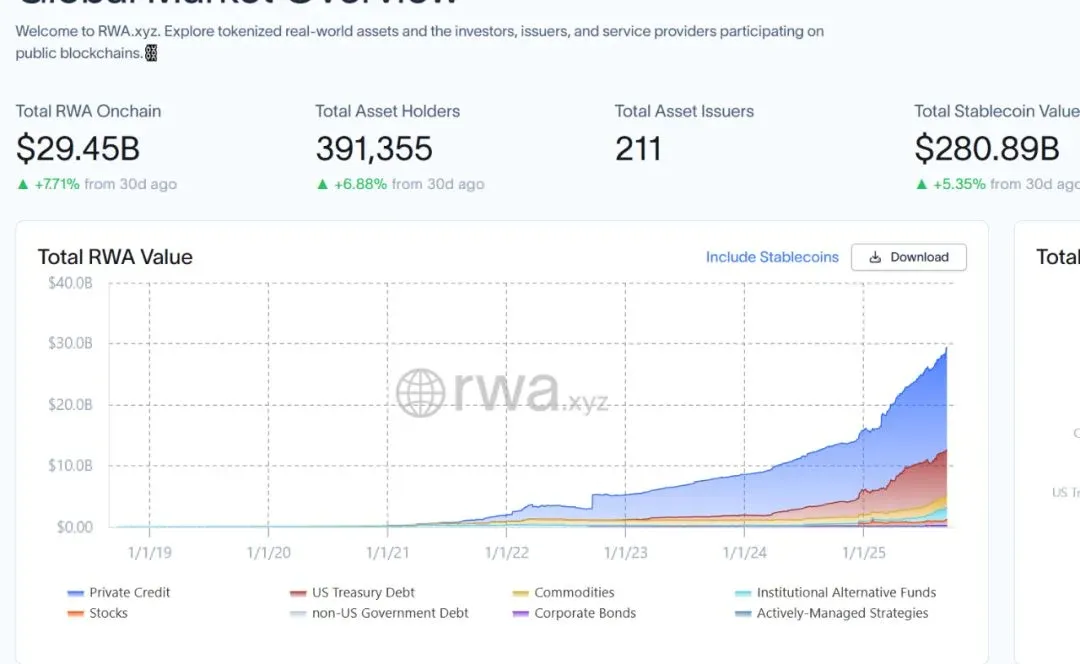
Within this capital‑migration wave, Ethereum, thanks to its technical maturity, asset security, and comprehensive DeFi ecosystem, stands as the central stage. Ethereum co‑founder Joseph Lubin has explicitly stated that RWAs will be one of the key engines driving Ethereum’s growth over the next ten years. Whether it is tokenized U.S. Treasury bonds (e.g., Ondo Finance) or on‑chain financing of private credit (e.g., Centrifuge), various RWA projects are blooming simultaneously.
The significance of RWAs goes far beyond merely putting assets on chain; it signals a deep transformation of the financial paradigm and may simultaneously reshape the underlying structures of DeFi and traditional finance:
- For DeFi, RWAs introduce stable, low‑correlation, cash‑flow‑generating high‑quality collateral, reducing systemic risk while enhancing asset diversity and market depth.
- For traditional finance, tokenization can unlock illiquid assets (such as real estate or private‑equity holdings), fragment ownership, and enable efficient transfer, dramatically improving capital utilisation.
- For the broader ecosystem, Ethereum is gradually evolving into a “global unified settlement layer,” providing the infrastructure needed for cross‑chain and cross‑asset value flows.
Fundamentally, RWAs represent an incremental‑capital narrative: they not only supply DeFi with sturdier collateral but also mark the first deep‑level convergence between the blockchain world and the real‑world financial system. It is reasonable to anticipate that over the next decade RWAs could become the pivotal turning point for crypto to achieve mainstream adoption and integrate with the real economy.
Note: Crypto gains may be taxable in many jurisdictions. Users should consult local tax regulations and consider reporting obligations, especially when dealing with tokenized real‑world assets that generate income or capital appreciation.
Practical Considerations for Global Users
- When converting fiat to crypto, use USD for dollar‑denominated transactions, and employ SEPA or SWIFT for cross‑border transfers.
- U.S. residents must access Binance.US rather than the global Binance platform to remain compliant with local regulations.
- Always verify that the custodial entity behind a tokenized asset (e.g., J.P. Morgan for stock tokens) is recognised under the relevant jurisdiction’s compliance framework.
By keeping these points in mind, participants can responsibly explore the expanding RWA landscape while aligning with both blockchain innovation and traditional financial safeguards.
Related Reading
- Ethereum Gas Fees Explained: Base & Priority Fees
- RWA 2026 Guide: Mechanisms, Top Projects & Risk Analysis
- Ethereum Smart Contracts: Benefits, Risks, and Challenges
💡 Register on Binance with referral code B2345 for the maximum trading fee discount. See Binance complete guide.



