
 Bitaigen Research
Under the current Basel III regulatory framework, banks are required to allocate a capital buffer that corresponds to the risk weight of each asset they hold. For Bitcoin and other digital assets, the rule assigns a 1,250 % risk weight, forcing banks to set aside an amount of capital equal to the full book value of every Bitcoin they hold. By contrast, investment‑grade corporate bonds carry a risk weight of only 75 %, while gold, sovereign bonds and physical cash are treated as 0 % risk assets.
“The Federal Reserve has just released a proposal to implement these rules in the United States and has opened a 90‑day public comment period. Even a modest improvement in the regulatory treatment of Bitcoin could eventually allow banks to formally incorporate Bitcoin into their financial‑services offerings.”
— Nick Parkin
Market analyst Nick Parkin further notes that the latest Basel III amendment is slated to take effect in 2026. Should Bitcoin receive a more lenient risk rating under the new regime, a substantial influx of liquidity is expected, potentially boosting the funding environment for the Bitcoin market in a noticeable way.

Source: Nick Parkin
In February of this year, senior executives from the digital‑asset industry called for a reform of the Basel rules, advocating for a lower risk weight for digital assets so that banks could engage more actively in the blockchain economy.
In this article we outline the possible shift in Bitcoin regulatory stance resulting from the latest Basel III revisions, analyze how a relaxation of the risk weight could redirect bank capital toward digital assets, and discuss the potential impact on market liquidity. The details are worth watching, so please continue reading.
Basel Rules Create Another Bottleneck
The Basel Committee on Banking Supervision (BCBS) placed cryptocurrencies in the highest‑risk category in 2021, explicitly defining the stringent capital requirements that apply to them. Jeff Walton, Chief Risk Officer at Strive, explained: “Under the current framework, Bitcoin and other cryptocurrencies are assigned a risk weight of 1,250 %, whereas investment‑grade corporate bonds of comparable size are only 75 %.” He added that gold, sovereign bonds and physical cash carry a 0 % risk weight, which he described as a “risk‑pricing imbalance.”
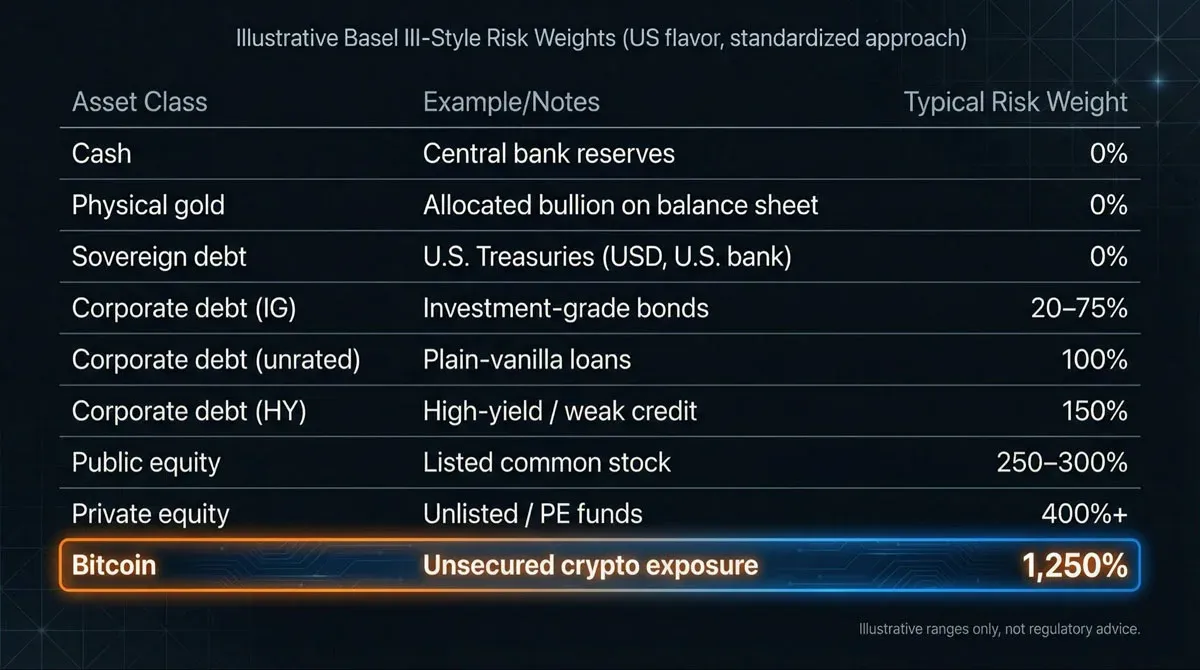
Illustration of risk‑weight allocations for different asset classes under the Basel III framework. Source: Jeff Walton
CoinFund President Chris Perkins told Cointelegraph that Basel’s capital requirements act as a subtle suppressive mechanism. Compared with the decentralisation shock generated by “Bottleneck 2.0,” these requirements curb the crypto industry’s development more through cost pressures. “It’s a very nuanced form of suppression; by making the cost of banking‑related activities extremely high, it indirectly limits the mainstream adoption of crypto assets,” Perkins said.
In summary, if the forthcoming Basel revisions lower the risk weight assigned to Bitcoin, the BTC market could experience a “massive” liquidity boost. For a deeper dive into how Basel rule changes may affect Bitcoin liquidity, stay tuned to Bitaigen’s (比特根) upcoming coverage.
*Note: When dealing with fiat transactions, the global market typically uses USD transfers via SEPA (for Euro‑zone) or SWIFT. U.S. users wishing to trade on Binance must use Binance.US rather than the global Binance platform.*
*Tax disclaimer: Cryptocurrency gains may be subject to taxation in your jurisdiction; consult a qualified tax professional for advice.*
💡 Register on Binance with referral code B2345 for the maximum trading fee discount. See Binance complete guide.



