
 Bitaigen Research
 In this article we examine the recent shift of Bitcoin’s funding rates into negative territory, combine the insights of K33 analysts, discuss whether this phenomenon may signal that the market is approaching a bottom, and provide key reference factors for judging entry timing, helping readers form a clearer investment perspective amid volatility.

Since September, Bitcoin’s price has still not broken the USD 60,000 threshold. The funding‑rate heat map from Coinglass (the figure below shows days when the funding rate is negative) indicates that over the past six months the funding rate has been positive for the majority of the time, turning negative only in April, August and September. A negative funding rate means the overall market sentiment is bearish, and short‑position holders must pay a fee to long‑position holders.
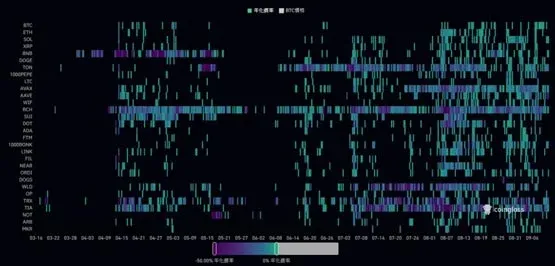
Funding rates are a mechanism used by perpetual‑contract exchanges to keep the contract price aligned with the spot price of the underlying asset. By adjusting the rate, the platform can make either longs or shorts incur a cost, nudging the contract price back toward the spot price. When overall sentiment is bearish, the rate usually turns negative, causing shorts to pay longs.
Crypto research firm K33 Research
K33 Research released a report on the 10th of the month stating that, although some investors remain concerned that Bitcoin could continue to decline, the funding‑rate metric—a relatively reliable indicator—suggests that a noticeable rebound may occur in the near term and possibly extend over the coming months. The report notes that the correlation between Bitcoin and the S&P 500 has risen to its highest level in the past 23 months, indicating that macro‑economic factors remain the primary driver of market momentum ahead of the first interest‑rate cut. At the same time, the persistent bearish sentiment in the perpetual‑contract market is emitting a rare and strong signal.
The report further points out that the 30‑day average funding rate for perpetual contracts has fallen into negative territory. Since 2018, this has happened only six times. K33’s analysts summarize: “Historically, whenever the monthly funding rate turns negative, the market is typically already near a bottom.” Based on statistical data from similar past episodes, the average return within 90 days after the funding rate goes negative can reach 79 %, with a 55 % return specifically over the 90‑day window.
Meanwhile, as short positions gradually increase, the open‑interest of derivatives contracts has risen to the highest level since late July. Analysts believe that this funding‑rate environment provides a fairly strong basis for actively building Bitcoin exposure over the next several months.
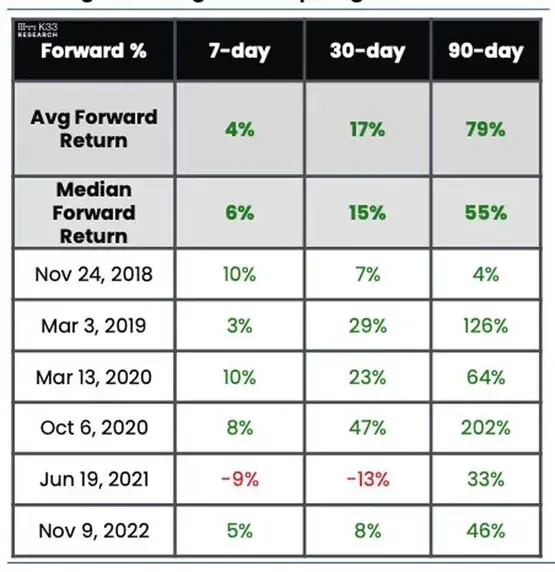
30‑day average funding rate turns negative – BTC price performance (K33 Research)
K33 analyst Vetle Lunde added on Twitter that this is the fifth occurrence of a monthly average funding rate turning negative since January 2020. In the previous four instances, three of the negative periods lasted between 1.5 and 2 months.
The above content outlines whether Bitcoin’s shift to a negative funding rate constitutes an entry opportunity and presents K33 analysts’ view that the market may have already bottomed. For more information on K33 Research, please follow the coverage from Bitaigen (比特根).
Additional notes for a global audience
- Fiat transactions are typically processed via USD wire transfers (SWIFT) or SEPA where applicable.
- U.S. residents should use Binance.US rather than the global Binance platform.
- Crypto gains may be subject to tax in the holder’s jurisdiction; readers should consult local tax regulations or a professional advisor.
Related Reading
- Bitcoin Negative Funding Rate May Push BTC to $90K
- Buy Bitcoin on OKX 2026: Beginner’s Step‑by‑Step Guide
- Bitcoin Perpetual Contracts Funding Rate Explained
💡 Register on Binance with referral code B2345 for the maximum trading fee discount. See Binance complete guide.



