
 Bitaigen Research
 Bitcoin’s price swings since the first block in 2009 have often been driven by the four‑year Halving mechanism. With the launch of spot ETFs and rapid shifts in the macro‑economic landscape, a heated debate has emerged over whether this traditional pattern still holds. This article sets aside sentiment, relying solely on on‑chain data, historical trends, and newly emerging market variables to systematically dissect the post‑halving price evolution, offering investors a more objective reference framework.

In this paper we focus on Bitcoin’s market behavior after each halving, combining on‑chain metrics with macro variables to objectively assess whether the four‑year cycle remains a useful guide. Through systematic charts and case studies, readers can clarify the potential direction of the current phase and obtain a reference point for subsequent decisions.
4. Where Are We in the Cycle Right Now?
If we apply the historical average (approximately 530 days from halving to peak) to the current market, the timeline for this Bitcoin cycle looks roughly as follows:
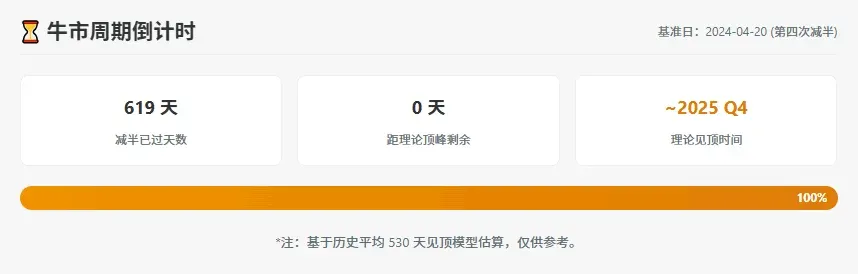
Risk Warning: All models based on historical data have limitations. Macro‑policy shifts (e.g., Federal Reserve rate moves), regulatory surprises, or global liquidity tightening can instantly break established trajectories. Do not base a full‑position trade on a single calendar date.
1. Code Is Law: How Halving Creates Supply‑Demand Shock
Bitcoin’s core driver is a supply shock. Unlike fiat currencies, which can be printed at will, Bitcoin’s total issuance is hard‑coded. The halving mechanism reduces block rewards by 50 % every 210,000 blocks (approximately every four years) until the capped supply of 21 million BTC is reached.

2. History Does Not Repeat, but It Often Rhymes
Reviewing the price performance after the first three halvings reveals several clear commonalities. Although each rally’s magnitude shows a diminishing‑return trend (i.e., a “decreasing ROI” effect), the basic direction of price appreciation after a halving has remained unchanged.
| Halving Date | Price at Halving | Cycle‑Peak Price | Days from Halving to Peak | Cycle Multiple (ROI) |
|---|---|---|---|---|
| 2012‑11‑28 | $12 | $1,130 | 369 days ≈ 93× | 93× |
| 2016‑07‑09 | $650 | $20,000 | 518 days ≈ 30× | 30× |
| 2020‑05‑11 | $8,800 | $69,000 | 549 days ≈ 7.8× | 7.8× |
| 2024‑04‑20 | $64,000 | TBD (???) | Ongoing… | TBD |
Data Insights
- Cycle Lengthening: The interval from halving to peak has grown (369 → 518 → 549 days).
- Diminishing Returns: As market cap expands, the capital required to double the price rises exponentially, making a lower ROI per cycle an economically sensible outcome.
3. This Cycle’s “Black Swan”: ETFs and Institutional Entry
The 2024 halving differs from previous ones in that Bitcoin had already broken its all‑time high (ATH) before the event—a first in halving history. The key catalyst for this anomaly is the approval of a U.S. spot Bitcoin ETF, which has ushered in large‑scale institutional buying.
Potential Impacts
- Left‑Side Cycle: Traditionally, the peak is expected 12‑18 months after the halving. Early institutional inflows could shift the apex forward.
- Volatility Smoothing: Ongoing institutional accumulation makes Bitcoin behave more like a mature financial asset, potentially narrowing extreme price swings.
Appendix: Core Terminology for Crypto‑Cycle Analysis
The following glossary explains the professional terms that appear throughout this report, helping readers grasp the underlying logic.
Stock‑to‑Flow Model (S2F)
A scarcity‑quantification framework introduced by PlanB that calculates the ratio of existing supply (Stock) to annual new supply (Flow). While its price‑prediction power remains debated, it illustrates how halving increases scarcity and can support long‑term upward pressure.
Miner Capitulation
If Bitcoin’s price does not quickly compensate for the reduced block reward after a halving, less‑efficient miners may be forced to shut down or sell their holdings. This process often signals a localized bottom.
Bitcoin Halving Cycles
The four‑year production‑reward cut is the central timing node for Bitcoin’s bull‑bear oscillations, typically divided into accumulation, bull‑run launch, mania, and bear‑market correction phases.
Pi Cycle Top Indicator
A historically precise top‑signal tool that uses the crossing of the 111‑day moving average with twice the 350‑day moving average.

Frequently Asked Questions (FAQ)
Does Bitcoin always surge after a halving?
Historical data show a tendency for post‑halving price appreciation, but the rise is rarely instantaneous. Typically, a “miner capitulation” phase and a 3‑6 month sideways consolidation occur first. Once the market absorbs sell pressure and demand remains steady, the supply shock can translate into upward price movement.
What is the “Supercycle” theory?
This viewpoint argues that deep institutional participation (e.g., ETFs) could free Bitcoin from the strict four‑year rhythm, ushering in a longer, smoother, equity‑market‑like upward trajectory. If validated, deep bear markets would become less frequent.
When might the current bull market end?
Based on past experience (518‑549 days after halving), the peak could land around September‑October 2025. However, the front‑loading effect of ETF capital has led some analysts to project a high point as early as the first half of 2025. Monitoring Federal Reserve liquidity policy changes is more insightful than merely watching the calendar.
What does a Bitcoin halving mean for altcoins?
In the early halving phase Bitcoin often outperforms, while altcoins lag. Only after Bitcoin breaches a new high and settles into a high‑level range do funds typically flow into Ethereum and other altcoins, initiating a so‑called “alt‑season.” Consequently, holding BTC around the halving tends to outperform most altcoins.
How should long‑term holders leverage the four‑year cycle?
The core principle is “go with the flow.” Dollar‑cost average during the late‑bear/accumulation phase (roughly the year before the halving). Hold through the first ~18 months post‑halving (the launch phase). When the market reaches the mania stage and FOMO spikes, consider partial profit‑taking and retain cash for the next cycle’s bottom.
---
*Note: Cryptocurrency gains may be taxable in your jurisdiction; consult local tax regulations or a professional advisor.*
*For U.S. residents, trading on Binance’s global platform is not permitted; use Binance.US or another regulated U.S. exchange.*
This concludes a deep‑dive analysis of the current relevance of Bitcoin’s four‑year cycle theory. For further research on this topic, stay tuned to Bitaigen’s upcoming reports.
Related Reading
- Bitcoin Approaches $70K as Fed Rate‑Cut Hopes Fade
- Standard Chartered Spot ETF Outlook: SOL, XRP & Crypto
- Bitcoin Price Forecast 2026: Long‑Term Trend, Halving Cycle
💡 Register on Binance with referral code B2345 for the maximum trading fee discount. See Binance complete guide.



