
 Bitaigen Research
When the funding rate of perpetual contracts falls into negative territory, short positions face fee pressure and are forced to cover, strengthening the buying side, and the price could be pushed up to roughly $90,000 in the short term.
A negative Bitcoin funding rate and a large short‑liquidity zone may indicate a brief squeeze, potentially breaking above $90,000 or even higher.
Bitcoin began to consolidate and recover after last week’s deep pullback; after falling from $106,000 to $80,600 over ten days, it is now climbing back into the $87,000‑$90,000 range. This rebound has reignited the debate over whether Bitcoin has already bottomed, even though a group of key whales continues to offload supply.
In this article we outline recent market signals from Bitcoin perpetual contract funding rates turning negative, analyze the potential buying pressure from short covering, and combine on‑chain whale holdings with retail activity to provide a multi‑dimensional view of the upcoming market trajectory, helping you capture potential opportunities.
Key Points
- Bitcoin whales and retail investors remain net sellers overall, but mid‑size holders continue to accumulate.
- Accumulation‑address demand hit a record 365,000 BTC, showing a resurgence of long‑term confidence.
- Negative funding rates suggest traders are capitulating, which could trigger a short squeeze.
Bitcoin Distribution Meets Slow Accumulation Trend
On‑chain data show that the market is currently driven by an imbalance among different participant groups. Wallets holding more than 10,000 BTC, as well as institutional groups with 1,000‑10,000 BTC, have maintained a stable distribution during the decline, resulting in structural weakness. Retail wallets holding fewer than 10 BTC have also been net sellers over the past 60 days, offering limited support.
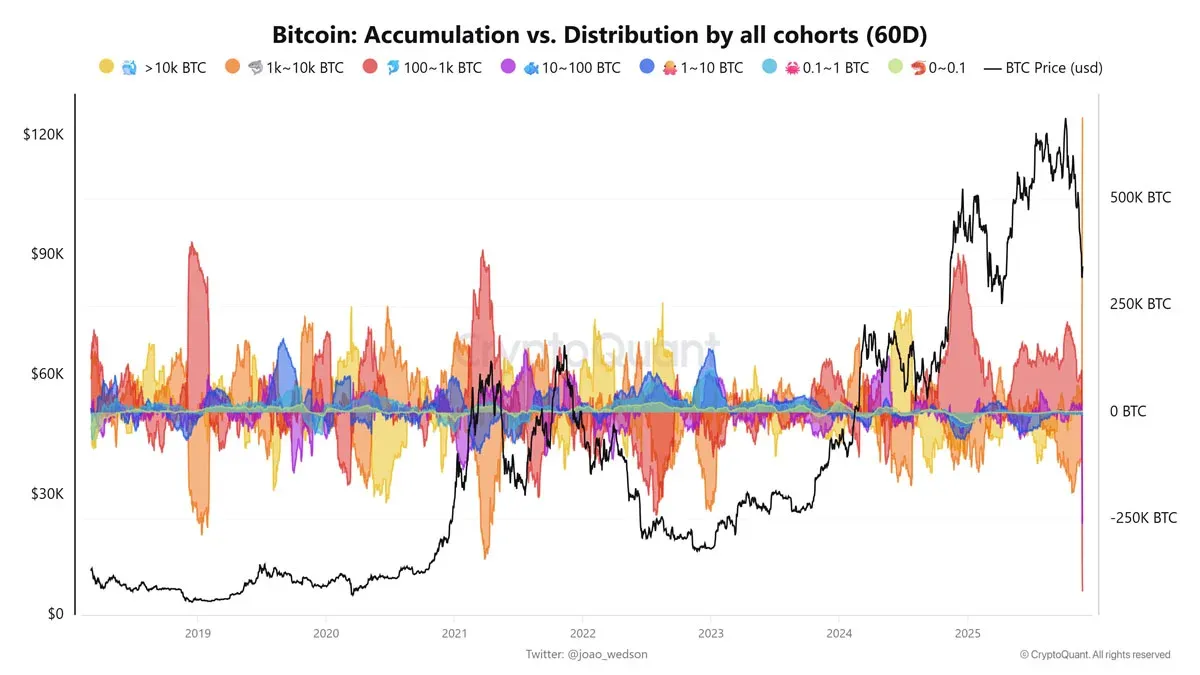
Bitcoin accumulation and distribution across participant groups (source: CryptoQuant)
In contrast, holders in the 10‑100 BTC and 100‑1,000 BTC ranges have continued to accumulate during this correction, absorbing some of the selling pressure. On November 23, Bitcoin “accumulation address” demand rose to a historic high of 365,000 BTC (up from 254,000 BTC on November 1), indicating a significant increase in activity among these groups, reflecting
---
*For U.S. residents, cryptocurrency trading on Binance must be conducted via Binance.US rather than the global Binance platform. Fiat deposits and withdrawals in the global market typically use USD, SEPA, or SWIFT channels.*
Related Reading
- Buy Bitcoin on OKX 2026: Beginner’s Step‑by‑Step Guide
- Bitcoin Perpetual Contracts Funding Rate Explained
- Buy Bitcoin with USDT: Simple Step‑by‑Step Guide
💡 Register on Binance with referral code B2345 for the maximum trading fee discount. See Binance complete guide.



