
 Bitaigen Research
Bitcoin has experienced a fourth historical episode of extreme oversold conditions relative to gold, and technical indicators suggest the possibility of triggering a new super‑bull market. Consequently, with improving macro‑liquidity and supportive policy measures, BTC could commence a rapid rally over the coming months.
“As long as you don’t invest in crypto, everything else can make money.”
Recently, the crypto market has shown a stark polarization compared with other global asset classes.
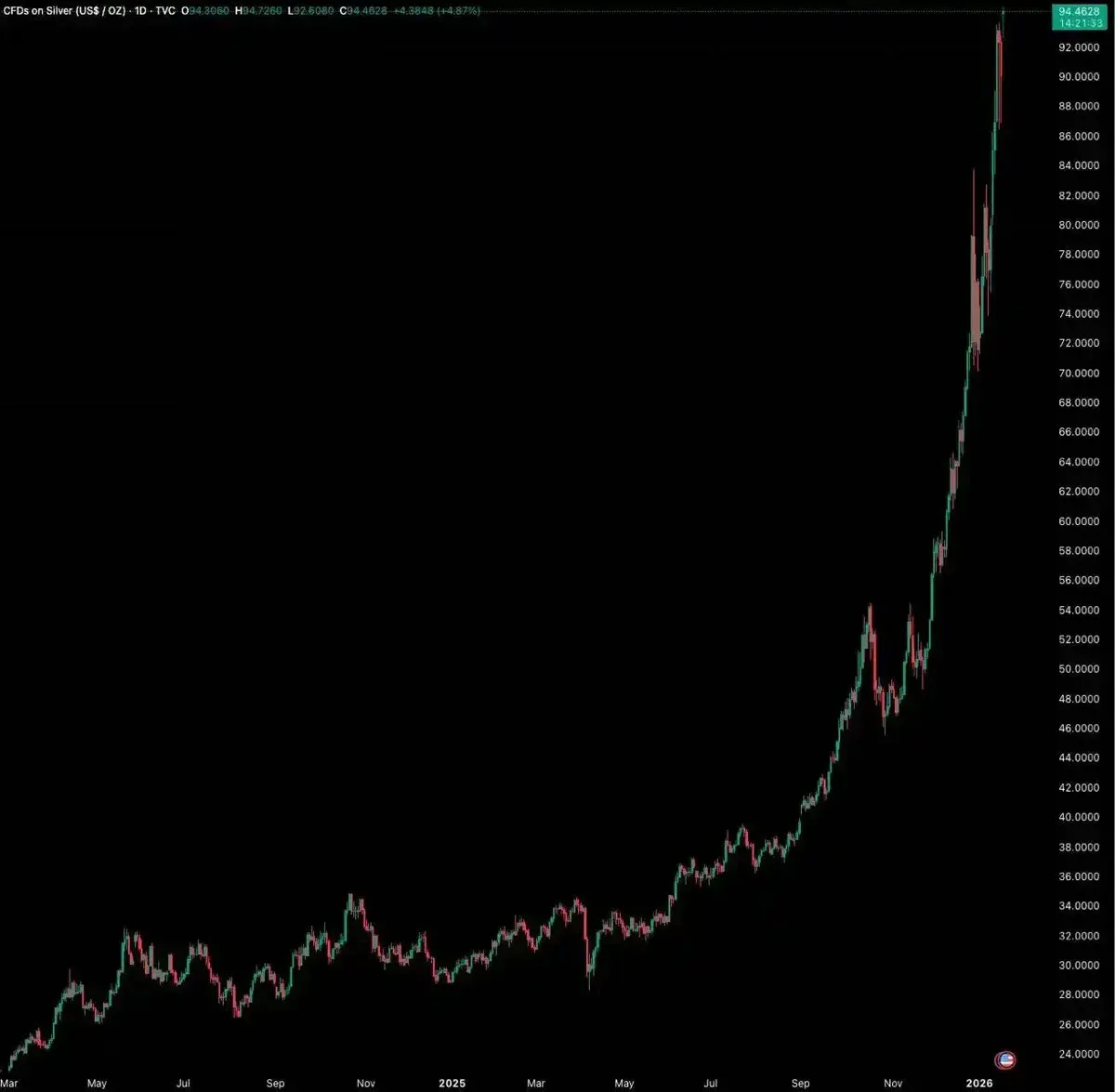
- 2025: Gold rose more than 60 %, silver surged 210.9 %, and the U.S. Russell 2000 index gained 12.8 %.
- Bitcoin: After briefly hitting a new high, the annual chart closed in the red.
Entering 2026, the divergence intensified. On January 20, gold and silver set fresh all‑time highs; the Russell 2000 outperformed the S&P 500 for 11 consecutive days; China’s STAR 50 index posted a month‑over‑month gain of over 15 %. By contrast, Bitcoin fell for six straight days from January 21, sliding from $98,000 to below $90,000.
Shift in Capital Flows
Since the end of 2024, capital has been exiting the crypto space in large volumes. BTC has been trading below $100,000 for three months, entering a period of historically low volatility. Investor sentiment turned broadly pessimistic, giving rise to the “ABC” mindset—Anything But Crypto—meaning that any asset other than crypto is expected to generate profit.
The previous wave of optimism around “Mass Adoption” was not defined by the proliferation of decentralized applications, but rather by Wall Street’s deep asset‑ization of crypto. The shift in stance by U.S. regulators and financial giants manifested in several concrete actions:
- The SEC approved a spot ETF
- BlackRock and JPMorgan added Ethereum exposure to their portfolios
- The United States incorporated Bitcoin into its national strategic reserves
- Multiple state pension funds allocated a portion of their assets to Bitcoin
- The NYSE announced plans to launch a cryptocurrency trading platform
Despite these developments, Bitcoin remained lackluster even as precious metals and equities simultaneously reached new peaks. Why has Bitcoin failed to climb in tandem with the broader U.S. equity rally, despite strong institutional endorsement?
By reviewing Bitcoin’s four historical episodes of extreme oversold conditions, and by combining current macro‑liquidity and policy factors, we dissect the potential signals embedded in technical indicators and assess whether BTC is poised to launch a fresh bull market. This article offers a panoramic view to help you spot possible price inflection points and is worth a careful read.
Why Is Bitcoin Underperforming?
1. Leading‑Indicator Character
Bitcoin is often regarded as a leading indicator for global risk assets. Real Vision founder Raoul Pal has repeatedly emphasized that Bitcoin’s price is primarily driven by worldwide liquidity, with comparatively little direct influence from any single nation’s earnings reports or interest‑rate decisions. Its movements tend to precede those of major indices such as the Nasdaq.
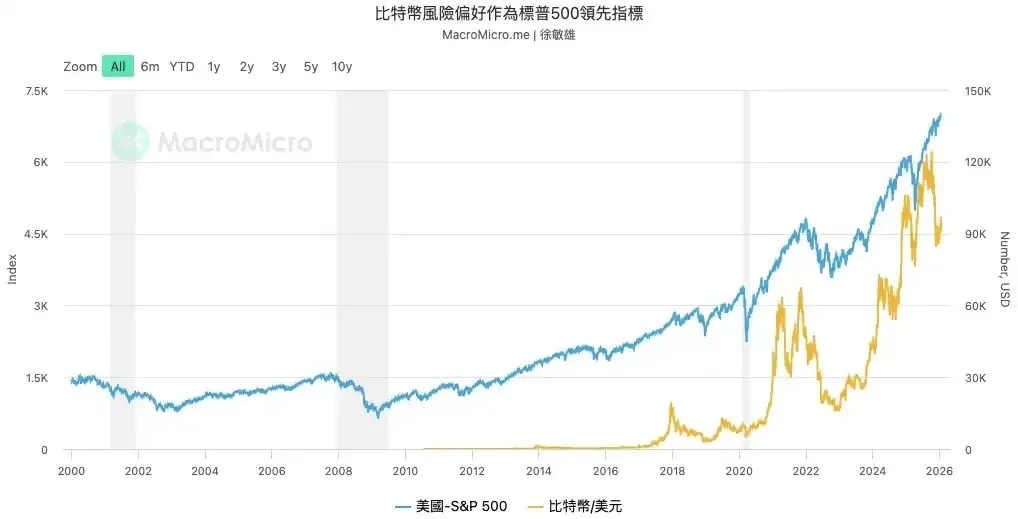
MacroMicro data show that over the past few years, Bitcoin’s turning points have frequently preceded those of the S&P 500. When Bitcoin’s upward momentum stalls, it often foreshadows a weakening of momentum in other risk assets as well.
2. Global Liquidity Tightening
Bitcoin’s price remains tightly linked to global net U.S. dollar liquidity. Although the Federal Reserve cut rates during 2024‑2025, the quantitative tightening (QT) program that began in 2022 continues to drain liquidity from the markets. The 2025 Bitcoin high was largely fueled by fresh inflows from ETFs, but it did not alter the underlying tight‑liquidity environment.
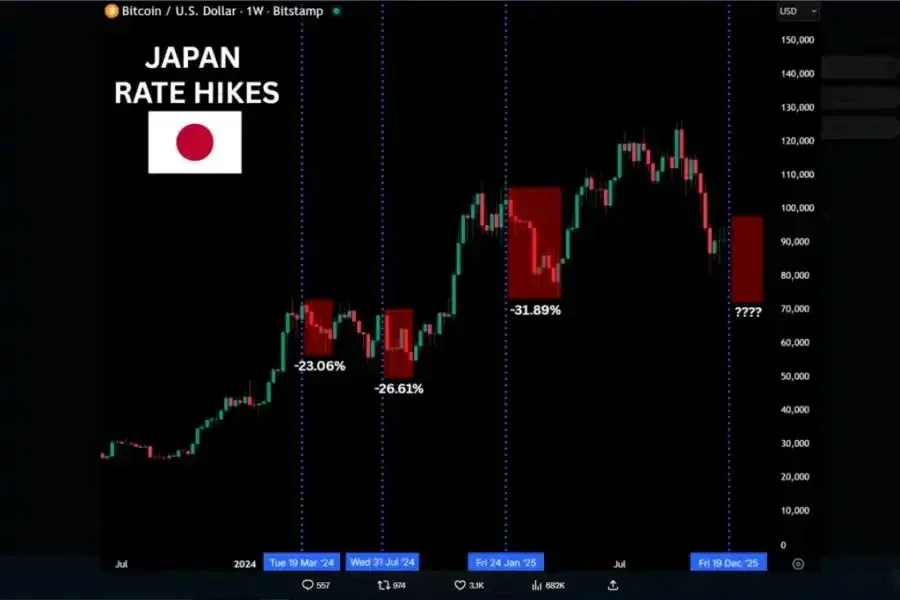
At the same time, the world’s second‑largest source of liquidity—the Japanese yen—has also been contracting. In December 2025, the Bank of Japan raised its short‑term policy rate to 0.75 %, a 30‑year high, curbing carry‑trade funding. Historical data reveal that each of the three rate hikes Japan implemented since 2024 coincided with Bitcoin drops exceeding 20 %; the simultaneous tightening of both the dollar and yen further compresses global liquidity.
3. Geopolitical Uncertainty
Early 2026 saw a series of unilateral actions by the Trump administration that heightened global political risk, including a military incursion in Venezuela, a potential clash with Iran, an attempted acquisition of Greenland, and tariff threats toward the European Union. These moves pushed great‑power relations into a “gray zone,” replacing expectations of a full‑scale hot war with a patchwork of localized conflicts and “unknown unknowns.”
Domestically, Trump proposed renaming the Department of Defense to the Department of War and deployed troops to quell domestic protests, further inflaming internal political tensions. Such high‑pressure environments encourage institutional investors to hold cash and adopt a wait‑and‑see stance rather than allocate capital to the high‑volatility Bitcoin.

Why Are Other Assets Still Rising?
Precious metals, U.S. equities, and China’s A‑shares have all posted strong performance since 2025, but their gains stem less from macro‑liquidity improvements and more from sovereign will and industrial policy driven structural trends.
- Gold: Central banks view it as a hedge against cracks in the U.S. dollar system. According to the World Gold Council, global central banks purchased a net >1,000 tonnes of gold in both 2022 and 2023, setting a historic record. The primary driver of gold’s rise is official buying, not speculative market activity.
- U.S. equities: The CHIPS and Science Act elevated artificial intelligence to a national‑security priority, shifting capital from mega‑cap tech stocks to policy‑aligned mid‑ and small‑cap growth firms.
- China A‑shares: Capital is concentrated in “Xinchuang” (indigenous innovation) and “defense‑industrial” sectors that are closely tied to national security and industrial upgrading. A government‑led rally follows a fundamentally different pricing logic than Bitcoin, which relies almost entirely on market‑driven liquidity.
Will History Repeat Itself?
Bitcoin’s divergence from other assets is not unprecedented; each prior divergence eventually culminated in a strong Bitcoin rebound. The RSI (Relative Strength Index) of Bitcoin relative to gold has breached the extreme oversold threshold of 30 on four occasions:
| Year | Oversold Trigger | Subsequent Performance |
|---|---|---|
| 2015 | RSI < 30 | 2016‑2017 super‑bull market |
| 2018 | RSI < 30 | Cumulative rebound > 770 % starting 2020 |
| 2022 | RSI < 30 | Outperformed gold again |
| 2025 | RSI < 30 | Entered the fourth oversold zone |
In 2025, gold surged 64 % while Bitcoin’s RSI relative to gold re‑entered oversold territory. Historically, such signals have preceded notable price recoveries.
Is Chasing Other Assets a Wise Move?
During the “ABC” craze, hastily dumping Bitcoin in favor of other markets carries non‑trivial risk.
- Russell 2000: Since its 2025 trough, the index has risen over 45 %, but many constituents are low‑profit, rate‑sensitive firms. A shift in Fed policy could quickly expose their fragility.
- AI sector: Companies like Nvidia and Palantir are trading at historic valuation peaks, and the sector’s high energy consumption could spark a new inflationary wave, prompting central banks to tighten further and potentially burst an AI‑related bubble. Both Deutsche Bank and Bridgewater founder Ray Dalio have flagged an AI bubble as the biggest risk for 2026.
- Investor sentiment: A Bank of America survey in January showed global investor optimism hitting its highest level since July 2021, while cash holdings fell to a historic low of 3.2 %. Defensive positioning is at its weakest since January 2018.
Against a backdrop of sovereign‑driven asset appreciation, heightened investor optimism, and escalating geopolitical friction, Bitcoin’s “stagnation” should not be read merely as “under‑performance.” It functions more as an early warning of macro‑risk, accumulating strength for the next major narrative shift.
For true long‑term believers, this period is a crucial test of conviction, a chance to resist temptation, and an opportunity to prepare for the forthcoming cycle of challenges and opportunities.
The above provides a complete analysis of “History repeats for the fourth time—Will Bitcoin (BTC) launch a new super bull market?” For more information on a potential new Bitcoin super bull market, please explore other articles from Bitaigen.
---
Related Reading
- Tariff Pause Shifts Capital, Bitcoin Falls, Crypto Outlook
- US CPI Drops to 2021 Low, Bitcoin Seeks Liquidity
- Gold Hits $5,080 Historic High as Bitcoin Slides to $86K
💡 Register on Binance with referral code B2345 for the maximum trading fee discount. See Binance complete guide.



