
 Bitaigen Research
In this article we combine the views of BTCC analysts to outline the latest shifts in Bitcoin market sentiment, policy developments, and key technical indicators. By deeply analysing signals such as moving averages, MACD and Bollinger Bands, we aim to help readers identify potential support and resistance zones and to glimpse possible price trajectories. For a full understanding of the 2026 market logic, please continue reading the article.
Bitcoin price forecast
Market sentiment and fundamentals
BTCC analyst Mia believes that market sentiment has become markedly polarized. Some reports—such as “Despite low sentiment, institutions still view Bitcoin as an undervalued asset” and “Institutions maintain Bitcoin positions during the pull‑back”—indicate that institutional players remain confident about the long‑term outlook; other headlines—“Bitcoin keeps falling, bearish momentum strengthens” and news of global financial turbulence—exert direct downward pressure on price. Mia adds: “Europe’s policy tilt toward crypto and the ongoing discussion around Bitcoin infrastructure constitute positive structural factors, but the systemic uncertainty created by Japan’s removal of yield‑curve controls should be watched closely.”
Technical analysis (BTCUSDT)
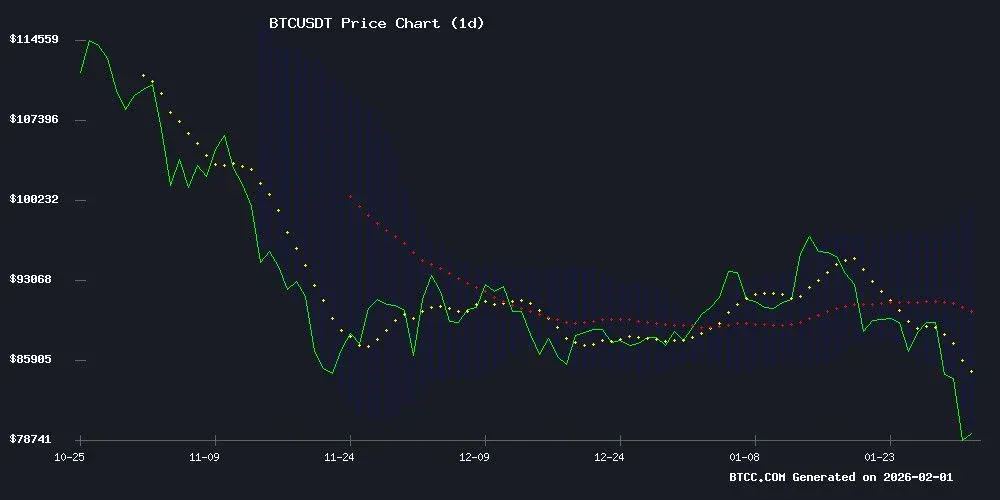
According to BTCC financial analyst Mia, the current transaction price of Bitcoin is $78,120, which has slipped below the 20‑day moving average ($89,529), indicating that short‑term selling pressure remains. However, the MACD is still positive (5,523.08) and the histogram sits at 2,963.64, suggesting that upward momentum, while weakening, is still present. Price is trading near the lower Bollinger Band ($79,229), a level that could provide technical support. Mia comments: “Although the overall position is below both the moving average and the middle Bollinger Band, showing a corrective pattern, the pull‑back near the lower band together with a positive MACD implies that selling pressure may be diminishing.”
Institutional valuation perspective on Bitcoin
Even though data from Coinbase Institutional and Glassnode both indicate that Bitcoin has entered a bear market, nearly 70 % of institutions still consider it undervalued. This apparent contradiction suggests that during market downturns institutions tend to treat Bitcoin as a relatively safe crypto asset. In the fourth quarter of 2025, Bitcoin’s market share rose modestly from 58 % to 59 %. David Duong of Coinbase Institutional explained: “While we aim to reduce overall risk, we still want exposure to the crypto market, and Bitcoin naturally becomes the first choice.” The figures show that this is not a large‑scale exit from digital assets, but rather a shift from higher‑volatility tokens toward the higher‑quality Bitcoin.
Case study: Maintaining a Bitcoin position
A particular strategy continued to hold 712,647 BTC throughout this year’s pronounced correction. According to filings submitted to the U.S. SEC, at a valuation of $77,900 per coin the holding is worth roughly $55.72 billion, approaching the breakeven point. At its peak the position was valued at $81 billion, only about 70,000 BTC less than today. Chief Executive Michael Saylor financed the position with long‑term convertible bonds rather than margin loans, avoiding forced liquidations caused by price swings. Although the correction erased paper gains, the strategy did not adjust its size and continued to add at lower levels, underscoring a strong conviction in Bitcoin’s long‑term store‑of‑value role.
Infrastructure project: Bitcoin Everlight
Within discussions of Bitcoin’s underlying infrastructure, the Everlight project has attracted attention because its transaction‑routing layer and node mechanism are observable already in the pre‑sale stage. Runtime performance, system‑design choices, and operational transparency are viewed as key metrics for assessing its credibility. Compared with most pre‑sale projects that remain vague until functionality is delivered, Everlight demonstrates its technical capabilities up‑front, earning recognition from the developer community. This “pre‑verification” approach reflects the crypto ecosystem’s unique demand for infrastructure trust—building confidence through demonstrable performance rather than marketing hype.
Market dynamics: Recent decline and chart pattern
Bitcoin recently attempted to rebound to its previous highs but failed, slipping to $78,263, a decline of roughly 6.16 %, with a daily trading volume of $81.67 billion. The total market cap stands at about $1.57 trillion, and safe‑haven sentiment remains strong. Analyst Crypto Patel believes the pull‑back aligns with his earlier technical assessment, breaking a previously set resistance level by roughly 22 %. The breakout of a bearish flag makes $75,500 a critical support zone. Patel stresses that “planning beats prediction,” and notes that investors who adhere to strict trading discipline without using leverage are more likely to profit amid volatility.
Political and macro‑economic factors
European right‑wing parties and crypto
Following former U.S. President Donald Trump’s 2024 campaign, which highlighted crypto as a core issue, several European right‑wing parties have begun to emulate the approach, using digital assets to attract voters and promote industry growth. Bitcoin’s decentralized nature and its friction with traditional regulation resonate with conservative constituencies, yet the opacity of capital flows also fuels opposition. Funding of these parties by crypto firms signals that blockchain technology is becoming a new political talking point.
Japanese bond‑market turbulence
After abandoning yield‑curve control, Japan’s bond market has become more volatile. The 10‑year government‑bond yield rose from roughly 1 % to 2.25 % within a year, while the 40‑year yield breached 4 %, eroding the “free‑funds” advantage that crypto traders historically enjoyed through Japan‑based interest‑rate arbitrage. Even though the Bank of Japan keeps its policy rate at 0.75 % and hints at possible future hikes, the market faces asymmetric risk: as yen‑based arbitrage opportunities shrink, leveraged positions may be forced to liquidate, triggering a cascade of clearings. Historical experience shows that when yen arbitrage wanes, crypto assets often become a high‑volatility liquidity substitute until markets regain stability.
Other hot topic: Epstein and Bitcoin
Recent Department of Justice disclosures of 2016 emails reveal that convicted financier Jeffrey Epstein claimed direct contact with Bitcoin’s founder and proposed a “dual‑currency” concept: a physical paper note compliant with Islamic law and a digital counterpart linked to the Bitcoin blockchain. The emails state that the Bitcoin founder showed “great interest” in the proposal. Although no concrete evidence currently substantiates a real connection, the information has sparked public scrutiny of Epstein’s financial network and raised questions about the potential role of cryptocurrencies in grey‑area finance.
Is Bitcoin a good investment?
Synthesising the current technical and fundamental analysis, Bitcoin’s outlook appears decidedly mixed. Technically, the price is correcting but shows signs of stabilising near the lower Bollinger Band; fundamentally, institutional approval is rising and infrastructure projects keep progressing. For investors who can tolerate volatility and focus on the long term, the present pull‑back could present a buying‑the‑dip opportunity; however, short‑term participants should remain vigilant about selling pressure and macro‑economic uncertainty. As always, diversified asset allocation and prudent position sizing are essential for risk mitigation.
---
For deeper analysis of the 2026 Bitcoin price forecast, stay tuned to future posts from Bitaigen (比特根) or follow the related links below. Thank you for reading, and we look forward to your continued support!
Related Reading
- Bitcoin 2026 Price Forecast: Global Trends & Market Drivers
- Texas Gov't $5M Bitcoin Deal: ETF First, Self‑Custody Next
- Bitcoin Stabilizes in Jan 2025, Eyes Feb 2026 Rally
💡 Register on Binance with referral code B2345 for the maximum trading fee discount. See Binance complete guide.



