
 Bitaigen Research
 In this article we review four major Bitcoin valuation models, delving into their underlying principles and applicable scopes, to help readers assess Bitcoin’s potential value from the perspectives of production cost, scarcity, network effects, and holding behavior. By comparing the logic and data behind each method, you will gain a more objective long‑term viewpoint. The following sections will expand on each model in detail, so please continue reading.
Four Bitcoin Valuation Methods Forecast: BTC Could Reach $2.9 Million by 2050
By combining the Production‑Cost Model, the Stock‑to‑Flow (S2F) Model, Metcalfe’s Law, and the AHR999 Holding Indicator, the forecast for 2050 puts Bitcoin’s price at roughly $2.9 million. Bitcoin has been trading around $56,000 – $57,000 recently, and the American asset‑management firm VanEck issued a 2050 projection in July 2024 that aligns with this figure.
Below, the Bitaigen editorial team will introduce each of the four valuation models one by one, helping readers develop a more comprehensive understanding of Bitcoin’s worth.

Bitcoin Valuation Methods
Traditional assets such as equities and bonds already have mature valuation frameworks, yet a unified standard for assessing Bitcoin’s value is still lacking. At present, four relatively common models are used:
- Production‑Cost Model – treats the electricity, hardware and other expenses incurred by mining as the underlying value of Bitcoin.
- Stock‑to‑Flow Model (S2F) – measures scarcity through the “stock‑to‑flow” ratio.
- Metcalfe’s Law – posits that the square of the number of network users is positively correlated with the network’s value; it can be applied to blockchain networks.
- AHR999 Holding Indicator – created by the Weibo user *ahr999*, this metric assists systematic investors in judging entry timing.
Production‑Cost Model
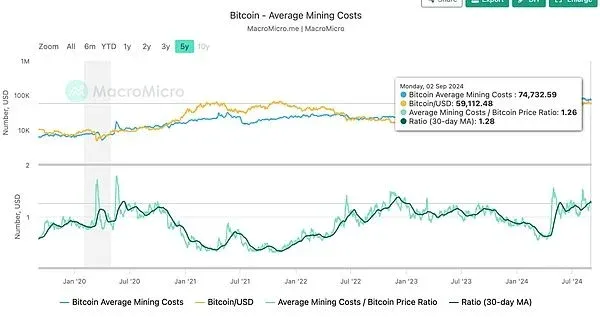
Unlike fiat currencies, which can be printed at almost zero marginal cost, Bitcoin is created through an energy‑intensive mining process. Over the long term, the cost to mine a single Bitcoin usually converges toward its market price, making it a practical lower bound for price. If the market price falls below the cost of production, inefficient miners are forced to shut down, the total hash rate declines, and upward price pressure typically follows.
Data source: MacroMicro (2024‑09‑02)
The average mining cost is approximately $74,000 USD, which constitutes the current valuation of Bitcoin under the production‑cost approach.
Should Bitcoin’s price stay persistently below this level, two outcomes are possible: either the miner population shrinks, or the price rebounds to a level above the average cost.
Stock‑to‑Flow Model
The Stock‑to‑Flow (S2F) model is frequently employed for commodities such as gold and silver. Its core formula is:
\[
\text{S2F} = \frac{\text{Stock (Total Supply)}}{\text{Flow (Annual Production)}}
\]
- Stock: the total number of Bitcoins currently in circulation.
- Flow: the number of newly minted Bitcoins each year.
As of August 2024, circulating supply is about 19,750,000 BTC, and annual production is roughly 164,359 BTC, yielding:
\[
\text{S2F} \approx 120.1
\]
This ratio implies that, at the current issuance rate, it would take about 120 years to produce an amount equal to the existing stock. Compared with gold (S2F ≈ 59.7), Bitcoin’s scarcity is roughly twice that of gold.
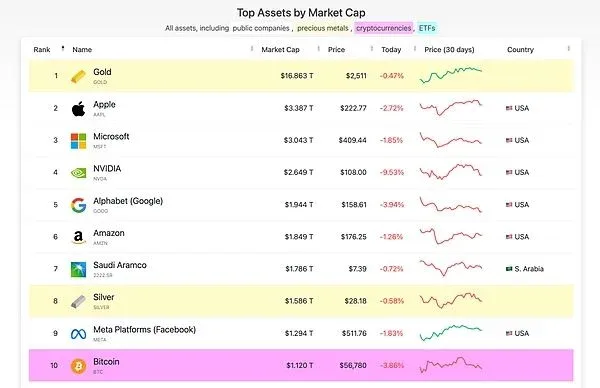
Valuation example: If Bitcoin’s market cap were scaled by the same scarcity multiplier that gold enjoys (2024 gold market cap ≈ $16.8 trillion), Bitcoin’s potential market cap would be about $33.6 trillion, corresponding to a price of roughly $170,800 USD per coin—around 30 times the current level.
Note: This type of back‑of‑the‑envelope calculation lacks rigorous justification and should be taken as a speculative illustration only.
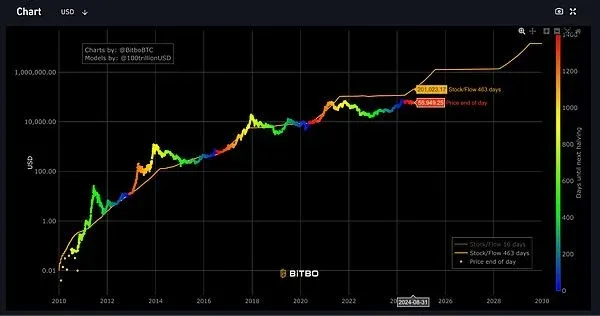
Real‑time S2F charts show that since 2022 the model‑derived price has consistently trended above the actual market price. According to the latest chart, the model’s current valuation for Bitcoin is about $210,000 USD.
Metcalfe’s Law
Metcalfe’s Law originated in telecommunications and states that a network’s value is proportional to the square of its user count. Applying this to Bitcoin gives:
\[
\text{Value} \propto (\text{Active Addresses})^{2}
\]
On 4 September 2024, the number of active Bitcoin addresses rose from roughly 26 million five years earlier to about 54 million, an increase of 2.08 ×. Under a squared relationship, the market cap should be about (2.08)² ≈ 4.3 times what it was five years ago, which translates to a price near $41,000 USD per BTC.
AHR999 Holding Indicator
The AHR999 indicator blends three components—Bitcoin’s price, the 200‑day dollar‑cost‑averaging (DCA) cost, and an exponential growth valuation—to help investors judge buying opportunities. Its formula is:
\[
\text{AHR999} = \frac{\text{BTC Price}}{200\text{-day DCA Cost}} \times \frac{\text{BTC Price}}{\text{Exponential Growth Valuation}}
\]
- AHR999 < 0.45 → considered a buying dip.
- 0.45 ≤ AHR999 ≤ 1.2 → suitable for systematic DCA.
- AHR999 > 1.2 → price likely overvalued; caution advised.
Using the 4 September 2024 price of $57,481.9 USD:
\[
0.6 = \frac{57,481.9}{63,570.07} \times \frac{57,481.9}{\text{Exponential Growth Valuation}}
\]
Solving yields an Exponential Growth Valuation of roughly $86,628 USD, indicating that Bitcoin’s implied valuation is well above $80,000 at that moment.
Summary
Each of the four models emphasizes a different aspect of Bitcoin’s economics:
| Method | Core Driver | Current Model Valuation (Reference) |
|---|---|---|
| Production‑Cost Model | Mining cost | $74,000 USD |
| Stock‑to‑Flow Model | S2F ratio | $210,000 USD |
| Metcalfe’s Law | Square of active addresses | $41,000 USD |
| AHR999 Holding Indicator | Price / DCA cost | $86,000 USD |
These frameworks allow analysts to view Bitcoin through the lenses of cost structure, scarcity, network scale, and investor behavior. Nevertheless, actual market prices remain subject to sentiment, regulatory developments, macro‑economic conditions, and other variables; therefore, any valuation should be treated with caution.
*Tax reminder*: In many jurisdictions, gains realized from buying and selling cryptocurrencies are taxable events. Readers should consult local tax regulations or professional advisors to determine their obligations.
*Regional note*: For users residing in the United States, access to the global Binance platform is restricted; you should use Binance.US or other regulated U.S. exchanges when trading Bitcoin. For the rest of the world, SEPA, SWIFT, or other fiat‑on‑ramp services can be used in conjunction with the platforms mentioned above.
The above constitutes the Bitaigen editorial team’s compilation of four Bitcoin valuation methods, intended to serve as a reference for those seeking a deeper understanding of Bitcoin’s intrinsic worth.
Related Reading
💡 Register on Binance with referral code B2345 for the maximum trading fee discount. See Binance complete guide.



