
 Bitaigen Research
 In this article we start from the technical fundamentals to systematically analyze the security boundaries of mnemonics and private keys, and explain why cracking them by brute‑force is essentially impossible when the BIP‑39 standard is followed. By deeply dissecting the combinatorial space of the wordlist, we help readers dispel misconceptions about mnemonic collisions and understand the true level of risk. If you want to know the underlying mathematics and implementation details, keep reading.
---
Recently, many people have been asking us to provide an address and then attempt a targeted brute‑force attack on the corresponding private key. I can state clearly that, given current physical hardware limitations, the probability of successfully performing a directed brute‑force attack on a single address is virtually zero.
When mnemonics conform to the BIP‑39 standard, they are practically uncrackable; the collision probability is lower than the number of atoms in the observable universe, making real‑world attacks infeasible. Even with a supercomputer running continuously, obtaining the same mnemonic or its associated private key within a reasonable timeframe is out of reach.
Can a mnemonic be guessed?
A common concern is whether two different users could end up with the *same* mnemonic that maps to the *same* address. The answer is: no.
The most widely adopted BIP‑39 mnemonic standard uses a fixed wordlist of 2 048 words. The two most common configurations are 12‑word and 24‑word phrases:
- 12‑word combination possibilities: \(2048^{12} = 5.44 \times 10^{39}\)
- 24‑word combination possibilities: \(2048^{24} = 2.96 \times 10^{79}\)
A magnitude of \(10^{79}\) is comparable to the estimated number of atoms in the observable universe, so a brute‑force search is practically impossible. Even if a massive supercomputer were to run continuously from the birth of the universe until now, it would still fall far short of covering this space.
BIP‑39 specifies the exact algorithm for turning a mnemonic into a seed; the words must be ordered exactly as they appear in the official wordlist. Randomly typing any 24 words will not generate a valid cryptocurrency address. The probability that two people independently pick the *exact same* 24‑word sequence (identical words in identical order) is \(1 / 2048^{24}\), which is akin to finding a particular atom in the whole universe.
In practice, even a 12‑word phrase already provides ample security; the more words you use, the higher the seed entropy and the harder a collision becomes.
Try generating your own mnemonics on Ian Coleman’s BIP‑39 mnemonic generator (BIP39 – Mnemonic Code) to experience the randomness first‑hand.
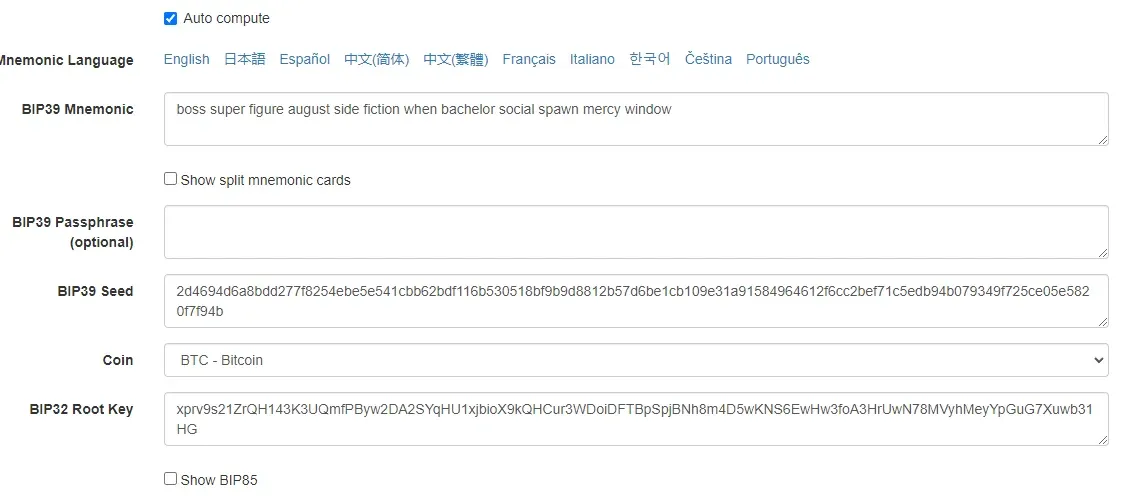
Detailed collision‑probability calculation
Although the algorithm is public, the effective collision space is roughly \(2^{136}\). Tests on a top‑tier AWS GPU instance (p2.8xlarge equipped with 8 × K80 GPUs) yielded:
- Computation speed of about 80–88 M attempts per second (≈ 8 × 10⁷ attempts/s)
That translates to roughly 80 million collision attempts each second. Even if computing power were scaled up to the 1 G (i.e., \(2^{30}\)) level, you would still need to perform about \(2^{106}\) attempts—still astronomically beyond feasibility.
Bitcoin address generation primarily involves three algorithms: ECDSA, SHA‑256 and RIPEMD‑160. After GPU acceleration, these steps consume negligible time; the bottleneck shifts to the Bloom filter. Bloom filters use multi‑level hash maps to achieve near‑optimal set‑membership testing, yet there remains room for further optimization.
Analysis of address‑prefix distribution
Bitcoin addresses are encoded in Base58, and their leading characters follow a roughly normal distribution. We examined all P2PKH addresses that existed up to 2018‑12 (a total of 377 059 211 entries), extracted the first four characters, and counted their occurrences. The top‑10 most common four‑character prefixes are:
- 1bit – 23 600
- 1btc – 23 086
- 13vs – 21 895
- 1gbx – 21 329
- 1gbt – 21 267
- 1gba – 21 267
- 1gbb – 21 210
- 1gbf – 21 206
- 1gbu – 21 196
- 1gbr – 21 189
The most frequent prefixes are 1bit and 1btc, each appearing about 10 000 more times than the third‑most common prefix. This anomaly likely stems from users deliberately generating “show‑off” addresses.
Overall, there are 42 877 distinct four‑character prefixes among all P2PKH addresses. If a Bloom filter applies this prefix list at its first level before proceeding to deeper checks, overall filtering efficiency can improve by roughly an order of magnitude.
On a consumer‑grade machine equipped with a GTX 750 Ti, we measured a collision‑testing speed of 10 M attempts per second. Swapping to a more powerful GPU such as an RX 580 could theoretically match the performance of the top‑end AWS GPU. Even a 10⁸‑fold speed increase would only cover about \(2^{90}\) of the search space—still far from sufficient for a realistic attack.
Private‑key collisions versus mining hashpower
Early on the Bitcointalk forum, Laszlo Hanyecz raised the question of whether advances in hardware could ever make private‑key collision profits exceed mining rewards. Satoshi Nakamoto’s response highlighted that achieving the required computational capacity would still take an exceedingly long time.
The current Bitcoin network hashrate is roughly 40 EH/s (≈ \(2^{62}\)), equivalent to about 4 million Antminer S9 ASICs running non‑stop for a year. If private‑key‑collision hardware could reach a comparable level, the probability of a successful collision would only be reduced to the order of \(2^{-60}\)—still an astronomically low figure.
Moreover, as users become more security‑aware, previously used addresses are abandoned, causing Bloom filter entries to change frequently and further raising the difficulty of any collision attempt.
Even if transaction fees rise and block rewards continue halving, projected mining revenue is expected to stay within 1–10 BTC per block. To achieve a single successful private‑key collision within a year, one would need computational throughput on the order of \(2^{90}\) operations per second, far beyond any existing or near‑future technology.
Conclusion
- Under the BIP‑39 standard, the collision probability for mnemonics is effectively zero; practical cracking is infeasible.
- Even with the most powerful GPU clusters or highly optimized Bloom filters, the searchable space dwarfs any realizable hashpower.
- The expected profit from a private‑key collision will not surpass mining rewards given foreseeable hardware progress.
Consequently, a targeted attack on the private key of a single address is virtually impossible. Randomly attacking a large pool of funded addresses marginally improves odds, but the event remains astronomically improbable. Only a breakthrough in computation—such as large‑scale quantum computers—could change this assessment; until then, such attacks lack practical viability.
*Note: Crypto gains may be subject to taxation according to the regulations of your local jurisdiction. Always consult a qualified tax professional.*
💡 Register on Binance with referral code B2345 for the maximum trading fee discount. See Binance complete guide.



