
 Bitaigen Research
 In this article we outline Chia’s dual space‑time consensus mechanism, dissect the technical workflow of plotting and challenges, and assess its low‑energy ecological advantages. By presenting the founding team and capital backers, readers can quickly gauge the project’s position within the decentralized ecosystem. Subsequent sections will reveal implementation details, making a thorough read worthwhile.
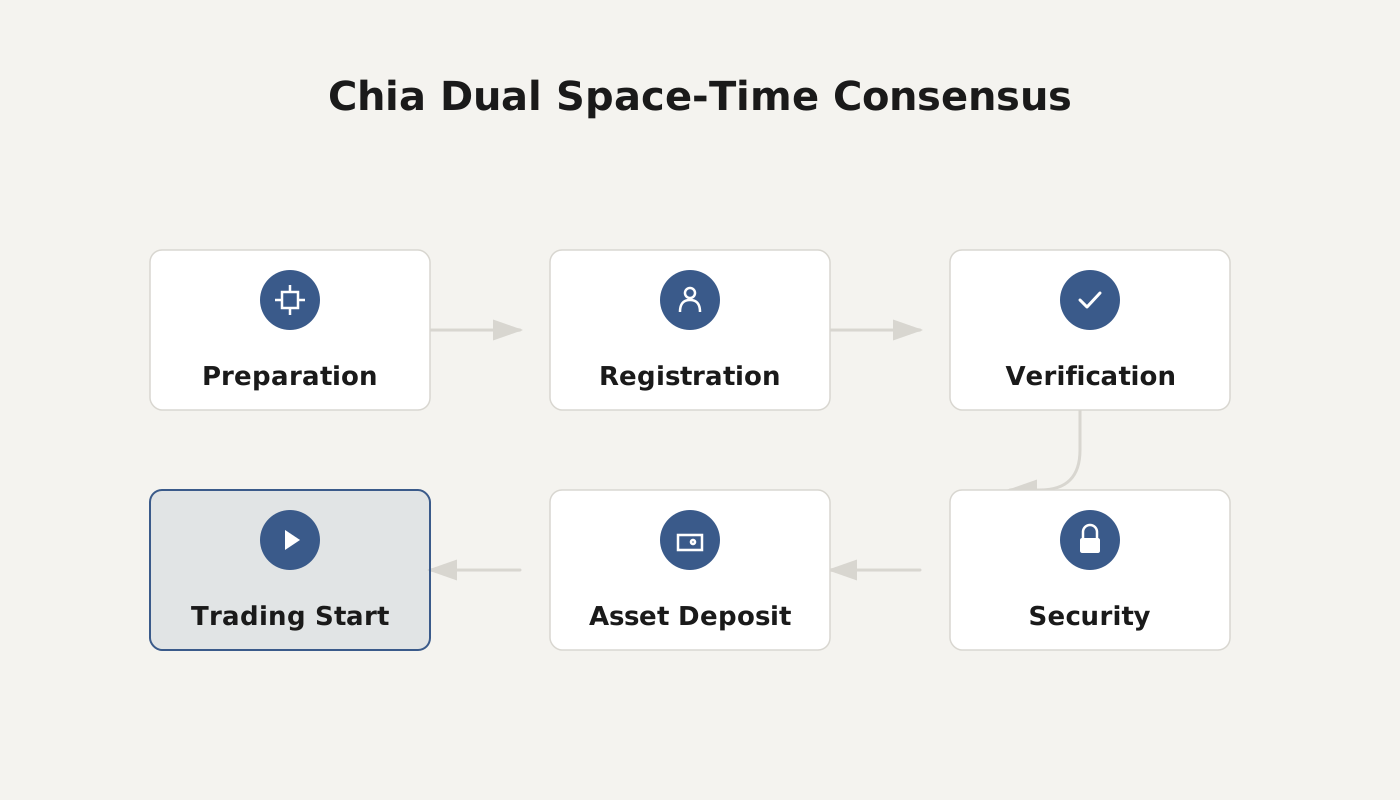
How does Chia perform mining?
Chia combines Proof of Space with Proof of Time to enable farming (plotting) and harvesting (challenging) using idle hard‑drive capacity, thereby completing the mining process.
1. Chia’s strong background
- Founder: Bram Cohen, the creator of the BitTorrent protocol, bringing experience in decentralized digital sharing.
- Investors: Top‑tier firms such as a16z, Greylock Partners, DCM Ventures, Coinbase, etc., which completed two financing rounds in 2017 and 2018.
- Green and sustainable: Chia replaces raw compute power with hard‑drive space, positioning itself as a low‑energy, eco‑friendly mining solution.
Bitcoin relies on Proof‑of‑Work (PoW), which drives fierce hash‑rate competition and massive energy consumption (approximately 134.68 TWh per year), exceeding the electricity usage of many mid‑size nations. Chia’s Proof of Space and Time aims to be a more environmentally friendly alternative digital currency.
2. How Chia mining works
2.1 Plotting phase
- Generate plot files: The software uses a hash algorithm to create a large number of nonces (single‑use random numbers) and writes them to the drive, producing `.plot` files.
- Occupy disk space: These files act like “seeds” planted on the hard drive, and participants are therefore called farmers.
2.2 Harvesting (Challenge) phase
| Step | Description |
|---|---|
| **Block broadcast** | The network publishes a new challenge. |
| **Scan plots** | Farmers scan their local plots to compute the hash value closest to the challenge. |
| **Proof of Space** | If the hash is sufficiently close to the target, the system confirms that the farmer has provided valid storage space. |
| **Proof of Time** | A **Verifiable Delay Function (VDF)** sequentially generates the block timestamp, ensuring fair ordering and preventing large‑capacity farmers from attacking the network. |
| **Reward distribution** | Farmers meeting the criteria receive **Chia (XCH)** token rewards. |
- Proof of Space: Demonstrates that the user retains unused storage on their drive. The chance of winning is proportional to the user’s space relative to the total network space.
- Proof of Time: Uses a VDF for sequential computation; while the calculation takes time, verification is extremely fast, minimizing electricity waste.
3. Farmer earnings and network effects
- Revenue source: Block rewards are directly tied to the proportion of hard‑drive space a farmer contributes; larger space yields a higher probability of receiving rewards.
- Hard‑drive demand: To boost earnings, many farmers purchase large quantities of drives, creating supply‑shortage pressure and price increases in the storage market.
- Network growth: Continuous addition of storage drives drives exponential growth in Chia’s total network space, enhancing security and decentralization.
Chia’s mining model does not depend on high‑power compute equipment; instead it leverages ordinary hard drives to achieve “green” mining, lowering entry barriers and offering an environmentally conscious alternative for users worldwide.
For readers seeking deeper technical details about Chia farming, please follow the related topic articles on Bitaigen (比特根).
Note: When converting fiat to cryptocurrency, global users typically use USD via SEPA or SWIFT channels. U.S. residents should use Binance.US rather than the global Binance platform. Crypto gains may be subject to taxation in the holder’s jurisdiction; consult local tax regulations for guidance.
Related Reading
- Chia (XCH) Explained: Proof of Space‑and‑Time Crypto & Storage Hardware Trend
- Chia Mining Economic Model: Issuance, Inflation & Rewards
- Chia: Scam or Green Mining Opportunity 2024?
💡 Register on Binance with referral code B2345 for the maximum trading fee discount. See Binance complete guide.



