
 Bitaigen Research
 In the blockchain ecosystem, DApps have become a hot concept.
In this article we outline the core concepts and technical components of DApps, and systematically categorize their main forms in wallets, finance, gaming and other sectors. By presenting a clear hierarchical structure, we help readers quickly grasp the essence of decentralized applications and their real‑world deployment scenarios. Subsequent sections will further explore the functional characteristics and development trends of each DApp category, making the piece well worth a careful read.
What does a blockchain DApp mean?
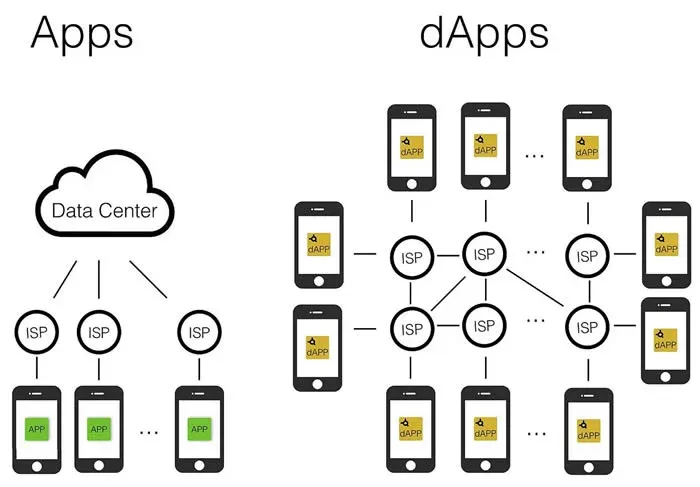
DApp refers to a decentralized application that runs on a blockchain. Its core consists of smart contracts plus a front‑end user interface. Users interact through a web browser or a dedicated client, while data is stored on a distributed ledger that guarantees immutability.
“App” is short for “application,” meaning a client‑side program. DApp combines D (decentralization) with App, emphasizing that its runtime environment does not rely on centralized servers but on a blockchain network. To fully understand a DApp, one must first master the notion of a smart contract: a contract written as code and uploaded to the blockchain, immutable once deployed, and automatically executed when predefined external conditions are met. Consequently, a DApp is essentially a smart contract + front‑end interaction composite.
An application can be called a DApp if it satisfies the following three criteria:
- Operates on a distributed network;
- Stores participant information securely, with privacy effectively protected;
- Achieves decentralized operation through network nodes.
What are the applications of DApps?
In the era of mobile internet, traditional apps have deeply permeated every aspect of daily life, yet their fundamental model remains centralized. By contrast, DApps leverage blockchain technology to offer higher trust levels and tamper‑proof data, gradually opening up new business models. Below are some of the most common DApp categories today:
1. Wallet‑type DApps
Every public blockchain needs a companion wallet application. For example, Bitcoin, Ethereum, MOAC, as well as domestic chains such as NEO and Jingtong, each have corresponding DApp wallets. Users can manage private keys, send transactions and view asset balances within these wallets.
2. Content‑platform DApps
The synergy between blockchain and content creation is strong, giving rise to many decentralized content platforms. Internationally, Steemit is a well‑known example; in China, platforms such as Bihu, Biwen, Primas, Iveryone, PressOne and others have emerged. These DApps use blockchain’s anti‑counterfeit and incentive mechanisms to provide creators with transparent revenue‑sharing channels.
3. IoT / Artificial‑Intelligence‑integrated DApps
The combination of DApps with the Internet of Things (IoT) and the sharing economy is viewed as a potential growth engine. Take autonomous‑driving scenarios: the traditional model relies on centralized servers to relay traffic data, which introduces single‑point‑failure and latency risks. If traffic information is written directly onto a blockchain, vehicles can read it in real time and make decisions autonomously, improving safety and efficiency. Similarly, artificial intelligence can employ smart contracts to enable trustworthy interactions between machines.
Definition: In the scenarios described above, blockchain supplies decentralized data storage and consensus, while smart contracts handle the automatic execution of business logic. Together they form the technological foundation of a DApp.
Although blockchain technology has matured, DApps are still in their infancy—much like a newborn still swaddled in its blanket. The market currently lacks large‑scale, fully‑realized DApp projects, which means the space remains a treasure trove awaiting continuous innovation and exploration by developers.
The above explains “what a blockchain DApp is and what its applications are.” For more encyclopedic interpretations of blockchain DApps, feel free to follow other related articles published by Bitaigen (比特根).
Note for U.S. readers: When accessing related services, be sure to use Binance.US rather than the global Binance platform.
Financial context: When fiat transactions are involved, values are typically quoted in USD, and cross‑border transfers may use SEPA or SWIFT networks.
Related Reading
- 14 Must‑Watch DeFi Projects for 2024: Uniswap, Aave, Lido
- Stablecoin Design Visualized: USDT, DAI, FEI, Basis Cash, ESD
- DeFi Revolution: Decentralized Finance Redefining Banking
💡 Register on Binance with referral code B2345 for the maximum trading fee discount. See Binance complete guide.



