
 Bitaigen Research
 The financial world is undergoing the biggest transformation since the birth of the internet. Imagine being able to borrow, trade currencies, or earn interest on savings without ever stepping into a bank or handling cumbersome paperwork. This is not science fiction—it is gradually becoming reality through Decentralized Finance (commonly abbreviated as DeFi).
DeFi (Decentralized Finance) is a blockchain‑based peer‑to‑peer financial system that offers lending, trading, yield generation and other services via smart contracts, eliminating traditional intermediaries and providing 24/7 global accessibility.

In this article we systematically outline the concepts, technical foundations, and core applications of DeFi, helping readers understand how decentralized finance enables peer‑to‑peer lending, trading and yield generation on the blockchain. Through clear case studies and ecosystem diagrams, you will learn its operating mechanisms, advantages, and challenges, and be able to judge whether it warrants your attention.
Key Takeaways
- What is DeFi? Decentralized Finance removes traditional financial intermediaries such as banks, using blockchain smart contracts to create open, transparent, and always‑on (24/7) peer‑to‑peer financial services.
- Market Growth DeFi has grown exponentially, with Total Value Locked (TVL) surpassing USD 200 billion, and continues to expand as institutions and mainstream users adopt it.
- Core Applications Popular DeFi services include lending (Aave, Compound), decentralized exchanges (Uniswap, Curve), staking, yield farming, and stablecoin protocols (e.g., MakerDAO).
- Major Advantages DeFi offers global accessibility, lower costs, faster transactions, full transparency, user‑controlled assets, and a market that never sleeps regardless of geography.
- Key Risks Users must understand smart‑contract vulnerabilities, market volatility, impermanent loss, regulatory uncertainty, and the necessity of self‑custody security practices.
- Getting Started Begin with a secure non‑custodial wallet (MetaMask), experiment with small amounts on reputable platforms, thoroughly research each protocol, and follow best‑practice security guidelines.
What Is DeFi? Understanding Decentralized Finance
Decentralized Finance (DeFi) is a blockchain‑based form of finance that operates without banks, brokerages, or exchanges. It leverages smart contracts on programmable blockchains (primarily Ethereum) to rebuild and improve traditional financial instruments in a permissionless, transparent, and global manner.
DeFi is to finance what the internet was to information—removing the gatekeepers of data and, similarly, eliminating the gatekeepers of financial services. With DeFi you can:
- Lend cryptocurrency and earn rates higher than those offered by traditional banks;
- Borrow funds without approval or credit checks;
- Trade assets directly with other users without relying on a centralized exchange;
- Generate passive income through yield‑farming strategies;
- Access financial services anytime, anywhere.
The phrase “decentralized finance” precisely captures its essence: a financial system not controlled by any single entity or institution, but run by a distributed network and automated protocols.
Traditional Finance vs. DeFi: Key Differences
| Traditional Finance | DeFi Finance |
|---|---|
| Banks control funds and transactions | Users control assets through self‑custody wallets |
| Business‑hour limits (weekdays) | 24/7 operation |
| Geographic restrictions and high cross‑border fees | Global access via internet, low fees (often payable in USD via SEPA/SWIFT for fiat on‑ramps) |
| Lengthy approval processes | Near‑instant transaction and approval |
| Opaque operations | Full transparency via blockchain records |
| Requires extensive documentation and credit history | No location or financial‑history barriers |
This shift from centralized control to distributed protocols is one of the most disruptive innovations since the inception of modern banking.
Core Components That Make DeFi Work
- Smart Contracts: Self‑executing code that enforces protocol terms without intermediaries.
- Blockchain Networks: Ethereum is the dominant platform; Binance Smart Chain, Polygon, Solana and others also expand the ecosystem.
- Cryptocurrencies and Tokens: Including ETH, DAI, USDC and governance tokens that confer voting rights.
- Decentralized Applications (DApps): User interfaces for interacting with DeFi protocols, such as Uniswap, Aave, Compound, etc.
How Does DeFi Operate? The Underlying Technology
1. Smart Contracts: The Engine of DeFi
Smart contracts are the backbone of every DeFi protocol. They function like digital vending machines: once predefined conditions are met, they automatically execute without human intervention.
In a lending protocol, the smart‑contract workflow looks like this:
- A user deposits cryptocurrency as collateral;
- The contract automatically calculates the maximum loan amount;
- When conditions are satisfied, funds are instantly transferred to the borrower’s wallet;
- Interest accrual and liquidation are handled entirely on‑chain.
“Code is law,” and most DeFi protocols are open‑source, allowing anyone to audit how they operate.
2. Leading DeFi Blockchains
| Blockchain | Notable Features | Typical Use Cases |
|---|---|---|
| **Ethereum** | Most mature ecosystem, largest number of protocols | Traditional DeFi applications |
| **Polygon** | Ethereum Layer‑2 scaling solution, fast and cheap transactions | High‑frequency DApps |
| **Solana** | Ultra‑high throughput, low cost | Applications demanding massive throughput |
Each chain offers a different balance of security, speed, fees, and ecosystem maturity, letting users select the platform that best fits their needs.
Leading DeFi Platforms and Applications
The DeFi ecosystem continuously spawns innovative products. Below are the most influential categories.
1. DeFi Lending
DeFi lending directly matches lenders with borrowers, often offering rates more favorable than those of traditional banks.
Operational Flow
- Lenders deposit cryptocurrency into a lending pool;
- Borrowers provide 150‑200 % (or more) collateral;
- Smart contracts automatically set interest rates based on supply and demand;
- Interest is settled every block (approximately every 15 seconds).
Major Platforms
- Aave: The world’s largest lending protocol, offering variable and stable rates plus the innovative “flash loan” feature.
- Compound: Utilizes algorithmic interest rates and issues the governance token COMP.
- MakerDAO (now Sky Protocol): Issues the decentralized stablecoin DAI; users can lock ETH and other assets to borrow DAI.
2. Decentralized Exchanges (DEX)
DEXs let users trade assets directly from their wallets without custodial intermediaries, offering several advantages:
- Non‑custodial: Assets stay under the user’s control;
- Permissionless: No KYC required, instant access;
- Global Reach: Anyone with an internet connection can trade;
- Transparent Ledger: All trades are on‑chain and publicly verifiable;
- Reduced Counterparty Risk: No single exchange can be hacked to steal user funds.
Leading Platforms
- Uniswap: Uses an Automated Market Maker (AMM) model; anyone can create a trading pair and earn fees.
- SushiSwap: Builds on Uniswap’s model with added yield‑farming and governance features.
- Curve Finance: Specializes in stablecoin swaps with minimal slippage, ideal for large‑volume trades.
- 1inch: A DEX aggregator that scans multiple exchanges for the best price.

3. DeFi Staking and Yield Farming
Yield farming and staking are among the most attractive passive‑income mechanisms in DeFi.
- Yield Farming: Deposit tokens into a protocol to earn transaction fees, interest, or governance‑token rewards.
- Common Strategies
- Providing Liquidity: Supplying equal‑value tokens to a DEX pool to collect fees;
- Lending: Supplying assets to a lending platform for interest;
- Locking Governance Tokens: Gaining extra rewards and voting rights;
- Using Aggregators (e.g., Yearn Finance) to automatically optimize returns across protocols.
- Staking: Lock tokens to help secure a blockchain or participate in protocol governance; for example, staking ETH for Ethereum 2.0 yields an annual return.
4. Stablecoins in DeFi
Stablecoins anchor price stability and form the backbone of many DeFi operations.
| Type | Example(s) | Mechanism |
|---|---|---|
| **Centralized** | USDC, USDT | Backed by fiat or equivalent assets |
| **Decentralized** | DAI, LUSD | Over‑collateralized or algorithmically adjusted |
| **Algorithmic** | AMPL (experimental) | Supply is dynamically adjusted via smart contracts |
DAI is the most successful decentralized stablecoin, issued by MakerDAO (now Sky Protocol). It maintains a 1 USD peg through over‑collateralization and serves as a core asset across the DeFi landscape.
Advantages of DeFi: Why It Gains Attention
1. Financial Inclusion and Accessibility
- Global Reach: Anyone with internet access can participate;
- Zero Barriers: No minimum deposit— even a few dollars (USD) can be used;
- No Credit Checks: Collateral‑based loans bypass traditional credit assessments;
- 24/7 Availability: Markets never close;
- Innovation Freedom: Developers can launch new products without awaiting regulatory approval.
2. Lower Costs and Faster Settlement
- Reduced Fees: Eliminates intermediary commissions;
- Instant Settlement: Most transactions finalize within minutes;
- Transparent Pricing: Fees are displayed on‑chain;
- No Hidden Charges: Smart contracts execute exactly as coded.
3. Transparency and User Control
- Open‑Source Code: Anyone can audit the contracts;
- Public Ledger: Every transaction can be verified;
- Self‑Custody: Private keys remain under the user’s control;
- Immutable Records: On‑chain data is permanent;
- Real‑Time Monitoring: Users can view protocol status instantly.

Risks and Challenges of DeFi
1. Smart‑Contract Vulnerabilities
- Code Bugs: Exploits can drain funds;
- Flash‑Loan Attacks: Uncollateralized loans are used to manipulate protocols;
- Governance Attacks: Malicious actors acquire voting power to enact harmful changes;
- Oracle Manipulation: Tampered price feeds cause erroneous liquidations.
Mitigation Tips
- Use only audited, reputable protocols;
- Start with small amounts and scale gradually;
- Diversify across multiple platforms;
- Stay informed about security updates and community reports.
2. Market Volatility and Impermanent Loss
- Impermanent Loss: Providing liquidity while token prices diverge can lead to lower value than simply holding the assets;
- Liquidation Risk: A rapid drop in collateral value can trigger automatic liquidation;
- Token Price Swings: Governance tokens can experience sharp price declines, affecting overall returns.
3. Regulatory Uncertainty
- Potential Restrictions: Governments may impose limits on DeFi activities;
- Compliance Requirements: Future regulations could mandate KYC/AML procedures (U.S. users should therefore use Binance.US rather than the global Binance platform for fiat on‑ramps);
- Tax Implications: DeFi transactions generate complex tax obligations; crypto gains may be taxable according to the user’s local jurisdiction;
- Platform Risks: Regulatory pressure could lead to platform shutdowns or feature restrictions.
How to Get Started with DeFi
1. Set Up a DeFi Wallet
The first step is to create a non‑custodial wallet and keep the private key under your own control.
Popular Wallets
- MetaMask: The most widely used browser extension wallet;
- Trust Wallet: Includes a built‑in DApp browser;
- Coinbase Wallet: A standalone self‑custodial wallet;
- Rainbow: Mobile‑first wallet geared toward DeFi users.
Setup Checklist
- Download only from the official website or app store;
- Securely back up the seed phrase after wallet creation;
- Never share your private key or seed phrase with anyone;
- Enable PIN, biometric, or other security layers;
- Keep the initial capital within a risk‑tolerant amount.
2. Choose Your First DeFi Platform
For beginners, it is advisable to start with well‑audited, established protocols:
- Compound or Aave: Simple entry into lending and borrowing;
- Uniswap: Experience peer‑to‑peer token swaps;
- Curve: Low‑slippage stablecoin exchanges;
- Yearn Finance: Automated yield optimization across multiple strategies.
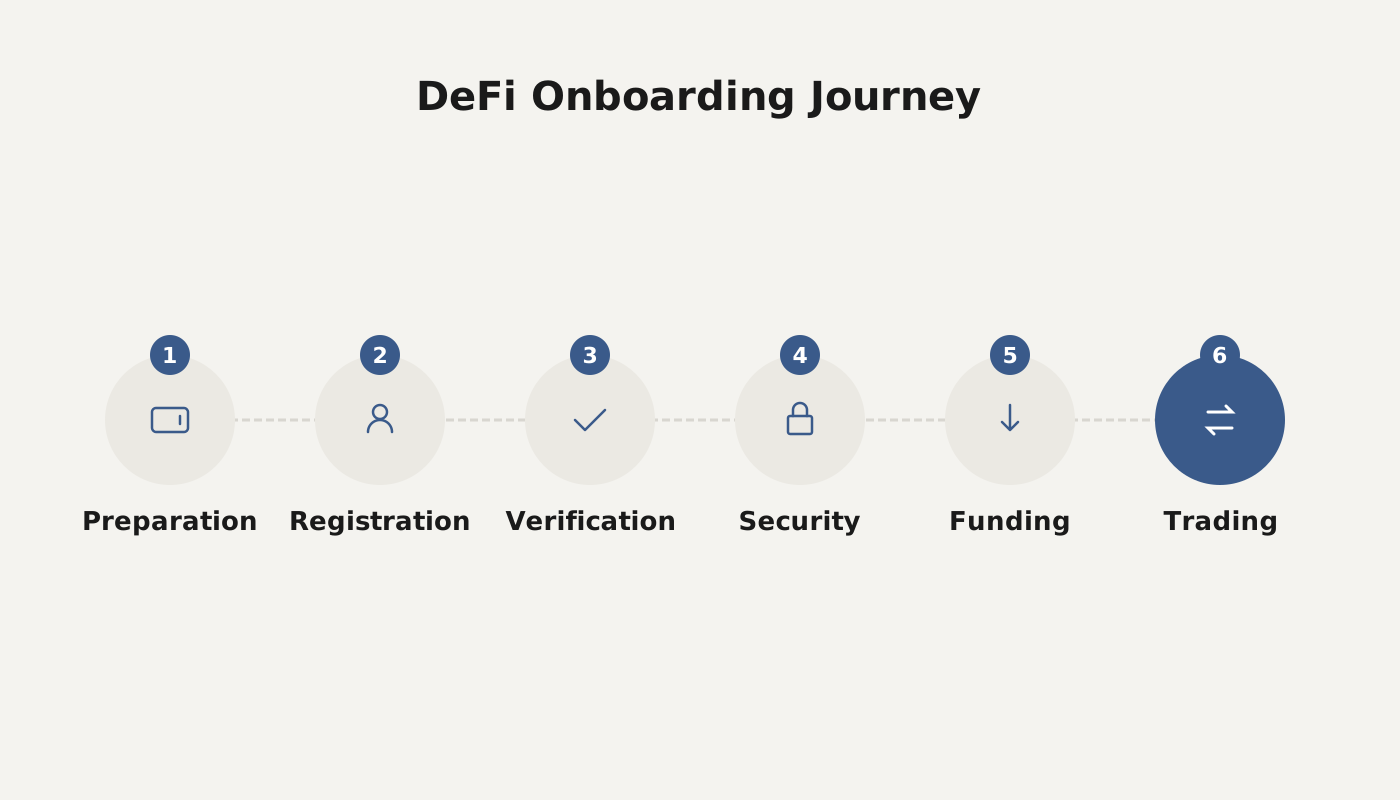
3. First DeFi Transaction: Step‑by‑Step Guide (Using Compound as an Example)
- Acquire Crypto Assets: Purchase ETH and USDC on a centralized exchange (using USD via SEPA/SWIFT) and transfer them to your non‑custodial wallet.
- Connect Your Wallet: Navigate to `compound.finance` and click “Connect Wallet”.
- Supply USDC: Choose the USDC market, enter the amount you wish to supply, and confirm the transaction; the smart contract will lock your USDC and issue cUSDC tokens representing your deposit.
- Borrow Against Your Collateral: After supplying, you can borrow another asset (e.g., DAI) up to the allowed collateralization ratio; confirm the borrowing transaction.
- Monitor Position: Use the Compound dashboard to track supplied assets, borrowed amounts, accrued interest, and health factor.
- Repay When Ready: To close the loan, repay the borrowed amount plus accrued interest, then withdraw your original USDC.
4. Ongoing Best Practices
- Regularly review the security audits of any protocol you use;
- Keep your wallet software up to date;
- Use hardware wallets for larger balances;
- Stay informed about regulatory developments in your jurisdiction;
- Remember that crypto‑related gains may be subject to tax reporting requirements.
By following these steps and maintaining a cautious, informed approach, you can begin exploring the expansive world of decentralized finance while managing the inherent risks.
Related Reading
- Yield Aggregators in DeFi: Contracts Automate Rebalancing
- Blockchain Cross‑Chain & Side‑Chain Tokens Explained
- AI赋能DeFi:实时分析、自动化策略与风险管理
💡 Register on Binance with referral code B2345 for the maximum trading fee discount. See Binance complete guide.



