
 Bitaigen Research
 In this article we outline the core concepts and operating principles of Ethereum Layer 2 networks, helping you quickly understand how they achieve scalability, fee reduction, and speed improvements without altering the underlying protocol. We compare the leading solutions and guide you step‑by‑step through the value proposition and use cases of Layer 2, with later sections diving deeper into technical details—worth a careful read.
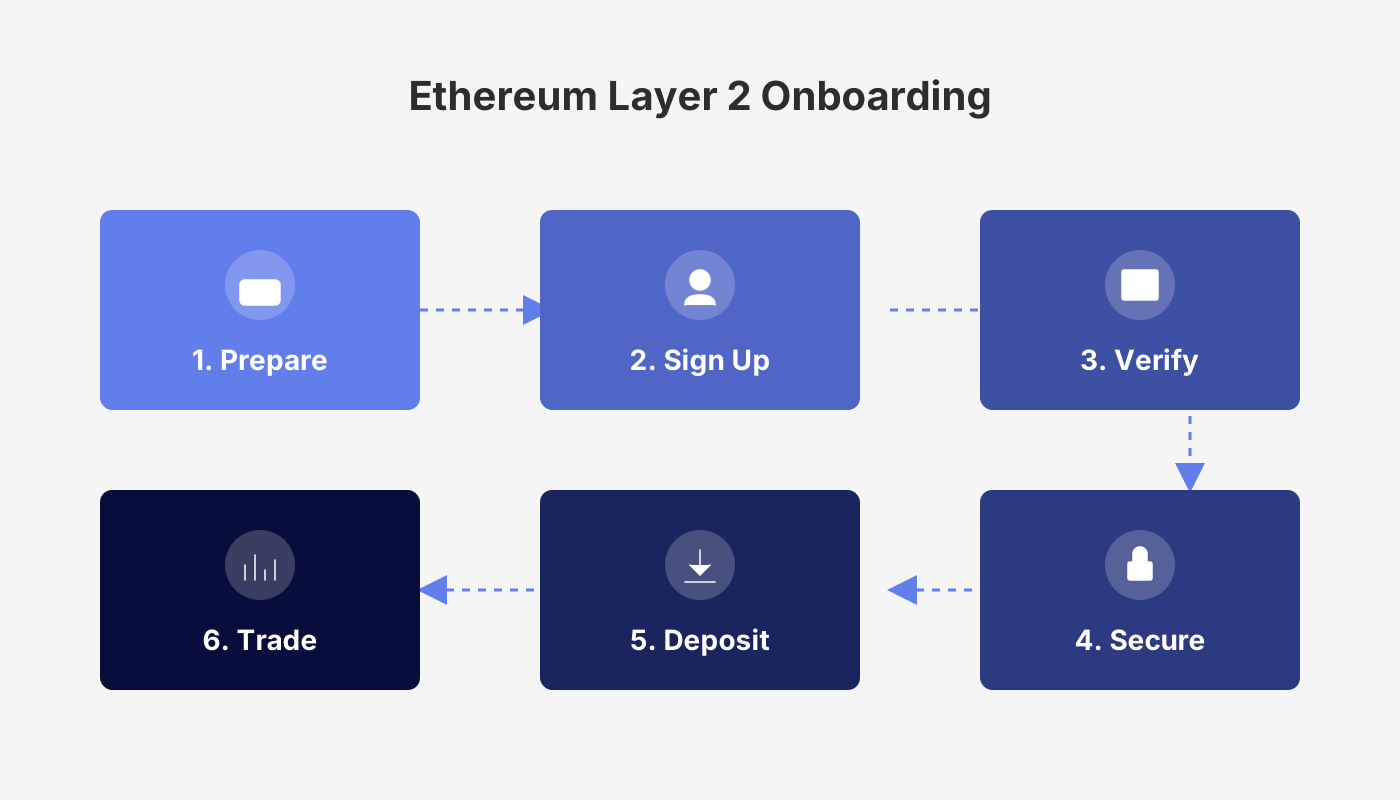
Ethereum is today one of the most popular blockchain networks, hosting thousands of decentralized applications (DApps) and a massive active user base. As the number of participants continues to grow, performance bottlenecks such as network congestion and high gas fees become increasingly evident. This is precisely the environment that gave rise to Ethereum Layer 2 networks (Layer 2).
Ethereum Layer 2 networks (Layer 2) are solutions that run on top of the Ethereum main chain and use smart contracts to provide scalability, lower transaction fees, and faster transaction throughput.
Without modifying Ethereum’s base protocol, they offer off‑chain computation, transaction aggregation, and similar mechanisms, thereby easing the load on the main chain.
What is Layer 2?
- Layer 2 deploys dedicated smart contracts on the main chain (Layer 1) to enable batch processing of transactions or off‑chain execution.
- This layer remains interoperable with the main chain and can submit state roots to Layer 1 at any time, ensuring that security and decentralisation are not compromised.
- The primary goals are to increase transaction throughput, reduce gas fees, and achieve faster confirmation times while preserving network security.
As user numbers surge, Ethereum’s network capacity is approaching its limits, leading to rising transaction costs and longer confirmation times. Layer 2 addresses these challenges through the following approaches:
- Transaction Aggregation: Bundles a large number of small transactions into a single, larger transaction that is submitted to the main chain.
- Off‑Chain Computation: Performs calculations on sidechains or state channels, writing results to the main chain only when necessary.
- Shard Coordination: Works in tandem with Ethereum’s upcoming sharding technology to further boost overall scalability.
Common Ethereum Layer 2 Implementations
Below are several widely‑followed Layer 2 solutions, each with a slightly different focus:
- Polygon
- Aims to build a multi‑chain ecosystem that is fully compatible with Ethereum.
- Provides developers with a complete toolset for quickly deploying efficient Ethereum‑compatible instances.
- Achieves low fees and high throughput through sidechains, Plasma, and related technologies.
- Arbitrum
- Utilises the Optimistic Rollup mechanism and is compatible with Solidity contracts.
- Core components include a compiler, an EthBridge, and a network of validators.
- Does not issue a native token, concentrating instead on technical implementation and transaction aggregation.
- Optimism
- Also based on Optimistic Rollup, emphasizing affordable transaction costs.
- Supports Solidity contracts with certain limitations and has deep integrations with projects such as Synthetix.
- Offers staking incentives to users who hold SNX tokens.
- Immutable X
- The first Layer 2 solution focused on NFTs, built on StarkWare’s zk‑Rollup technology.
- Delivers instant transaction finality, zero gas fees, and high scalability while retaining Ethereum’s security guarantees.
- xDai
- Employs a Proof‑of‑Stake sidechain whose native token, xDAI, is a stablecoin.
- Transaction fees are extremely low and confirmation speeds are fast, making it suitable for everyday payment scenarios.
Significance and Challenges of Layer 2
Layer 2 solutions provide Ethereum with scalability and cost‑effectiveness, yet they still face challenges relating to technical maturity, cross‑chain interoperability, and user experience. As the ecosystem evolves, it is expected that a few technical approaches will emerge as dominant, leading to a more unified Layer 2 landscape.
Conclusion: Ethereum Layer 2 networks constitute a critical pathway for on‑chain scaling, fee reduction, and faster transaction processing. Although still maturing, they already represent a pivotal step toward realizing Ethereum’s vision of a “world‑computer.”
Related Reading
- Binance & OKX Tokenize US Stocks: Apple, Tesla on Chain
- Solana vs Ethereum: Trading Volume & Liquidity Analysis 2024
- Understanding TVL in DeFi: What It Means & How to Get Started
💡 Register on Binance with referral code B2345 for the maximum trading fee discount. See Binance complete guide.



