
 Bitaigen Research
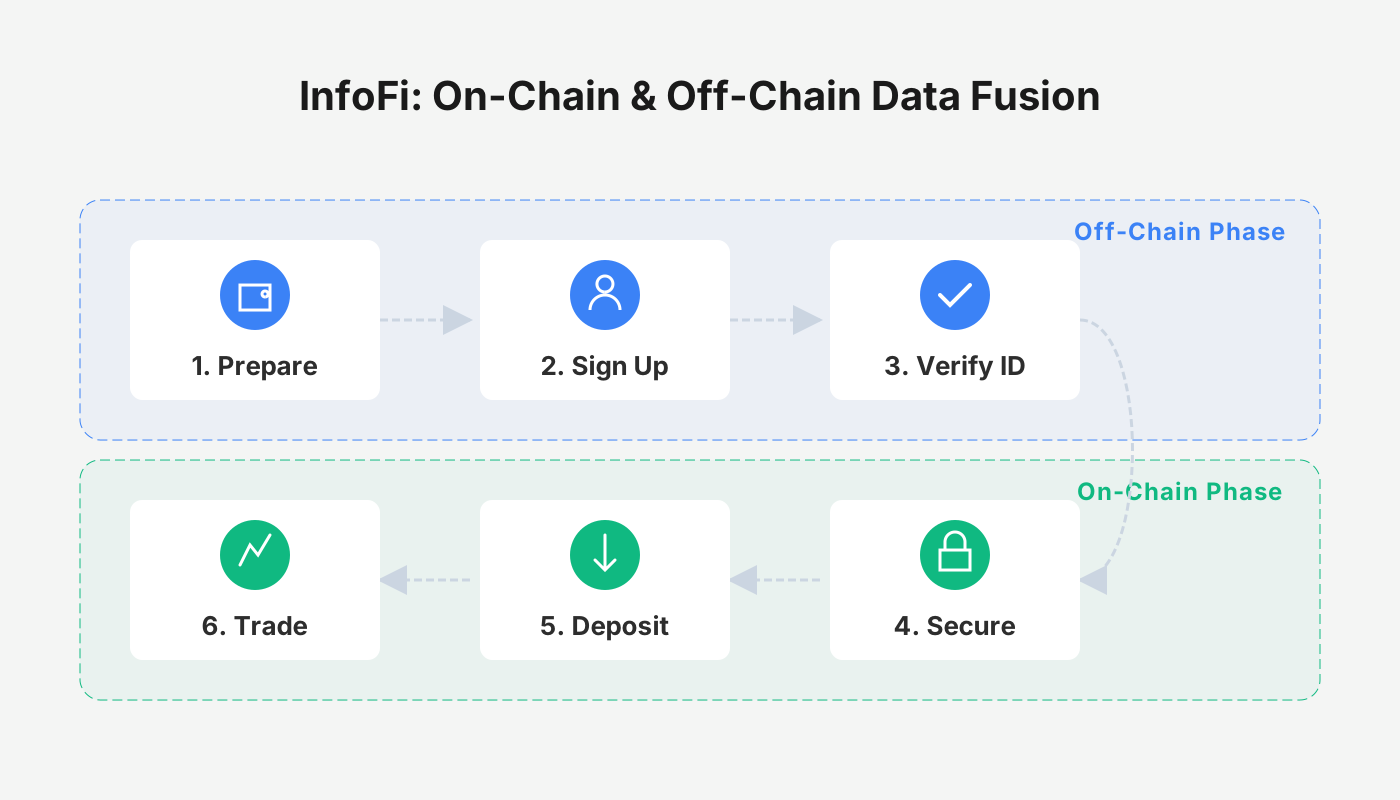
 We delve deeply into the concept and technical implementation of InfoFi in this article, exploring its core advantages in on‑chain and off‑chain data fusion, and assessing the main challenges and potential development paths, helping readers grasp the value and outlook of this emerging information‑finance paradigm.
What Is the New Web3 Concept InfoFi? Challenges and Future Development Analysis
InfoFi (Information Finance) combines on‑chain and off‑chain data with AI analysis to provide a crypto‑information‑finance service platform that can be queried in natural language.
What Is InfoFi
InfoFi is short for “Information Finance,” which can be rendered in Chinese as 资讯金融. It is not a single product but a class of emerging platforms whose core lies in:
- On‑chain ↔ off‑chain data fusion: Simultaneously capture wallet transactions, contract interactions, and community information from Twitter, Discord, GitHub, and other sources.
- AI‑driven semantic analysis: Convert user questions into structured queries through natural‑language processing.
- Executable insight output: Organize fragmented crypto information into understandable reports or actionable recommendations.
For example, when you want to learn about “the latest developments in Ethereum Layer 2,” you simply type a natural‑language query into the InfoFi interface. The system automatically aggregates Twitter discussions, GitHub commits, on‑chain data, and DAO governance records, then generates a concise summary and follow‑up action suggestions.
Why InfoFi Is Important
Traditional search engines (e.g., Google) and data platforms (e.g., CoinMarketCap, Etherscan) face the following limitations in a Web3 environment:
- Information fragmentation: Twitter, Mirror, Discord, GitHub, and on‑chain activity are scattered across many channels.
- High usage barrier: Powerful tools like Dune and Etherscan require a certain level of technical background.
- Lack of integration: There is no single entry point where “one sentence” can retrieve all relevant information.
InfoFi adopts an “Information‑as‑a‑Service” (Info‑as‑a‑Service) model that lets users ask questions in plain language, while AI delivers cross‑chain, cross‑platform real‑time responses.
Characteristics of the InfoFi Platform
Below are the common core functions of InfoFi tools, helping readers quickly capture the main points:
| Feature | Description |
|---|---|
| **Multimodal data integration** | Simultaneously processes on‑chain transactions, contract interactions, and off‑chain news, community posts, GitHub updates. |
| **Natural‑language search** | Supports conversational queries such as “What’s the hottest restaking project?” or “Which DAOs are currently voting?” |
| **Real‑time news summarization** | Automatically pushes alerts when community discussion spikes or on‑chain activity deviates, eliminating the need to wait for a report. |
| **Personal AI assistant** | After binding a wallet, the assistant can track portfolio dynamics, collate project news, and even draft research reports. |
Case Study: Kaito — A Pioneer of InfoFi
Kaito is hailed as “the Google + Bloomberg Terminal of Web3,” aiming to build a unified information gateway for the crypto world. Its core functionalities include:
- Web3 unified search engine
- Integrates 50+ data sources (Twitter, Discord, Medium, Mirror, GitHub, news sites, and on‑chain activity).
- Enter a keyword such as “EigenLayer,” and the platform presents all related information on a timeline or thematic association view.
- Knowledge graph and topic aggregation
- Automatically generates a “knowledge map” that displays related KOLs, topics, communities, and on‑chain interactions. For instance, searching “Restaking” links EigenLayer, AVS, associated wallets, and project progress.
- AI‑generated research reports
- Supports command‑style requests like “Compare zkSync and Scroll” or “Predict the most promising projects in the LSD sector.” The system consolidates the latest community and technical material into a ready‑to‑use investment memo.
- Personalized AI assistant
- Provides customized prompts based on wallet activity:
- Alerts if a held project has an important proposal awaiting a vote;
- Instant notification when a token’s Twitter buzz spikes;
- Helps generate DAO proposal summaries or translate technical documents.
- Institution‑grade features
- Offers hedge funds, crypto VC firms tools comparable to a Bloomberg Terminal, such as token screening, narrative‑heat dashboards, and custom tracking reports.
Real‑World Use Cases for InfoFi
1. Early Capture of Narratives and Alpha
Searching “Modular DAOs” will simultaneously display:
- Technical articles posted by developers on Mirror;
- Early discussions on Twitter;
- Airdrop predictions or token accumulation activities linked to the narrative.
2. Essential Tool for Airdrop Hunters
Querying “StarkNet airdrop tasks” returns:
- Github task guides;
- Discord snapshot instructions;
- Successful claim experiences shared on Twitter.
This helps users quickly complete tasks and seize airdrop opportunities.
3. Personal Investment Management
After binding a wallet, you can ask directly: “Which of my current holdings are losing money? Any new developments?” The AI analyses the portfolio together with relevant news and automatically generates a concise summary.
4. Deep Analysis for VCs and Research Institutions
For the “Real World Assets (RWA)” narrative, the platform aggregates:
- Community sentiment trends;
- On‑chain capital flows;
- Technical development activity;
- Investment‑firm holding data.
The Three‑Layer Logical Foundation of InfoFi
Re‑architecting Value Creation
Traditional airdrops measure “early value” through interaction behavior. InfoFi argues that information behavior itself is the starting point of consensus formation—each tweet, meme, or opinion contributes to the market’s future memory.
Persona‑and‑Identity Binding Mechanism
On‑chain addresses are pseudonymous, yet social actions are identifiable. InfoFi links off‑chain identity and expression style with on‑chain addresses, forming an influence‑weight system with personality traits, thereby improving the precision of airdrop distribution.
Coupling Narrative Timing with Capital Release
Project launch milestones are tightly coupled with peaks in social discourse; airdrops become levers that amplify early hype, subsequently releasing attention dividends. Under this structure, “talk‑driven participation” is no longer a cheap activity but a native “mining” mode of the information age.
- In PoS, capital serves as collateral;
- In InfoFi, influence itself is collateral.
Users “stake” their identity by expressing opinions and taking social risk, completing a full value‑creation pathway. When on‑chain behavior becomes mechanized and scripted, the only input that retains human warmth is “voice.” Consequently, the platform tends to reward genuine, non‑contract‑forgeable social trust.
Note: There are already cases where AI‑generated or spun‑out airdrop content is being used at scale. This requires InfoFi project teams to employ model optimization and identity‑verification mechanisms for governance. Much like the “site farms” and “content farms” of the Web2 SEO era, such noise can be disruptive but also drives system evolution.
InfoFi as a Positive Response to Attention Finance in Web3
Within the Web3 ecosystem, wallets constitute the cold‑start layer, granting “operational rights,” while social channels form the hot‑start layer, providing “speech rights.” Information precedes assets, allowing early users to naturally become “content distribution nodes.” They are not merely promoters; they create a “consensus air layer” that enables token release. This air layer is not empty—it represents informational friction that gives legitimacy to capital flow.
InfoFi’s built‑in mechanism can be summed up as: whoever creates a larger surface of social friction earns more tokens. In this framework, “talk‑driven participation” is a professional entry point into the social‑consensus mechanism rather than a shortcut. Treating information as a financial asset that participates in production relations is the formal answer InfoFi gives to the financialization of attention.
Challenges and Future Development of InfoFi
Main Challenges
- Data quality: Incorrect sources lead to inaccurate AI conclusions.
- Privacy and security: Binding wallets to accounts must protect user data rigorously.
- Commercial sustainability: Most platforms are still early‑stage, and monetization models are not yet mature.
Possible Evolution Paths
- Web3‑specific large language models (LLMs) will improve semantic understanding and industry‑specific knowledge depth.
- Open knowledge‑graph DAO, incentivized by tokens, will encourage the community to contribute high‑quality data.
- Native integration: More wallets, DEXs, and games will embed InfoFi search functionality directly.
- Compliance convergence: Deep integration with AML, risk‑control, and regulatory audit layers to boost institutional trust.
InfoFi is elevating crypto‑world information retrieval into a smart financial operating system. In an era of information overload, those who can efficiently acquire, interpret, and apply insights will secure the first‑mover advantage.
Whether you are an airdrop hunter, DeFi investor, DAO participant, or institutional researcher, an InfoFi tool like Kaito can help you see the “big picture” amid massive data and act swiftly.
---
This concludes the introduction to the new Web3 concept InfoFi, its challenges, and future development analysis. For more InfoFi content, search for previous articles by Bitaigen (比特根) or continue browsing the related posts below. We look forward to your continued interest and support for Bitaigen (比特根)!
Related Reading
- Kaito Token Soars 70%: InfoFi & Attention Economy Explained
- InfoFi: On‑Chain Reputation, Attention & Prediction Markets
- InfoFi: Tokenizing Data & Attention on Blockchain
💡 Register on Binance with referral code B2345 for the maximum trading fee discount. See Binance complete guide.



