
 Bitaigen Research
From both technical and commercial perspectives, we outline the key evolution of LayerZero from an ultra‑light‑node bridge to a decentralized communication platform, dissect its architectural innovations, ecosystem positioning, and security controversies. Read on to help you assess whether this cross‑chain solution is a reliable foundation or a potential risk.
Introduction
Cross‑chain bridges remain a critical piece of infrastructure in a multi‑chain ecosystem.
LayerZero first delivered bridge functionality using ultra‑light nodes, and later introduced a Decentralized Verifier Network (DVN) in V2, completing the transition from a simple bridge to a full‑featured multi‑chain communication platform.
In 2023, powered by the Ultra Light Node (ULN) architecture, LayerZero surpassed a $3 billion valuation. The following year, LayerZero V2 recorded 30 million on‑chain cross‑chain transactions, cementing its position as an industry leader. Its Omnichain vision has attracted top‑tier investors such as Sequoia, a16z, and Binance Labs, yet it also sparks heated debate over centralization and security concerns.
- Some critics label it “technical garbage” or a “super‑intermediary,” arguing that V1 is merely a framework lacking substance.
- Others praise its three‑year‑plus business‑model innovation, calling it a model of “strategic alliance.”
This article examines the technical design, evaluates LayerZero’s business model and security foundations, and discusses whether it is a sturdy bridge or a sand‑cast castle.
1. Technical Analysis: LayerZero’s Architectural Evolution and Security Assumptions
1.1 V1 – Ultra Light Node and Associated Risks
LayerZero V1 (hereafter V1) introduced the Ultra Light Node (ULN) concept: a lightweight contract is deployed on each chain solely to send and receive messages, while cross‑chain verification is delegated to off‑chain oracles and relayers.
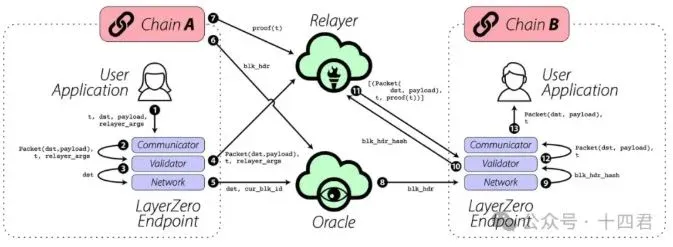
Source: LayerZero V1 official whitepaper, illustrating the interaction between Relayer and Oracle.
The core of V1 is “ultimate trust separation,” realized through a 2‑of‑2 multisig model that enables low‑cost cross‑chain transfers. While this design improves efficiency, it introduces several risks:
- Collusion risk: Security hinges on the social trust of off‑chain entities, lacking cryptoeconomic enforcement.
- Blurred liability: If an oracle or relayer ceases operation, messages cannot be delivered, harming availability (the 2023 Stargate bridge fee issue was dubbed a “cross‑chain assassin”).
- Chain‑level exposure: Full reliance on the underlying public chain’s security, with no intermediate arbitration layer.
- Centralization concerns: Although the protocol claims that Oracles and Relayers are “permissionless,” in practice they tend to concentrate among a few large operators; a 2023 Uniswap bridge governance vote highlighted criticism of V1’s excessive centralization.
1.2 V2 – DVN Mechanism and Its Security Analysis
In early 2024, LayerZero V2 (hereafter V2) added a Decentralized Verifier Network (DVN) at the verification layer, breaking the single‑model dependency on Oracle + Relayer.
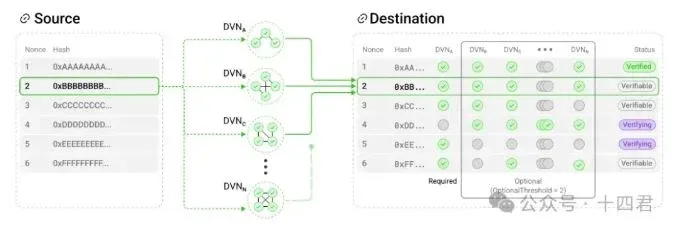
Source: LayerZero V2 official whitepaper, showing the multi‑group voting structure of the DVN.
V2 enables developers to compose multiple DVNs, allowing flexible security policies. Its main advantages include:
- Diverse sources – Teams may operate their own DVN or incorporate other bridges/networks (e.g., Wormhole, Axelar) as validators.
- Co‑existing verification schemes – The Arbitrum official bridge, Wormhole’s 19 guardians, Axelar’s PoS nodes, or MPC multisig can all be plugged in.
- User‑driven choice – A combination such as “Chainlink Oracle + LayerZero Labs DVN + Community DVN” raises customizability.
Nevertheless, security remains bounded by several factors:
- Security fragmentation – Different DVNs exhibit widely varying security levels; the weakest link determines the overall security posture.
- Selection risk – Developers who pick a single, low‑quality DVN directly expose themselves to attacks. Cost‑sensitive projects often opt for the cheapest single DVN, resulting in insufficient redundancy.
- System complexity – Combining multiple DVNs raises implementation difficulty; attackers may exploit code bugs rather than economic attacks (the Nomad bridge’s optimistic verification flaw resulted in a $190 M loss).
1.3 Technical Comparison Between V1 and V2
| Dimension | V1 (Ultra Light Node) | V2 (DVN) |
|---|---|---|
| **Compatibility** | Supports only mainstream EVM chains | Supports EVM, SVM, Move and other ecosystems; documentation and community are mature |
| **Security model** | 2‑of‑2 Oracle + Relayer, single‑point trust | Multiple DVN composition, enabling decentralized security; underlying safety still depends on DVN quality |
| **Liability** | Off‑chain failure leads to unavailability, unclear responsibility | Protocol layer is neutral; security liability shifts to the DVN(s) chosen by the application |
| **Ecosystem support** | Primarily early‑stage bridge tools | Serves as the cross‑chain communication standard for many DApps and wallets; higher degree of platformization |
Overall, V2 delivers a leap in compatibility and extensibility, yet its “decentralized” label is constrained by the actual concentration of DVNs. If the DVN ecosystem eventually expands to hundreds or thousands of independent validators with staking‑and‑slashing incentives ensuring honest behavior, LayerZero could truly shed the fragility of its trust model.
2. Implicit Shifts in the Cross‑Chain Landscape
2.1 Macro‑Trend in Capital Attention
Below is a financing overview of Web3 sectors from 2022‑2024:

Data sources are listed at the end of the article; methodology may vary slightly and are shown for trend illustration only.
Key observations:
- CeFi funding dropped sharply, indicating that 2022 still required external capital while many projects became self‑sustaining in 2023‑24.
- Web3 gaming saw a brief resurgence in 2024 thanks to Telegram hype, but demand is normalizing as the buzz fades.
- Infrastructure (including cross‑chain bridges) retained relative stability despite market uncertainty, making it a focal point for investors.
2.2 Are Cross‑Chain Bridges Still a Hot Investment Theme?
Bridges continue to hold a prominent position within infrastructure for four main reasons:
- Multi‑chain explosion – Cross‑chain capability is a necessity; controlling the “highway” that moves value across chains translates into fee revenue.
- Pain points and opportunities coexist – Bridges are pivotal for innovative use‑cases such as cross‑chain DeFi, cross‑chain NFTs, and inter‑chain identity, yet frequent security incidents mean stolen assets account for roughly 70 % of total crypto loss in the sector.
- Platform network effects – If a bridge protocol becomes the de‑facto standard (comparable to TCP/IP for the internet), early investors can reap outsized returns—this is a primary driver behind continued allocations from a16z, Jump, and others.
- From asset transfer to arbitrary messaging – Capital is increasingly focused on Arbitrary Message Bridge (AMB) potential; projects like LayerZero and Hyperlane position themselves as universal communication layers.
Although the number of financing rounds for new bridges fell in 2024, this does not signal a loss of interest; rather, the sector is maturing, and newcomers now face higher technical and regulatory hurdles.
2.3 Role Reversal of Bridges in a Multi‑Chain Era
Early bridges typically operated as independent service providers (the bridge). As the ecosystem matures, bridges are transitioning to underlying service providers (the “B‑side”), embedded within wallets or DApps:
- Backend‑as‑a‑service – Wallets such as MetaMask, OKX, and others integrate bridge aggregators; the bridge no longer directly serves end‑users (C‑side) but delivers value through B‑side partners, demanding easy integration and modularity.
- Polarized governance – In a “bridge‑controls‑user” model, the bridge decides which chains to support and sets fees. In large‑chain projects, governance votes determine which bridge to use, turning the bridge into a bidder competing for traffic.
LayerZero’s evolution mirrors this shift: V1 relied on oracles, making the bridge a B‑side component; V2’s multi‑DVN architecture positions the protocol as the A‑side orchestrator, while verification duties are outsourced to B‑side DVNs, altering revenue‑sharing dynamics accordingly.
2.4 LayerZero’s “Strategic Alliance” Playbook
LayerZero presents itself as a public utility for cross‑chain communication rather than the ultimate service provider. Its platformization strategy manifests in three ways:
- Security responsibility delegation – Validation security is left to the DVN(s) chosen by the user; the protocol layer offers a neutral framework. Should a cross‑chain theft occur, LayerZero Labs can assert that it does not hold custodial responsibility.
- Incentive alignment instead of subsidies – Partnerships are built through investment funds, ecosystem grants, and co‑development, rather than direct token subsidies.
- Capital endorsement – Shareholdings by Coinbase, Binance, a16z, Circle, and other institutions indicate broad acceptance among on‑chain ecosystem participants.
2.5 Why Has LayerZero Not Yet Reached a Series C Round?
To date, LayerZero has closed a Series B round at an estimated $3 billion valuation, but a Series C has not materialized. Publicly disclosed metrics show:
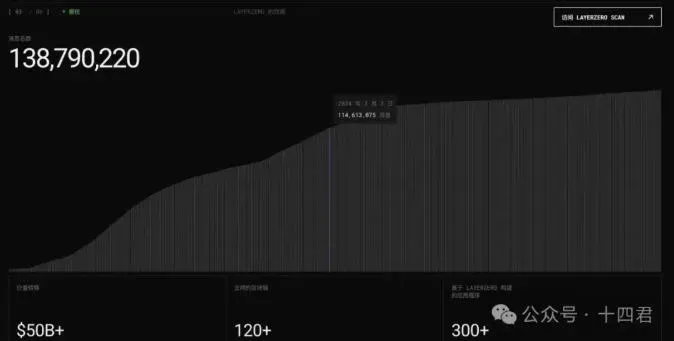
Source: LayerZero official website
- Total messages – 144 million to date, up from ~114 million a year ago; an annual increase of roughly 30 million messages (26.3 % YoY growth).
- Revenue estimate – Assuming a $0.10 fee per message yields about $3 million annual revenue; alternatively, a 0.06 % fee on $10 billion of transferred assets would generate roughly $6 million.
Even ignoring operating expenses, a $3 billion valuation translates into a price‑to‑earnings multiple well above 500×, far exceeding ratios of traditional internet giants. Consequently, a reasonably priced Series C round appears unlikely in the near term.
Tax note: Crypto‑related gains, including any income derived from using or providing LayerZero services, may be taxable under the user’s local jurisdiction. Recipients should consult a qualified tax professional and consider reporting requirements such as those for USD‑based transactions, SEPA/SWIFT transfers, or other fiat conversions.
Conclusion
Reviewing LayerZero’s three‑year trajectory reveals a full transition from a cross‑chain bridge to a platform‑level solution:
- V1 leveraged Ultra Light Nodes and a 2‑of‑2 multisig model to capture early market share quickly.
- V2 introduced a “framework‑as‑protocol” approach with DVN, offering flexible security compositions and a path toward decentralization.
Critics may argue that LayerZero “only acts as an intermediary,” yet its business logic focuses on delivering the most generic, stable base layer while delegating concrete implementations to market‑driven DVNs, thereby reducing its own risk exposure and expanding ecosystem reach.
From a technical standpoint, the V1→V2 evolution exemplifies the industry’s ongoing quest to balance security with decentralization. Commercially, the platform‑centric strategy, built on modularity and standardization, has attracted a large developer base and numerous on‑chain projects, securing LayerZero’s central role in the multi‑chain world.
Looking ahead, if the DVN ecosystem scales to hundreds or thousands of independent validators with robust staking‑and‑slashing economics and unified security standards, LayerZero could further enhance its decentralization degree and move closer to the ideal of a “bridge‑less” cross‑chain communication paradigm.
---
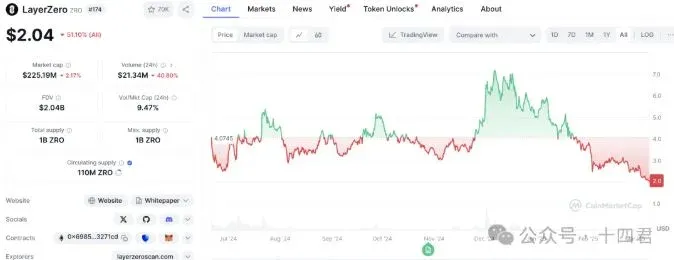
Source: CoinMarketCap
---
Related Reading
- Binance Wallet Cross‑Chain Bridge for Easy DeFi Transfers
- TON Blockchain Security: Key Risks and Optimization Strategies
- Understanding Ethereum Gas Fees: Costs, Validators, and Network Security
💡 Register on Binance with referral code B2345 for the maximum trading fee discount. See Binance complete guide.



