
 Bitaigen Research
 Binance announced an exciting development that sparked widespread discussion in the community: Block Street (BSB) has officially joined the Alpha‑version lineup. On March 4, Binance Alpha will become the first platform to support Block Street (BSB).
Block Street (BSB) is the native token of the project, serving three core roles: platform access, economic incentives, and on‑chain governance. It is the key asset that underpins the unified liquidity layer.
At the same time Binance confirms that a dedicated BSB airdrop program will be launched to reward Alpha traders. If you are interested in similar airdrop opportunities, Binance also offers a variety of other attractive reward schemes.
Block Street is a breakthrough infrastructure protocol designed to unify the fragmented crypto‑asset market and to provide a liquidity layer for on‑chain capital markets.

Block Street officially launched the BSB token — the soul of its ecosystem — and published a detailed token‑economics model. The project team notes that BSB will serve as the foundation for all network functions and governance, primarily fulfilling three strategic roles:
- Practical platform access
- Alignment of equity and economic interests
- Governance rights
From a long‑term perspective, the project recognises that, amid the explosive digitisation of global securities and real‑world assets (RWA), BSB acts as a central coordination layer. The token can link capital flows, operational capacity, and governance rights into a single infrastructure, preparing the ecosystem for the next generation of on‑chain markets.
In this article we outline the core concepts of Block Street (BSB), its token functions and ecosystem positioning, and combine Binance’s latest listing news to deeply analyse its economic model and potential market opportunities. By interpreting the technical framework and governance mechanisms, we aim to help readers comprehensively assess BSB’s long‑term value. Please continue reading.
1. What Is Block Street?
Block Street is an infrastructure layer that aims to build a unified liquidity system (a unified liquidity layer) for on‑chain capital markets. The project focuses on solving the fragmentation of tokenised real‑world assets (RWA), especially the challenges that arise when traditional equities are brought onto blockchain.
The advantage of Block Street lies in providing a “pipeline” that connects asset issuers, liquidity providers and decentralized applications, enabling capital to flow smoothly between traditional markets and the crypto space.
The leadership team brings together senior experts from large hedge funds such as Citadel and Point72, as well as leading technology firms like Google. Team members possess deep expertise in trading systems, risk management and highly scalable blockchain infrastructure.
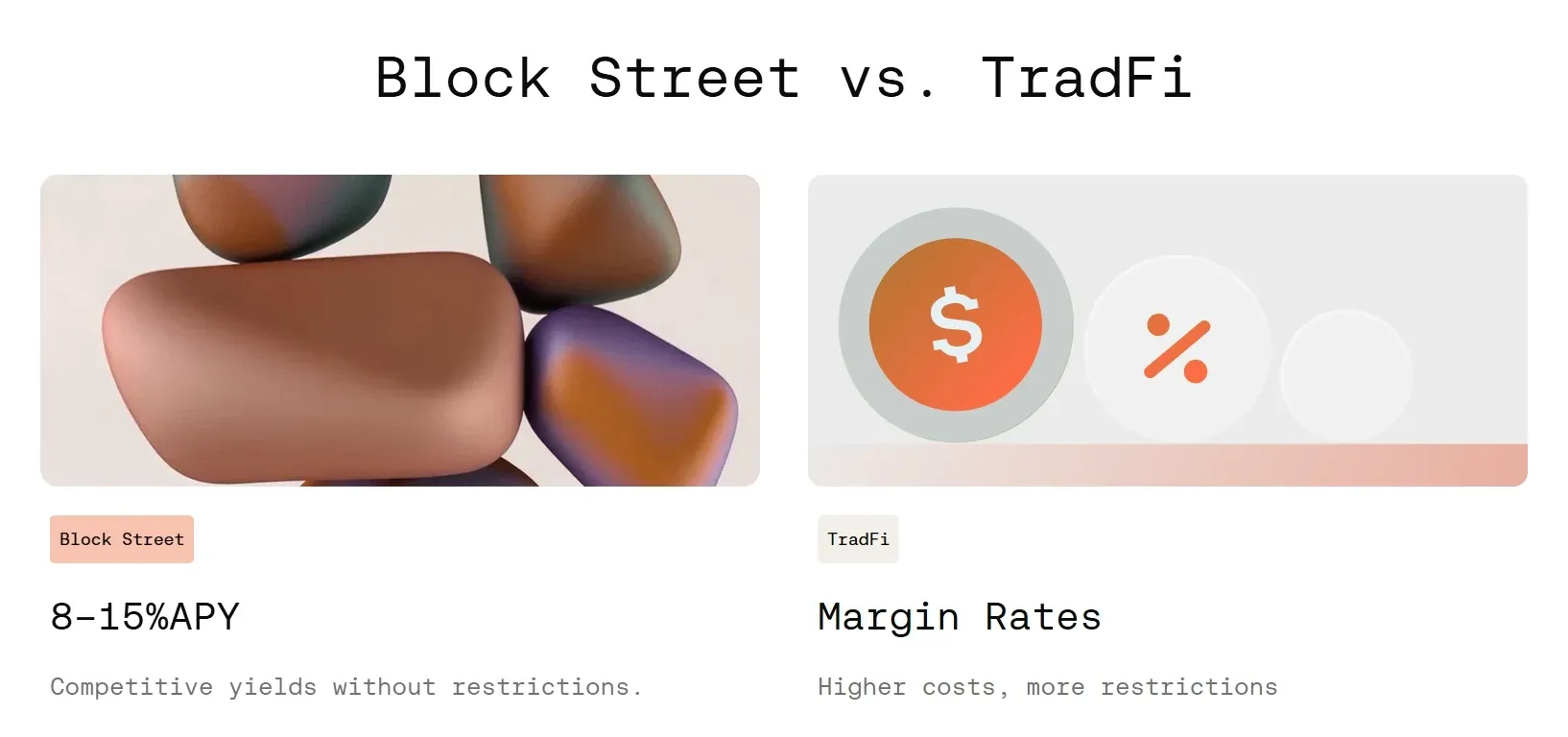
Investor Information and Recent Activity
- Funding: In a strategic financing round led by Hack VC, the project raised US $11.5 million, with participation from DWF Labs, Generative Ventures and StudioB among others.
- Network performance: The testnet hosts over 700,000 active wallets, a user retention rate of 35 %, and a daily login rate of 41 %.
2. BSB Token Details
- Token name: Block
- Symbol: BSB
- Airdrop date: March 4 10:00 UTC
- Platform: Binance Alpha (U.S. users should use Binance.US)
- Issuing networks: Ethereum and BNB Chain
- Total supply: 1,000,000,000 BSB
- TGE circulating supply: 20.775 % (equivalent to 207,750,000 BSB)
1. BSB Token Allocation
| Category | Percentage |
|---|---|
| Community & user incentives | 22.1 % |
| Ecosystem partners | 20.6 % |
| Exchanges & marketing | 10.65 % |
| Treasury bonds | 5.65 % |
| Team & advisors | 17.3 % |
| Major investors | 15.7 % |
| Strategic investors | 3 % |
| Liquidity | 5 % |
2. BSB Token Utility
BSB acts as the operational key on the Everst and Aqua platforms, allowing users to perform the following actions:
- Direct participation in trading programs and liquidity provision.
- Unlock higher‑tier order execution levels and receive fee discounts.
- Eligibility to access structured yield products and professional modules.
The staking mechanism of BSB is designed for sustainable growth, primarily through:
- Benefit alignment: Ensuring that liquidity providers and infrastructure participants jointly drive long‑term protocol prosperity.
- Commitment confirmation: Users holding large amounts of BSB receive priority access to special liquidity programs and trading position rights.
- Risk governance: Future implementation may introduce performance‑evaluation mechanisms based on capital discipline and stability.
Holders of BSB will have the right to decide key parameters of the unified liquidity layer, including:
- Adjusting fee structures and incentive schemes.
- Customising risk models within the hybrid liquidity engine.
- Defining listing standards for new assets.
- Managing funds and approving ecosystem grants.
3. Block Street Infrastructure and the Unified Liquidity Layer
The Block Street ecosystem runs on two complementary protocols: Aqua and Everst. Their combination constructs a complete infrastructure stack for digital capital markets.
1. Aqua – Cross‑Protocol Liquidity Network
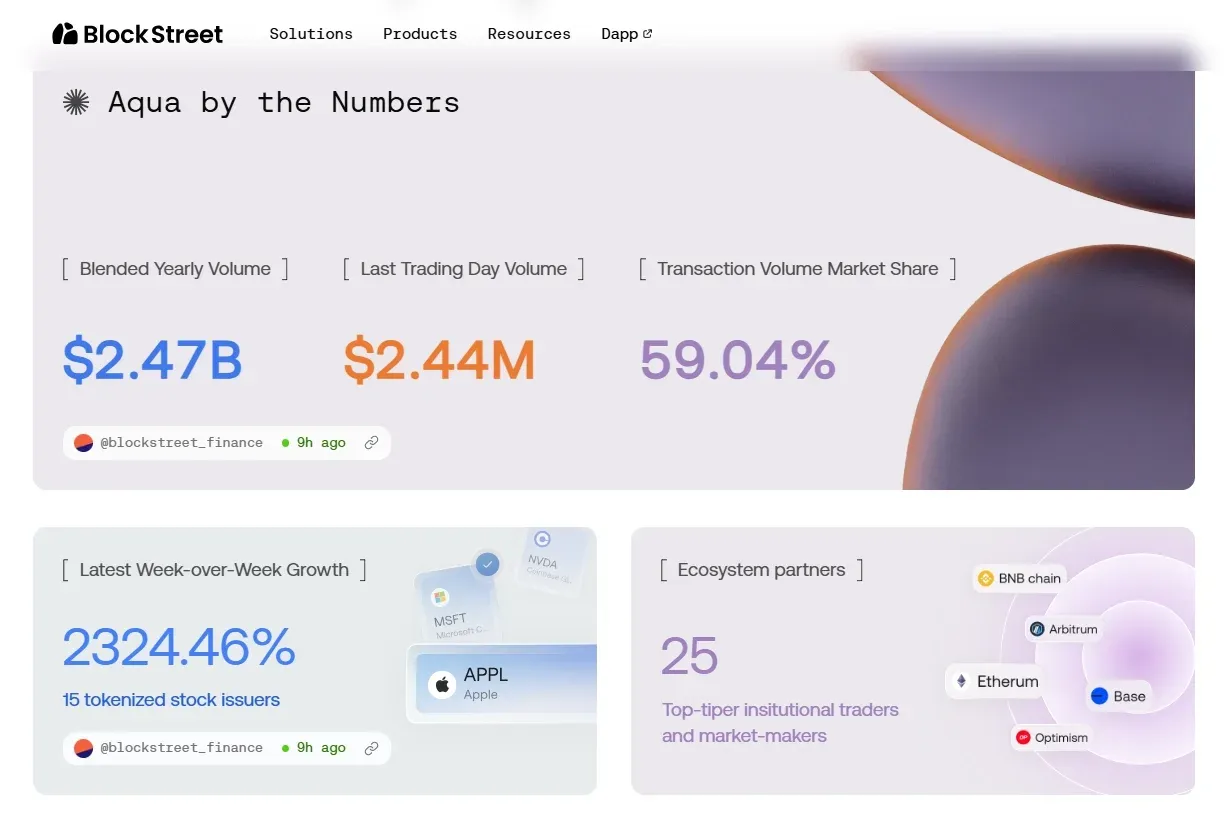
Aqua is described as the “pipeline system” of capital markets, using smart routing to solve asset fragmentation. It connects issuers and liquidity providers across multiple blockchains, including Ethereum, BNB Chain, Base and Monad.
Aqua effectively reduces the “fragmentation tax”, i.e., the 0.6 %–0.9 % loss caused by tracking errors.
2. Everst – Leverage and Liquidity Protocol
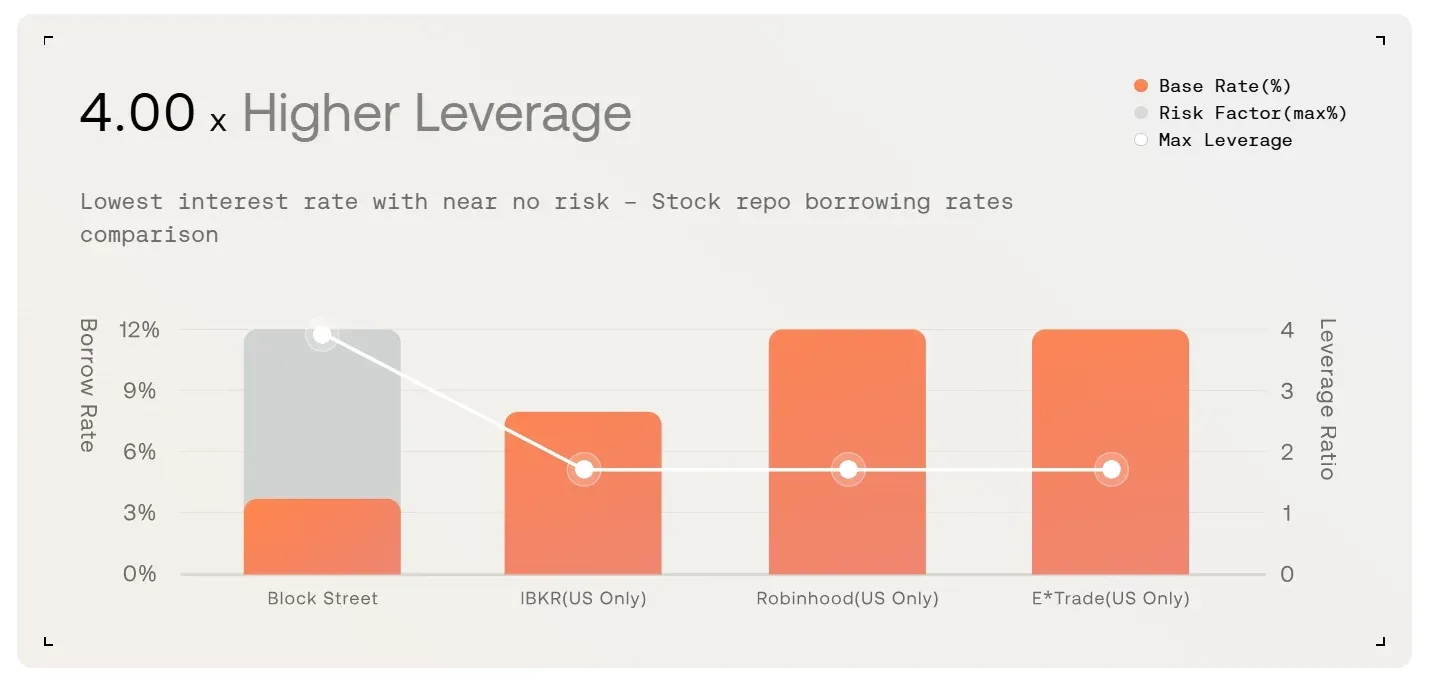
Everst is an application‑layer protocol that allows users to open leveraged positions using tokenised stocks as collateral. It employs a hybrid liquidity engine that blends off‑chain broker networks with on‑chain liquidity pools to achieve maximum capital efficiency.
4. Synchronous Operation Mechanism of the Block Street Ecosystem
The synergy between Aqua and Everst generates strong network effects, creating added value for every participant in the ecosystem. Aqua coordinates asset flow, while Everst serves as the “engine” that produces leverage and yield.
Beneficiary Groups and Specific Benefits
- Retail investors: Can directly access traditional equities (e.g., Apple, Tesla, Nvidia) within a DeFi environment, enjoying 24/7 trading. They may provide liquidity to earn yields or use leverage tools to hedge risk.
- Financial institutions: Offer low‑latency, high‑security professional order‑execution tools via institutional‑grade APIs for hedge funds and family offices.
- Developers and issuers: Receive a complete API toolkit that eliminates the need to build their own infrastructure, enabling seamless integration of RWA liquidity. Tokenised asset issuers can expand distribution through Aqua’s aggregation mechanism.
5. Main Highlights and Market Impact
Block Street is not only a platform for tokenised stock trading; it also represents a significant step toward reshaping the global financial architecture. The project aims to achieve a monthly trading volume of US $800 million by the end of 2026 and to capture 60 % of the institutional liquidity market share in the RWA sector.
Key Advantages
- Multi‑chain connectivity: Flexible support for Ethereum, BNB Chain, Base and especially Monad, enhancing transaction speed and reducing costs.
- Capital efficiency: A dynamic risk‑net‑settlement mechanism enables users to manage the risk of all positions and protocols in real time.
- Transparency & security: Clearing and asset management are fully automated by smart contracts, eliminating unnecessary intermediary interference.
The evolution of Block Street demonstrates that the future of finance lies in systematically bringing real‑world assets onto blockchain. By removing geographic and trading‑hour barriers, the project opens a new era for digital capital markets, placing liquidity and security at the forefront.
---
*Note: Transactions involving fiat on this platform can be settled via USD, SEPA or SWIFT, depending on the user’s location. U.S. residents should use Binance.US rather than the global Binance platform. Cryptocurrency gains may be subject to tax in the holder’s jurisdiction; users are advised to consult local tax regulations.*
The above constitutes the full content of “What is Block Street (BSB) token? Overview, token economics, token utility and market outlook analysis.” For more information on Block Street (BSB), please refer to other articles on Bitaigen (比特根).
Related Reading
- Block Street BSB Token: Governance, Liquidity & Roadmap
- XAUT Explained: Gold Backing, Pricing & Binance Buying Guide
- PIXEL Token: Binance-Listed Web3 Gaming Currency
💡 Register on Binance with referral code B2345 for the maximum trading fee discount. See Binance complete guide.



