
 Bitaigen Research
 As the blockchain ecosystem matures, the secure sharing of cross‑chain data, privacy protection, and verifiability have become the key bottlenecks driving the industry forward. Brevis leverages zero‑knowledge proof (ZKP) technology to offer a brand‑new solution for data interaction in multi‑chain environments.
In this article we dive deep into Brevis’s technological underpinnings and ecosystem layout, explain its innovative advantages in cross‑chain data security, privacy, and verifiability, and explore its future application prospects and partner ecosystem. If you want to understand how this ZKP solution can power Web3 data interoperability, keep reading.
7. Market Impact of Brevis
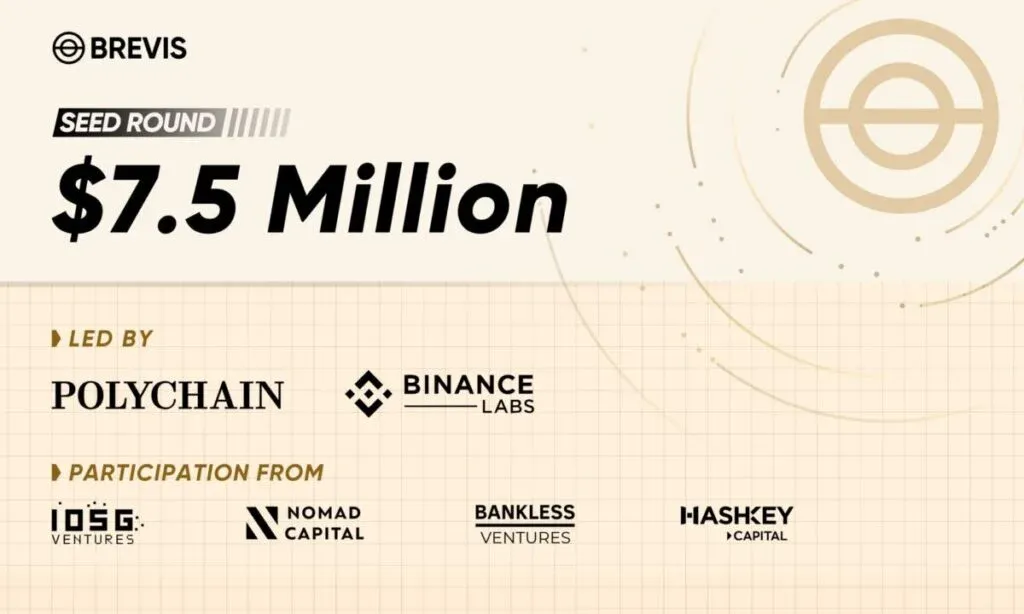
- Funding strength: In November 2024 the project closed a $7.5 million USD seed round, led by YZi Labs and Polychain Capital, with participation from IOSG Ventures, Nomad Capital, Bankless Ventures, HashKey Capital and others. The breadth of investors signals strong confidence from the capital market in both the technical direction and commercial outlook.
- Technical innovation: The platform boasts a unique architectural design for zero‑knowledge multi‑chain data proofs, an open query marketplace, and aggregated verification, setting a leading direction for the industry.
- Ecosystem deployment: Several node operators and leading projects have already joined, forming a collaborative network centered on zkFabric, zkQueryNet, and zkAggregatorRollup, which together advance Web3 data interoperability and cross‑chain collaboration.
2. Vision of Brevis
Current Web3 dApps are typically limited to reading the present on‑chain state; they struggle to access historical records, cross‑chain information, or complex on‑chain events. This limitation narrows the functional boundaries of decentralized applications. For example:
- Absence of incentive models based on historical behavior
- Difficulty building on‑chain identity, reputation, or social graphs
- Insufficient secure inter‑operability for cross‑chain assets and states
Brevis aims to build a ZK full‑chain data computation and verification platform, enabling dApps to securely, trustlessly, and automatically retrieve any information across multiple chains (including asset transfers, contract calls, event logs, state roots, etc.). In doing so, it injects “data intelligence” and “cross‑chain capability” into Web3.
3. Product Components
3.1 Pico zkVM
Pico is an open‑source zero‑knowledge virtual machine (zkVM) that adopts a “glue and coprocessor” innovative architecture, merging the efficiency of dedicated circuits with the flexibility of a general‑purpose zkVM. It redefines how decentralized applications can be built securely, scalably, and with high performance. Developers can customize proof systems to satisfy diverse cryptographic requirements.
Core features
- Fully decentralized, with no reliance on centralized nodes or data services, guaranteeing the integrity and verifiability of data sources.
- Currently compatible with Ethereum L1/L2; additional chains are planned for future expansion.
- Modular design supporting multiple consensus mechanisms (e.g., PoS) and block structures.
3.2 zkCoprocessor
This module offers computation outsourcing for smart contracts, focusing on on‑chain historical data analysis, state queries, and complex logic verification under zero‑knowledge.
Main advantages
- Developers submit on‑chain state‑query requests; Brevis generates a ZK proof that certifies the accuracy of the returned data.
- Applicable scenarios span DeFi risk controls, on‑chain reputation systems, cross‑chain verification, and other DApp use cases.
- Trust‑less, permissionless: Anyone can act as a Prover to generate ZK proofs for computation tasks, and the results are inherently trustworthy.
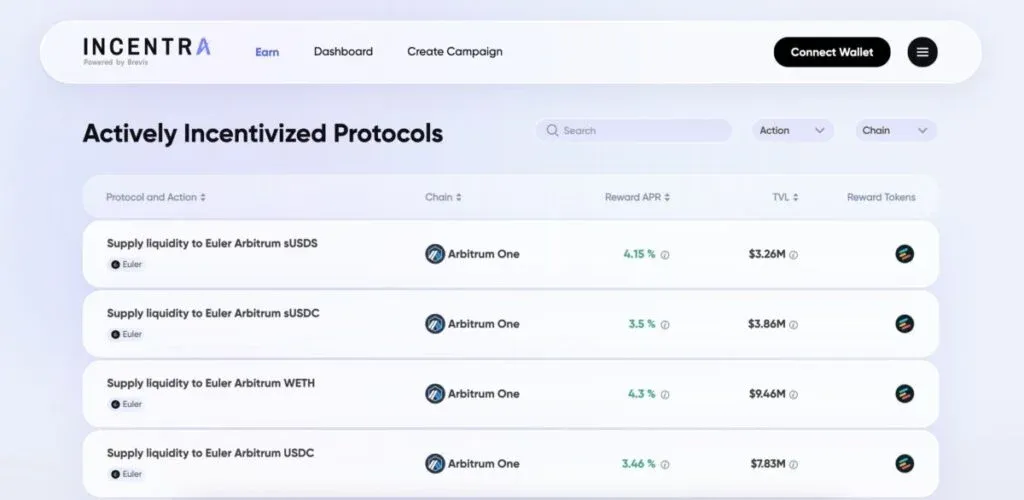
3.3 Incentra
Incentra is a decentralized incentive‑distribution platform built on top of zkCoprocessor. Its purpose is to connect DeFi protocols, liquidity providers, and ordinary users in a secure, trustworthy manner. By rewarding actions such as providing liquidity, holding tokens, and interacting with protocols, Incentra helps boost a protocol’s total value locked (TVL) and user activity, fostering healthy ecosystem growth.
Mechanism overview
- Incentive tasks are broken down and allocated to multiple participants.
- A hybrid off‑chain aggregation + on‑chain verification model improves efficiency.
- Economic incentives ensure network security and high‑performance operation.
- Supports single‑step tasks, multi‑step computations, and aggregated proofs, among other task types.
4. Core Advantages of Brevis
- High efficiency: Built on cutting‑edge ZK cryptographic algorithms and parallel computation, the platform can quickly process large‑scale, complex data sets, satisfying dApps that demand ultra‑low latency.
- Diverse developer tools: An easy‑to‑use SDK compatible with mainstream programming languages lets developers flexibly read historical states, transaction histories, contract events, and craft custom complex computation logic.
- Full‑chain compatibility: A unified interface accesses data across multiple chains and performs computation, simplifying cross‑chain application development while preserving a seamless user experience.
- Low trust assumptions: All data acquisition, computation, and verification are secured by zero‑knowledge proofs, eliminating reliance on third‑party trust and markedly improving security and scalability.
5. Application Scenarios
- Data‑driven DeFi incentives: Real‑time retrieval and verification of user historical behavior enable loyalty rewards, dynamic fees, or on‑chain governance voting power.
- zkBridges (zero‑knowledge cross‑chain bridges): ZK proofs guarantee the safe migration of assets and information between chains, enhancing reliability and efficiency of cross‑chain communication.
- zkDID (zero‑knowledge identity systems): Provide trustworthy identity and behavior proofs without exposing private data, useful for on‑chain social platforms, financial services, and reputation frameworks.
- Complex data analytics and cross‑chain oracles: Power multi‑chain data analysis and oracle construction, supplying foundational data for next‑generation DeFi, social, gaming, and other applications.
6. Ecosystem Partners
6.1 Project Deployments and Scenario Collaborations
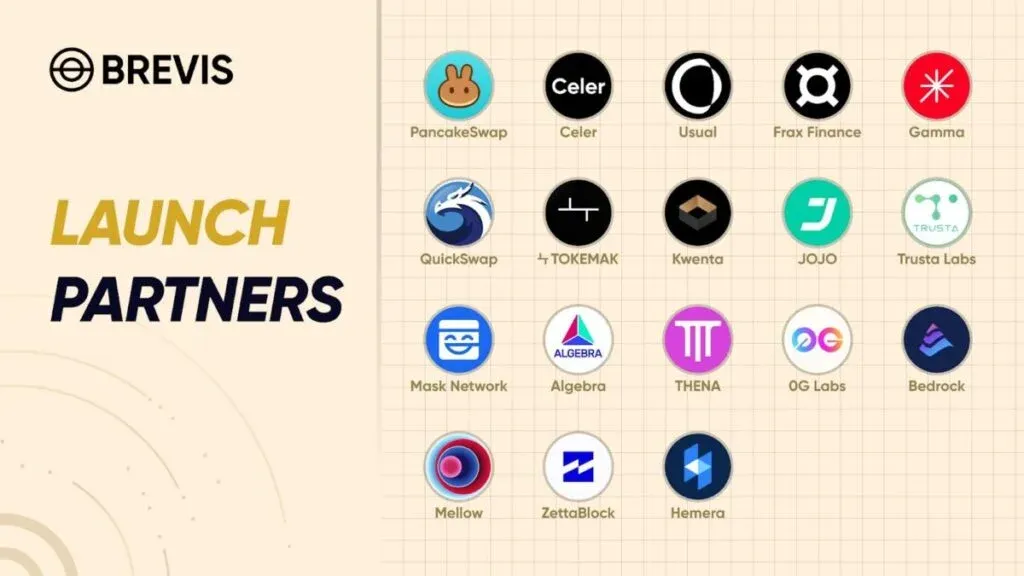
Brevis has forged deep collaborations with numerous industry‑leading projects across DeFi, NFT, social, and data‑service sectors. Representative cases include:
- QuickSwap – Integrated Brevis technology to implement a dynamic fee mechanism, boosting AMM liquidity and yields.
- PancakeSwap – Added intelligent trading features, increasing user stickiness and protocol activity.
- Usual Money – Leveraged Brevis for ZK‑driven reward and revenue distribution.
- Beraborrow – Utilizes Brevis to continuously provide protocol incentives, driving ecosystem vitality.
6.2 Node Operators and Collaborative Network
Brevis’s decentralized co‑processing network has attracted several well‑known node service providers, including Staketab, Ankr, CoinSummer, Luganodes, 01node, and Finoa Consensus Services. Together they maintain the security, stability, and high availability of the Brevis coChain AVS mainnet.
1. What Is Brevis?
Brevis is a zero‑knowledge (ZK) full‑chain data proof platform that enables decentralized applications to read, compute, and utilize arbitrary data across multiple blockchains without needing to place trust in any single party. Its use cases are broad, covering data‑driven DeFi, zkBridges, on‑chain user acquisition, zkDID, social‑account abstraction, and more.
The above content systematically outlines Brevis’s concept, vision, technical strengths, typical applications, and ecosystem partners. For deeper analysis of the Brevis project, stay tuned to Bitaigen’s (比特根) future coverage.
*Note*: Crypto gains may be taxable in your jurisdiction; consult local tax regulations. For users in the United States, fiat on‑ramps and withdrawals should be conducted via Binance.US (not the global Binance platform) using SEPA/SWIFT or other supported methods.
Related Reading
- Multi-Chain Era: Cross-Chain Bridges Unite Blockchain Assets
- How to Look Up a Blockchain Contract Address Quickly
- 5 DeFi Trends & 14 Projects to Watch in 2024
💡 Register on Binance with referral code B2345 for the maximum trading fee discount. See Binance complete guide.



