
 Bitaigen Research
 We systematically outline the basic concepts and operating mechanisms of liquidity mining in this article, helping readers understand how to earn passive income such as trading fees, lending interest, and governance tokens by providing liquidity. We also break down the key risks and practical considerations. Continue reading for a complete guide to getting started and evaluating suitable projects.
What Is Liquidity Mining and How Does It Work?
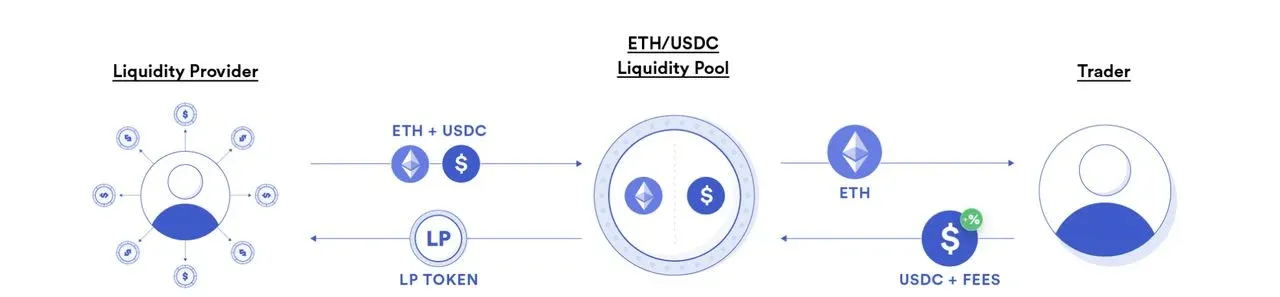
Liquidity mining refers to users depositing crypto assets into the liquidity pools of decentralized finance (DeFi) protocols to support trading or lending activities, and receiving rewards in return. These rewards fall into three main categories:
- Trading fees – When other users swap tokens within the pool, they pay a fee (a percentage of the trade). That fee revenue is distributed proportionally among all liquidity providers (LPs).
- Lending interest – On lending platforms, borrowers pay interest on the funds they draw. That interest is funneled into the pool and returned to LPs.
- Governance tokens – Many protocols also issue native tokens such as UNI, CAKE, COMP, AAVE, etc. Holders of these tokens can participate in protocol governance and enjoy voting rights.
The core purpose of these incentives is to ensure the market has sufficient depth so that traders and borrowers experience low slippage. Liquidity pools are essentially smart‑contract‑managed vaults that use an automated market maker (AMM) model to keep asset balances and compute prices. When a trade occurs, the fee is automatically routed to LPs. After depositing assets, users receive corresponding LP tokens, which can be redeemed at any time for the original capital plus any accrued earnings.
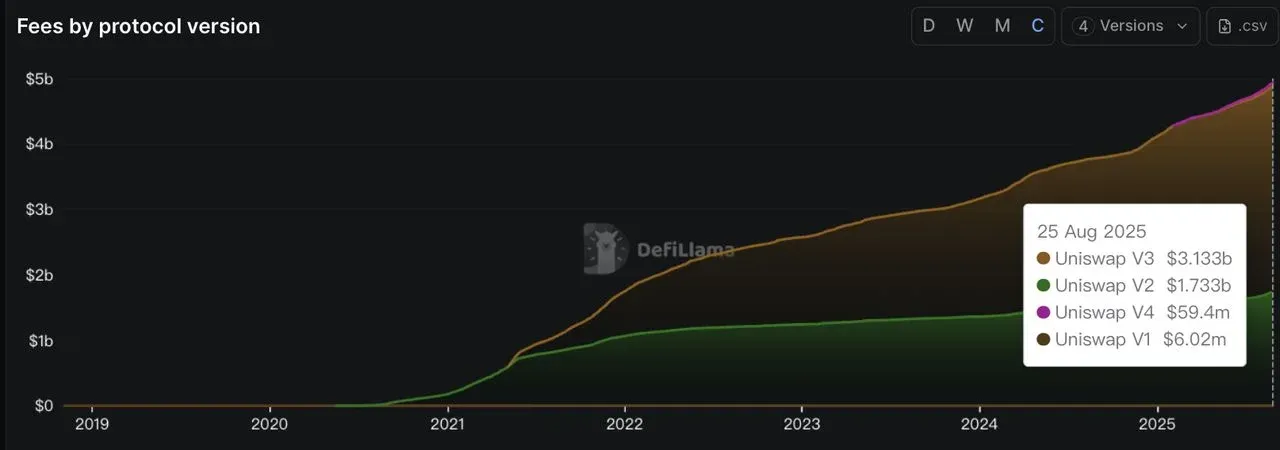
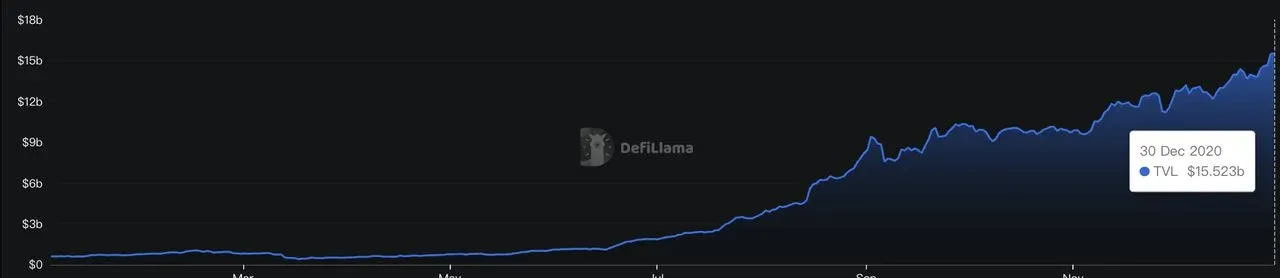
Since its launch in 2018, Uniswap has paid its liquidity providers nearly $4.8 billion in fees (source: DefiLlama). By the end of 2020, the total value locked (TVL) across DeFi surged from under $1 billion to more than $15 billion (source: DefiLlama).
---
The History of Liquidity Mining: The 2020 “DeFi Summer”
Before the 2020 “DeFi Summer,” decentralized exchanges such as Uniswap already introduced liquidity pools, but rewards were limited to trading fees. In June 2020, Compound Finance launched its COMP governance token, fundamentally changing the landscape. Compound began distributing not only the interest generated by lending but also additional COMP tokens, turning liquidity provision into a lucrative revenue stream.
The innovation attracted massive capital inflows. Compound’s TVL jumped from under $100 million to over $600 million within a few weeks, catalyzing broader DeFi expansion. Shortly after, SushiSwap executed a “vampire attack” on Uniswap, siphoning liquidity and issuing SUSHI tokens. Curve and Balancer followed suit with their own token incentives to jump‑start their ecosystems.
These cases demonstrate that liquidity mining evolved from a short‑lived experiment into a core growth engine for DeFi, driven by dual incentives of fees and governance tokens.
---
How to Become a Liquidity Provider on a DeFi Protocol
The process of becoming an LP is fairly standardized. The following steps can help beginners get started quickly:
Step 1: Prepare a Crypto Wallet
Download a DeFi‑compatible wallet (e.g., MetaMask, Trust Wallet) and transfer the tokens you plan to allocate into that wallet.
Step 2: Choose a Target Protocol
- Decentralized Exchanges (DEXes) – Examples include Uniswap and SushiSwap. You must supply an equivalent value of two tokens (e.g., ETH/USDC) to earn trading fees and possibly governance tokens.
- Lending Platforms – Examples include Aave and Compound. A single token can be deposited, with returns coming from borrowers’ interest and any protocol‑issued token rewards.
- Stablecoin Pools or Yield Aggregators – Examples include Curve’s 3‑pool, Yearn Finance, Beefy Finance. These suit users who want automatic optimization of yields across multiple protocols.
Step 3: Deposit Assets and Receive LP Tokens
Connect your wallet to the chosen protocol and submit the required tokens. The protocol will mint LP tokens or deposit receipts that represent your share of the pool.
Step 4: Claim and Manage Rewards
Rewards accrue over time in the form of fees, interest, and governance tokens. Most platforms allow you to claim manually, or you can auto‑compound rewards by reinvesting them.
Step 5: Redeem at Any Time
Whenever you wish, you can burn your LP tokens to retrieve your principal together with any earned returns.
Tip for Newcomers: Start with a small amount on reputable, audited protocols. Once you’re comfortable with the mechanics, you can gradually increase exposure or experiment with more complex strategies.
---
Advantages of Liquidity Mining
- Passive Income – Earn fees or interest simply by supplying liquidity; additional governance tokens can further boost returns.
- Open Market‑Making – Traditional market‑making is dominated by institutions, whereas DeFi enables any token holder to participate and profit.
- Portfolio Diversification – A single pool may hold multiple assets, ranging from low‑risk stablecoin pools to high‑volatility token pairs, catering to various risk appetites.
- Governance Participation – Governance tokens grant voting rights on protocol proposals, allowing you to influence future development.
- Ecosystem Contribution – Deep liquidity reduces slippage, improves the efficiency of DEXes and lending platforms, and supports overall DeFi health.
---
Liquidity Mining vs. Yield Farming: What’s the Main Difference?
Yield farming is a broader strategy that moves assets across multiple DeFi protocols to chase the highest possible return. It can involve lending, staking, borrowing, and re‑investing earned tokens into other pools, creating compound interest effects. Liquidity mining is a subset of yield farming that focuses specifically on supplying liquidity to exchanges or lending pools to earn fees and governance tokens.
In short, liquidity mining is relatively straightforward and suitable for beginners, while full‑blown yield farming requires more frequent asset reallocation and a higher risk tolerance.
---
Liquidity Mining vs. Staking Liquidity: How to Choose?
| Feature | Liquidity Mining | Staking Liquidity |
|---|---|---|
| Required Assets | Paired tokens (e.g., ETH/USDC) | Single token (e.g., ETH) |
| Revenue Sources | Trading fees + governance tokens | Staking rewards + derived tokens |
| Risk Level | Higher (impermanent loss, token volatility, contract risk) | Lower (protocol risk, derived token price swing) |
| Operational Complexity | Medium‑to‑high; requires monitoring | Low; can be set and forgotten |
| Ideal Audience | Users seeking higher yields who can tolerate volatility | Investors preferring stable, long‑term returns |
Decision Guidance
- If you are comfortable with higher volatility and want to engage actively in DeFi trading, liquidity mining may be appropriate.
- If you prefer lower risk and relatively stable returns, staking liquidity is the better option.
Many participants combine both approaches, for example by using already‑staked tokens as collateral for a liquidity pool to layer earnings.
---
Risks and Considerations Before Starting Liquidity Mining
- Impermanent Loss – When the price ratio of the two tokens in a pool diverges, the value of your LP share may fall below simply holding the assets outright.
- Smart‑Contract Vulnerabilities – Bugs or attacks (e.g., flash‑loan exploits) can lead to loss of funds.
- Reward‑Token Volatility – Governance tokens often experience sharp price swings, which can erode real‑world returns.
- Market Conditions – Declining trading volume or a bearish overall market reduces fee income.
- Regulatory Uncertainty – DeFi operates in a gray‑area regulatory environment; future policy shifts could affect participation methods or reward distribution.
Before allocating capital, assess these factors carefully and devise a money‑management plan that aligns with your personal risk tolerance. *Note: Crypto earnings may be taxable in many jurisdictions; consult a tax professional regarding local obligations.*
---
Market‑Size Overview
Since its launch in 2018, Uniswap has collected nearly $4.9 billion in user fees, of which roughly $4.8 billion has been directly passed to LPs. With a current daily trading volume of about $4.5 billion, LPs can earn roughly $2.5 million–$3.5 million per day in rewards. Similar figures appear on other platforms: PancakeSwap has distributed close to $3.3 billion to liquidity providers since 2020, while Aave’s depositors have accrued around $1.45 billion in lending‑interest income.
---
Conclusion
Since the 2020 DeFi Summer, liquidity mining has become a cornerstone of decentralized finance. By allocating assets to exchanges or lending protocols, LPs share in trading fees, interest income, and governance‑token distributions while supplying the market with essential liquidity that enhances overall efficiency. Although the model offers attractive passive‑income potential, it also carries impermanent loss, smart‑contract risk, and regulatory ambiguity that cannot be ignored.
For newcomers, we recommend starting with modest amounts on well‑audited platforms, mastering the reward mechanics, and then gradually scaling up or exploring hybrid strategies that blend yield farming and staking. As the DeFi ecosystem continues to expand, liquidity mining will remain a vital driver of the crypto economy’s growth.
For more hands‑on tips about liquidity mining, search for prior Bitaigen (比特根) articles or continue reading the linked resources below. Thank you for following Bitaigen (比特根) and for your support!
Related Reading
- DeFi Liquidity Mining: Boost Capital Flow & Trade Efficiency
- 5 DeFi Trends & 14 Projects to Watch in 2024
- BNB Chain Season 9 MVB Accelerator Announces 16 Projects
💡 Register on Binance with referral code B2345 for the maximum trading fee discount. See Binance complete guide.



