
 Bitaigen Research
 In this article we systematically outline the scenarios and practical steps for looking up a token’s contract address, helping users quickly pinpoint the correct address when trading, adding tokens to wallets, or invoking contracts, and we provide useful tips for avoiding forged addresses. Mastering these fundamentals makes subsequent asset management and development safer and more reliable, so it’s worth reading carefully.
When Do You Need to Look Up a Token’s Contract Address?
1. Conducting a Trade
When you want to buy or sell a particular token on an exchange or a decentralized platform, you must know that token’s contract address. Only by providing the correct contract address can you complete transfers, purchases, sales, and related operations.
2. Adding a Token to a Wallet
When manually adding a new token to a hardware wallet, software wallet, or mobile wallet, you also need to enter the corresponding contract address so the system can recognize the token and display its balance.
3. Invoking a Contract
Whether you are a developer building a front‑end interaction page or participating in secondary development of a smart contract, you need the contract address to call the appropriate contract functions.
---
What Is a Token’s Contract Address Used For?
A token contract is essentially a smart contract that records the relationship between account addresses and their balances. Every contract has a unique “garbled” identifier—its contract address. With this address, users can:
- Query holdings, transfer history, and the contract’s internal code details.
- Understand the token’s total supply, minting (creation) or burning mechanisms.
- When a token moves from one account to another, the contract automatically updates the balances on both sides.
- For contracts that support additional issuance, new tokens can be minted to increase the total supply; to destroy tokens, they are commonly sent to an uncontrollable zero address (0x000…) to achieve an “unusable” effect.
In more complex scenarios, a contract may embed dividend distribution, governance, or other extension features, but its core remains the “address ↔ balance” mapping.
---
How to Ensure the Accuracy of a Token’s Contract Address?
In the digital‑asset space, fraudulent tactics that forge contract addresses appear constantly. To avoid losing assets due to an incorrect address, follow these steps:
1. Cross‑Check Across Multiple Sources
Look up the same token’s contract address on several reputable platforms (e.g., Etherscan.io, CoinMarketCap, TokenView, etc.) and verify that the results match.
2. Verify Official Information
Visit the project’s official website or its official social‑media channels and confirm that the contract address displayed there aligns with the addresses you have found.
3. Watch Out for Anomalous Patterns
Scammers sometimes generate “look‑alike” addresses through brute‑force methods for phishing. If the address structure looks odd or does not conform to the format published by the official source, exercise caution and pause any transaction.
---
How to Look Up a Token’s Contract Address?
Below we use Etherscan as an example to demonstrate the basic workflow for finding a contract address on a blockchain explorer.
- Open the Etherscan homepage and type the token name, symbol, or a known fragment of the address directly into the search box at the top of the page. Press Enter and you will be taken to the corresponding address detail page.
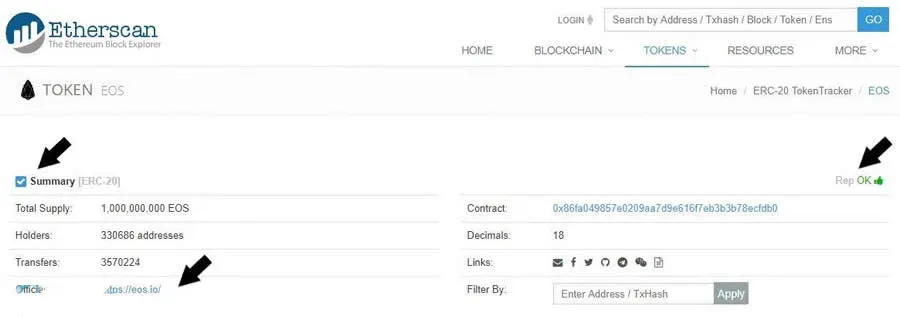
- On that page you will see all information related to the Ethereum address, as illustrated in the example screenshot:
1. Check Token Information
At the top of the contract page, the token’s logo, a link to its official website, and social‑media icons are usually displayed. Click these links and verify that the contract address shown matches the project you are interested in.
2. Review Token Reputation
Etherscan assigns a reputation rating to each token. The default status is “Unknown.” After the project team submits comprehensive information, the platform reviews it and may award a “Neutral” or “OK” badge. If the contract is flagged as “Suspicious,” “Unsafe,” or “Spam,” treat it with extra caution.
3. Pay Attention to the Blue Checkmark
Contracts bearing a blue checkmark are given higher priority in search results, helping users locate the official contract more quickly. This mark acts as a visibility weight applied by the platform.
---
Recommended tutorial: Where to Find a Token’s Contract Address? A detailed guide on how to locate token contract addresses
By following the steps above, you can quickly locate and verify a token’s contract address using a blockchain explorer. The page not only displays the address that created the contract, the block number, and the transaction hash, but also lists on‑chain data such as the token’s name, symbol, and logo, as well as off‑chain data like price, official website, and social media links. Most explorers provide an intuitive interactive interface that helps users interact with smart contracts safely and conveniently.
Related Reading
- Token Contract Addresses on Ethereum: Verify & Use
- DeFi Security Risks: Protecting Crypto Assets from Hacks
- OKX Pay: Simplifying Crypto Payments for Web3 Newcomers
💡 Register on Binance with referral code B2345 for the maximum trading fee discount. See Binance complete guide.



