
 Bitaigen Research
Modern society values efficiency; many opportunities are lost if they are not seized promptly. To help investors enter or exit positions more quickly, exchanges offer a highly efficient tool – the market order. It is akin to shouting “Driver, go now!” when hailing a taxi: regardless of traffic lights or congestion, the key is immediate action. Below we will explore how market orders work and the convenience they bring to trading.
In this article we dissect the mechanics of market orders, helping investors quickly decide when to use them and what risks may arise, while providing a systematic comparison with limit orders. Through examples and diagrams, you will master the essential techniques for boosting trading efficiency. Continue reading for practical operational guidance.
What is a market order?
A market order is an instruction from an investor to execute a trade immediately at the current market price. When placing the order you only need to specify the quantity; no price needs to be set. Its core advantage lies in execution speed – once submitted, the system completes the trade instantly at the best price available in the market.
Typical use cases:
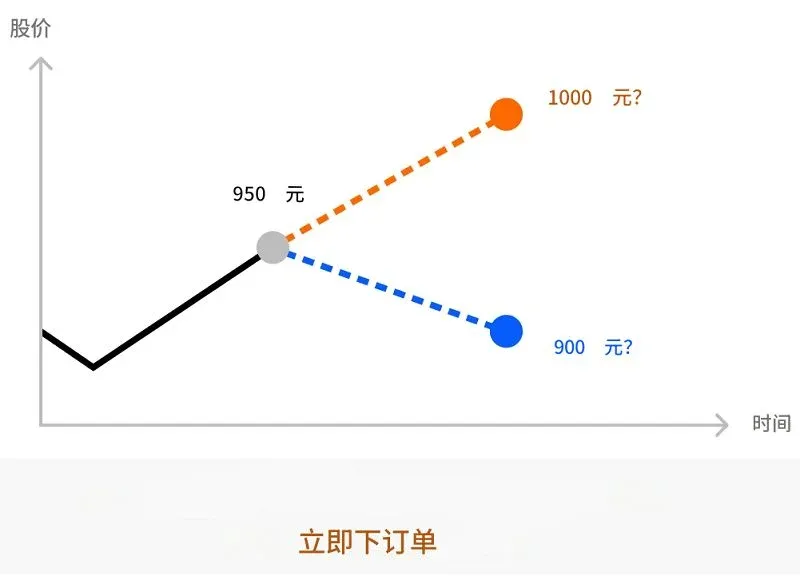
1. Fast entry
When a clear trading opportunity appears, a market order can buy instantly.
*Example:* Investor B sees a tech stock’s earnings report trigger a rapid price surge and immediately places a market buy order, successfully catching the move.
2. Fast exit
Useful for stop‑losses or locking in profits.
*Example:* Investor C holds a stock that drops sharply after an unexpected event, promptly issues a market sell order, and stops further loss.
How market orders are filled
The speed of a market order comes from directly matching the existing order book:
- Market buy order: Executes against the lowest ask price available.
- Market sell order: Executes against the highest bid price available.
Example: Assume a stock’s quote is:
- Highest bid: $100
- Lowest ask: $101
After submitting the order, the result is:
| Order type | Price | Execution |
|------------|-------|-----------|
| Market buy | $101 | Filled instantly |
| Market sell| $100 | Filled instantly |
This mechanism guarantees immediacy; investors do not have to wait for the price to reach a specific level.
Core advantages of market orders
1. Immediate execution, capturing opportunities
During volatile moves, a market order can be executed right away, preventing missed chances.
*Case:* A company releases positive earnings, the share price spikes within minutes, and Investor A uses a market buy order to get in early.
2. Simple operation, friendly to beginners
Only the quantity is required; no need to set a price.
3. Suited for short‑term and high‑frequency trading
Day traders can use market orders to open or close positions quickly, harvesting short‑term price swings.
Disadvantages and risks of market orders
1. Slippage risk
Slippage is the difference between the expected execution price and the actual price, especially noticeable in illiquid markets or during rapid price swings.
*Example:* An asset is quoted at $10. An investor submits a market buy order, but because the price moves quickly, the trade fills at $10.10, creating a $0.10 slippage.
- While a single trade’s deviation may seem small, large or frequent trades can accumulate substantial losses.
- When using market orders, stay vigilant about slippage and manage risk accordingly.
2. Market‑movement risk
Sudden events can cause prices to swing dramatically, and a market order may fill far above or below the anticipated level.
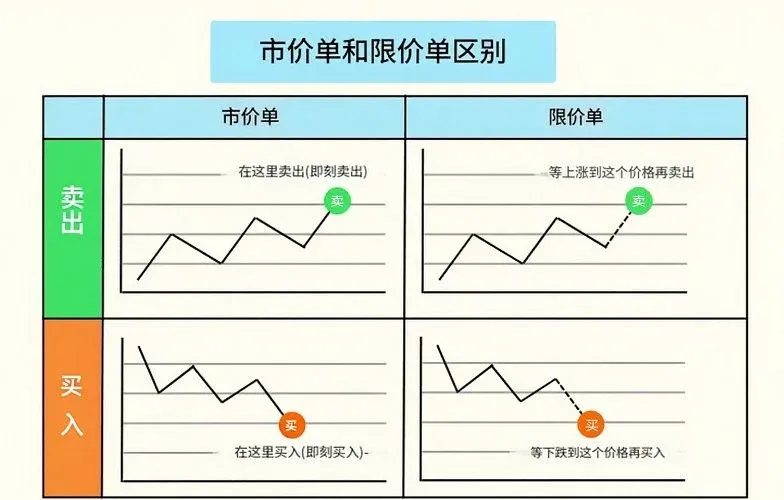
Market orders vs. limit orders
In financial trading, market orders and limit orders are the two fundamental order types, each with its own strengths and weaknesses. Understanding their differences is crucial for any investor.
Market orders
- Executed immediately at the current market price, ideal for traders who prioritize speed (e.g., day traders).
- Advantage: rapid execution.
- Disadvantage: possible slippage, especially in volatile or low‑liquidity markets.
Limit orders
- Executed only when the market reaches or improves upon a specified price, guaranteeing the trade price.
- No guarantee of immediate execution; if there is insufficient counterpart liquidity, the order may be partially filled or not filled at all.
Key characteristic comparison
| Feature | Market Order | Limit Order |
|---------|--------------|------------|
| Execution speed | Immediate | May be delayed |
| Price control | None | Precise |
| Slippage risk | Present | Minimal |
| Fill probability | High | Dependent on liquidity, possibly lower |
| Typical use case | Quick entry/exit | Cost control or profit locking |
Summary: Market orders chase speed; limit orders chase price control. Investors can choose flexibly according to their strategy.
Execution priority between market and limit orders
Within the order book, execution follows these rules:
- Market orders take priority over limit orders
Because market orders demand immediate execution, the engine first matches them against existing limit orders.
- Limit orders follow “price priority, then time priority”
- *Price priority*: Among buy limit orders, higher prices get priority; among sell limit orders, lower prices get priority.
- *Time priority*: When prices are identical, the earlier‑submitted order is filled first.
Market buy order matching against sell limit orders
Assume the sell‑side limit order book looks like this:
- Ask 1: $10.00, 100 shares
- Ask 2: $10.01, 200 shares
- Ask 3: $10.02, 150 shares
Investor A submits a market buy order for 400 shares. The fill sequence is:
| Sell limit order | Ask price | Quantity (shares) | Filled quantity | Cumulative filled |
|------------------|-----------|-------------------|-----------------|-------------------|
| Ask 1 | $10.00 | 100 | 100 | 100 |
| Ask 2 | $10.01 | 200 | 200 | 300 |
| Ask 3 | $10.02 | 150 | 100 | 400 |
The order first consumes Ask 1, then Ask 2, and finally the remaining 100 shares from Ask 3.
Market sell order matching against buy limit orders
Assume the buy‑side limit order book is:
- Bid 1: $9.99, 150 shares
- Bid 2: $9.98, 250 shares
- Bid 3: $9.97, 200 shares
Investor B places a market sell order for 400 shares. The fill sequence is:
| Buy limit order | Bid price | Quantity (shares) | Filled quantity | Cumulative filled |
|-----------------|----------|-------------------|-----------------|-------------------|
| Bid 1 | $9.99 | 150 | 150 | 150 |
| Bid 2 | $9.98 | 250 | 250 | 400 |
The order first matches with Bid 1, then the remainder matches with Bid 2.
Takeaway
- Market orders: Highest priority, executed swiftly.
- Limit orders: Subject to price‑first, time‑first rules; execution is not guaranteed. Choose based on market conditions and your trading objectives.
What is an auction market order?
In Hong Kong‑listed stocks, the opening auction runs from 09:00 – 09:22 and the closing auction from 16:00 – 16:10. During these windows, investors may submit auction market orders.
How the auction price is formed
All submitted orders are pooled together; the system selects the price segment with the greatest total volume as the uniform auction price, and then matches every order at that single price.
- Opening auction: the price is randomly determined between 09:20 – 09:22.
- Closing auction: the price is randomly determined between 16:08 – 16:10.
Difference between auction limit orders and auction market orders
- Auction limit order: If the final auction price is better than the limit price, the order fills at the auction price; if the auction price is worse, the order does not fill.
- Auction market order: Fills directly at the uniform auction price, regardless of any limit.
Important notes
- Order submission timing
Using the opening auction as an example, 09:20 – 09:22 is the “matching window.” If the auction price is generated at 09:21:01, any auction orders submitted before that moment will be filled at that price. Unfilled auction limit orders will roll over into continuous trading and continue waiting for execution.
- Execution priority
The same “price‑first, time‑first” rule applies. At the identical price level, auction market orders are matched before auction limit orders; if the price is the same, earlier submissions are prioritized.
- Modification and cancellation restrictions
- Opening auction: no modifications or cancellations after 09:15.
- Closing auction: no modifications or cancellations after 16:06.
How to use market orders effectively?
Although market orders carry certain risks, thoughtful management and combination with other order types can maximize their benefits.
- Pick the right market conditions
Deploy market orders during periods of high liquidity and relatively stable volatility to reduce slippage and price‑movement risk.
- Combine with other order types
You may simultaneously use market orders, limit orders, and stop‑loss orders within a single strategy. For instance, place a limit order to lock in a purchase price or a stop‑loss order to exit swiftly if the market turns against you.
- Control trade size
Align order size with your risk tolerance; avoid committing excessive capital in a single market order, which could amplify the impact of slippage or sudden price swings.
- Stay informed about market news
Monitor news and major events closely; exercise caution with market orders during abrupt market moves to avoid unfavorable fills.
Closing thoughts
A market order is essentially the “turbo‑boost” button in trading – lightning fast, but you still need to wear a seatbelt. When used wisely, it lets you enter positions instantly and stop losses promptly; used recklessly, it can lead to costly fills driven by impulsive decisions. The next time the market “goes berserk,” ask yourself whether you fear missing out more than overpaying, and choose the order type that aligns with that answer.
That concludes the article. For more on market orders, you can search for previous Bitaigen (比特根) pieces or follow the related links below. Thank you for supporting Bitaigen (比特根)!
*Note: Gains from cryptocurrency trading may be taxable under the laws of your jurisdiction. U.S. residents should use Binance.US rather than the global Binance platform for compliance with local regulations.*
💡 Register on Binance with referral code B2345 for the maximum trading fee discount. See Binance complete guide.



