
 Bitaigen Research
In recent years, the debate over whether Bitcoin can break the $1 million barrier has never ceased. At first, I also dismissed the figure as a pipe dream—Bitcoin’s market price was only a few thousand dollars, and imagining a fourteen‑fold jump seemed implausible. As my experience in the sector grew, I began to re‑examine the underlying assumptions behind that trajectory and discovered that I, like many analysts, was sharing the same cognitive blind spots when evaluating the opportunity. Below, I will dissect those blind spots and show that, under a set of relatively conservative premises, Bitcoin reaching a six‑figure price is not out of reach.¹
In this article we outline the macro‑economic and regulatory environment required for Bitcoin to breach a critical price level, dissect common misconceptions, and present potential pathways within a prudent assumption framework. By drawing lessons from the historical evolution of gold, we aim to help readers form a more comprehensive judgment. Subsequent sections will provide detailed arguments, so a careful read is worthwhile.
A Brief History of Gold
My systematic interest in gold began in 2004, when the United States launched its first gold‑backed ETF and the total global gold market capitalization stood at roughly $2.5 trillion—a size comparable to today’s Bitcoin ecosystem. Since then, gold’s market cap has climbed toward $40 trillion, delivering a compound annual growth rate (CAGR) of about 13 %. Drivers of this expansion include growing sovereign debt, heightened geopolitical risk, and accommodative monetary policy.
Gold Market Capitalization, 2004‑Present
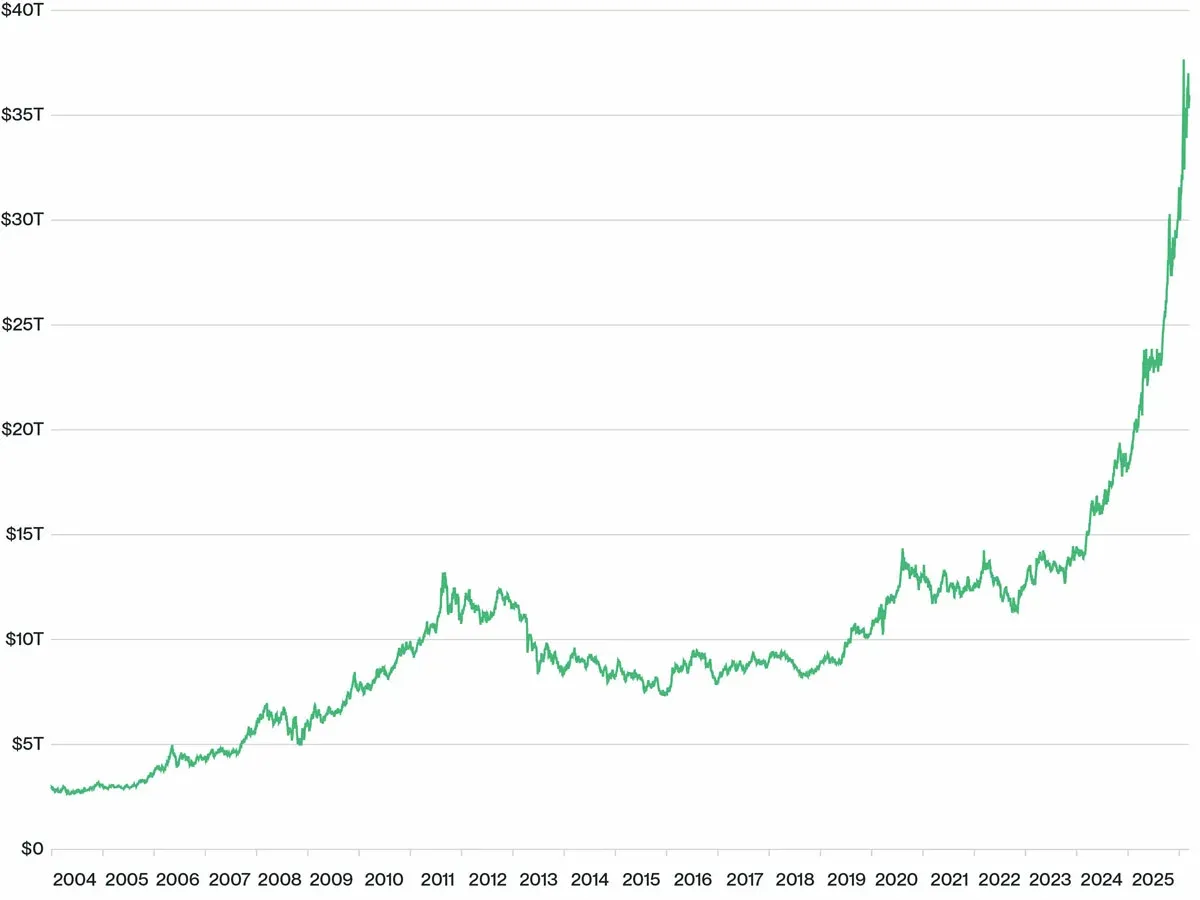
Source: Bitwise Asset Management, based on data from the World Gold Council and Bloomberg.
The chart above illustrates a clear expansion trend in the store‑of‑value segment over the past two decades. If this CAGR persists, the global store‑of‑value market could approach $121 trillion within ten years. In that macro context, Bitcoin would need to capture roughly 17 % of the market to push its price close to $1 million per coin.
How to Estimate Bitcoin’s Value
Treating Bitcoin as a novel store of value is the starting point of this analysis. Its function mirrors gold’s—providing holders with a wealth‑preservation tool outside fiat currencies and traditional financial systems—but it exists digitally, exhibits higher volatility, and has a much shorter history. Based on this premise, we can estimate its potential price in three steps:
- Determine the total size of the store‑of‑value market; currently about $380 billion (gold ≈ $360 billion, digital assets ≈ $14 billion).
- Assess Bitcoin’s share within that market; to date, Bitcoin accounts for less than 4 %.
- Multiply the market share by the total market size, then divide by Bitcoin’s maximum supply of 21 million coins to derive an implied per‑coin value.
Using today’s figures, Bitcoin would need to hold over 50 % of the store‑of‑value market to reach $1 million, a clearly daunting threshold. However, as noted earlier, market size is not static; continued expansion creates room for Bitcoin to increase its share.
At the same time, rising institutional participation is reshaping the landscape. In recent years, Bitcoin ETFs have become the fastest‑growing exchange‑traded funds, with holders now including the Harvard Endowment, the Abu Dhabi Sovereign Wealth Fund, and other large institutions. As Bitcoin’s long‑term volatility declines, an increasing number of professional investors have lifted their allocation from an initial 1 % to roughly 5 %.
Potential Risks
Although the outlook appears positive, several possible headwinds must be acknowledged. First, the growth of the store‑of‑value market could decelerate. The rapid expansion over the past twenty years was fueled by post‑global‑financial‑crisis quantitative easing and persistently low‑interest‑rate environments; a shift toward tighter macro policy could dampen demand for gold and other reserve assets.
Second, if Bitcoin fails to broaden its share of this market, its price upside will be constrained. Stricter regulation, technical security incidents, or sharp swings in market sentiment could all curb the willingness of institutions and retail participants to hold the asset.
It is also worth noting the opposite scenario—an acceleration of store‑of‑value market growth driven by worsening sovereign‑debt crises, prompting a flood of capital into safe‑haven assets such as gold and Bitcoin. In that case, Bitcoin’s market share could exceed 17 %, propelling its price well beyond current levels.
Footnotes
- The core thesis of this piece first took shape in 2023 and has since been refined through deeper market observation and data validation.
- For simplicity, this analysis limits the store‑of‑value market to gold and Bitcoin; including silver, platinum, palladium and other metals would raise the total size further.
Risks and Important Information
This article does not constitute any form of investment advice. Crypto assets are highly volatile; prices may experience sharp swings or instantaneous halts. Investors should conduct independent due diligence and assess associated risks before making any decisions.
>
While crypto assets can serve as a medium of exchange, unit of account, or store of value, they are not legal tender and are not backed by any government or central bank. Their value is entirely determined by market supply and demand, and price fluctuations are typically greater than those of traditional financial assets.
>
Risks of participating in crypto‑asset trading include, but are not limited to, extreme price volatility, market manipulation, cybersecurity breaches, and the possible loss of all or part of the capital invested. The regulatory environment for this industry remains relatively weak, lacking the investor‑protection mechanisms that apply to stocks, futures, and other conventional financial products.
>
Before entering the crypto‑asset market, ensure you possess sufficient professional knowledge and experience, and understand that under certain market conditions liquidity may be insufficient or you may be unable to close positions at a reasonable price.
>
Tax note: Gains from crypto transactions may be taxable in your jurisdiction; consult a tax professional to understand your obligations.
The foregoing provides a comprehensive analysis of the market and policy conditions required for Bitcoin (BTC) to achieve a $1 million target. For further insight into the pathways and factors influencing Bitcoin’s journey toward the six‑figure milestone, please explore additional articles on the Bitaigen platform.
---
Related Reading
- 2024 Bitcoin Market Snapshot: Real-Time Price & Volatility
- Bitcoin Timeline: Key Milestones from Concept to Launch
- Bitcoin (BTC) Price Today: Real‑Time Chart & Technical Outlook
💡 Register on Binance with referral code B2345 for the maximum trading fee discount. See Binance complete guide.



