
 Bitaigen Research
Bitcoin addresses are the unique identifiers used to receive and send BTC on the Bitcoin network. This article explains how they work, the different formats that exist, how to create them, and important security considerations.
In this article we systematically outline the principles behind Bitcoin address generation, the characteristics of the various encoding formats, and best‑practice guidelines for secure creation. The goal is to help newcomers quickly clarify concepts, avoid common pitfalls, and provide practical step‑by‑step instructions so you can confidently use a wallet for sending and receiving payments.
What Is a Bitcoin Address?
A Bitcoin address is a string of letters and numbers that serves as a unique destination for transactions on the blockchain. Typical addresses are 34–62 characters long and usually start with 1, 3, or bc1. An address is derived from the public key stored in a user’s wallet, but after compression and encoding it becomes shorter and easier to handle, often displayed as a QR code.
How Do Bitcoin Addresses Work?
A Bitcoin wallet (software or hardware) manages a private‑key/public‑key pair and generates the corresponding address. The core workflow is:
- Generate a key pair: Use an asymmetric encryption algorithm to produce a unique private key and its matching public key.
- Keep the private key secret: The private key signs transactions and must remain known only to its owner.
- Share the public key: The public key can be shared openly; it is used by others to send Bitcoin to you.
- Create the address: Apply a one‑way hash to the public key and encode the result with Base58 or Bech32, yielding a compact address string.
In essence, an address is a compressed representation of the public key that includes a checksum, allowing the wallet to verify its validity before a transaction is broadcast. If an address fails the checksum, the transaction is rejected, preventing accidental loss of funds. Although an address can technically be reused, privacy‑conscious users are encouraged to generate a new address for each incoming payment.
Types of Bitcoin Wallet Addresses
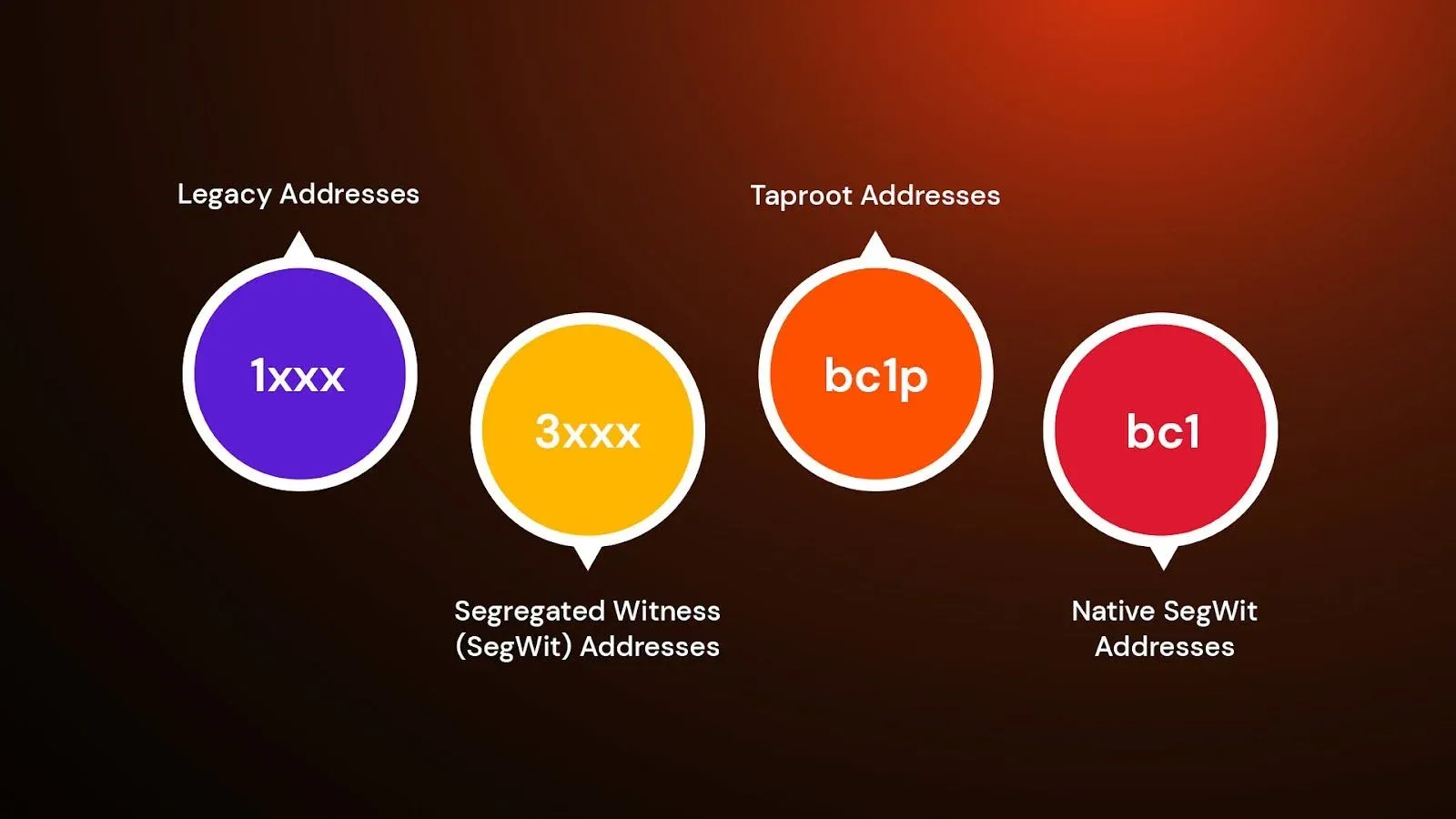
As the Bitcoin network has evolved, several address formats have emerged, each linked to a specific script type and level of compatibility. The main categories are:
| Type | Prefix | Script Type | Encoding | Main Features |
|---|---|---|---|---|
| **Legacy Address** | `1` | P2PKH | Base58 | Widest compatibility, but relatively higher transaction fees |
| **SegWit Address** | `3` | P2SH‑Wrapped SegWit | Base58 | Supports SegWit, lower fees |
| **Native SegWit Address** | `bc1` | P2WPKH / P2WSH | Bech32 | Higher efficiency, stronger error detection |
| **Taproot Address** | `bc1p` | P2TR | Bech32m | Enables Schnorr signatures and complex smart contracts |
1. Legacy Addresses
- Use Base58 encoding and start with the prefix `1`.
- Implement the Pay‑to‑Public‑Key‑Hash (P2PKH) script.
- Transactions are larger in size, resulting in higher fees, but these addresses enjoy the greatest compatibility across wallets and services.
2. SegWit (Segregated Witness) Addresses
- Identified by the prefix `3` and built on Pay‑to‑Script‑Hash (P2SH).
- Separate signature data from transaction data, reducing fees and increasing block capacity.
- Form the foundation for second‑layer solutions such as the Lightning Network.
3. Native SegWit Addresses
- Encode with Bech32, use the prefix `bc1`, and consist solely of lowercase letters.
- Employ Pay‑to‑Witness‑Public‑Key‑Hash (P2WPKH) or P2WSH scripts.
- Offer improved error detection, shorter length, and easier readability.
4. Taproot Addresses
- Introduced with the 2021 Taproot upgrade, carrying the prefix `bc1p` and using Bech32m encoding.
- Support Schnorr signatures and more sophisticated smart‑contract scripts (P2TR).
- Enhance privacy, efficiency, and flexibility while remaining backward compatible with earlier SegWit addresses.
How to Use X
*Translation of this section will be provided in the subsequent part of the guide.*
---
Global‑Market Note: When converting cryptocurrency proceeds to fiat, USD is the most common reference currency. International transfers typically rely on SEPA (for EUR) or SWIFT networks. Users located in the United States should use Binance.US for any exchange activity, as the global Binance platform is not available to U.S. residents.
Tax Disclaimer: Cryptocurrency gains may be taxable in your local jurisdiction. Please consult a qualified tax professional to understand your obligations.
Related Reading
- Bitcoin at $65k, Ethereum $3.1k, TON tops Dogecoin
- Bitcoin Halving 2024 Done – Next Halving Timeline & Impact
- Bitcoin $60K: Support Levels, Whale Moves & Crypto Tips
💡 Register on Binance with referral code B2345 for the maximum trading fee discount. See Binance complete guide.



