 Bitaigen Research
On June 29 Bitcoin underwent a difficulty adjustment, with the mining difficulty falling about 7.5 % to 116.96 T, the largest decline since 2021. At the same time, the network hashrate slipped from 902 EH/s to 838 EH/s, marking the most pronounced difficulty cut in four years.
The Bitcoin blockchain performs a difficulty retarget every 2,016 blocks (approximately two weeks) based on the change in total network hashrate. The purpose is to keep the average block‑generation time around 10 minutes, ensuring stable operation regardless of how many miners join or leave the network.
The latest retarget occurred at block height 903,168, with difficulty moving from 126.41 T down to 116.96 T. This is the biggest reduction since China’s nationwide mining ban in July 2021, when difficulty briefly dropped by 28 % and Bitcoin’s price fell from a peak of over $60,000 in April to roughly $34,000.
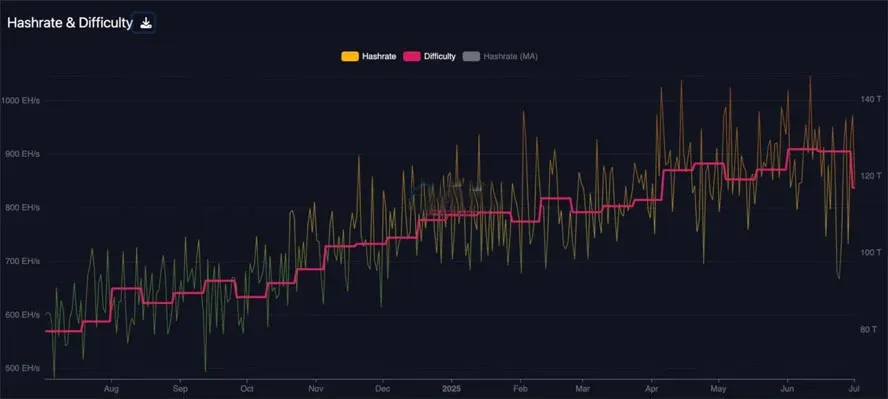
The mining difficulty is a direct gauge of competition among miners: a rise in hashrate pushes difficulty higher, making mining harder; a decline in hashrate pulls difficulty lower, allowing miners to solve blocks more easily. Although difficulty cuts are relatively rare, history shows that “price declines often follow a difficulty reduction within days to weeks.”
- Actual block time: before this difficulty cut, the average block time had stretched to 10 minutes 38 seconds.
- Network hashrate: fell from 902 EH/s to 838 EH/s, indicating a noticeable slowdown in mining power.
The primary driver behind this latest difficulty reduction was an extreme heat wave in regions such as Texas, USA. Mining equipment consumes massive amounts of electricity, and grid operators introduced incentive programs during peak‑load periods, encouraging large‑scale farms to voluntarily curtail power usage in exchange for subsidies or energy rebates. Consequently, several farms temporarily shut down, causing the overall hashrate to dip.
With difficulty lowered, the remaining miners on the network enjoy an immediate “positive catalyst”: the reward per unit of hashrate (the Hashprice) rebounded from depressed levels to about $60 per PH/s per day (approximately $0.05 per TH/s per day), improving short‑term revenue for those who stay online.
Hashprice is a metric coined by Bitcoin mining service provider Luxor to express the daily revenue generated per unit of hashrate (per TH/s). The figure fluctuates with Bitcoin’s price, difficulty, and block reward, and serves as a key reference point for miners assessing profitability.
The network’s average block time has now risen back to 8 minutes 24 seconds, suggesting that hashrate is gradually recovering, competition among miners is intensifying, and the next difficulty adjustment may trend upward.

In this article we conduct an in‑depth analysis of Bitcoin’s recent, rare network adjustment, explaining the technical and market forces behind the sharp difficulty drop and evaluating its potential impact on hashrate allocation and price dynamics. Through data visualizations and historical comparisons, readers can grasp the broader significance of this pivotal turning point; subsequent sections will provide a more detailed interpretation.
What Bitcoin Mining Difficulty Means
- Higher computational challenge: An increase in difficulty makes the underlying mathematical puzzle harder to solve, requiring miners to deploy more powerful hardware and consume additional energy to prevent blocks from being generated too quickly, thereby preserving network stability.
- Intensified competition: With a fixed block reward, more miners vie for the same payout. Higher difficulty reduces each individual miner’s probability of finding a block, directly affecting income.
- Maintaining block cadence: The core objective of difficulty adjustments is to keep the average time between new blocks at roughly 10 minutes. By dynamically tweaking difficulty, the network can absorb fluctuations in total hashrate while maintaining security and operational efficiency.
These dynamics have significant implications for both miners and the Bitcoin network. Miners must continuously upgrade equipment and fine‑tune algorithms to meet rising computational demands, while the Bitcoin protocol relies on the difficulty mechanism to uphold its security and performance.
*The analysis above provides a comprehensive overview of Bitcoin’s major network shift—a 7.5 % drop in mining difficulty, the steepest decline since 2021. For more information on the largest difficulty reductions over the past four years, please refer to other articles on Bitaigen (比特根).
*Note for U.S. readers: when purchasing or trading Bitcoin with fiat, use Binance.US rather than the global Binance platform. For fiat transactions outside the United States, SEPA (Euro) and SWIFT (USD) remain the standard channels.
*While this article does not delve into tax matters, be aware that cryptocurrency gains may be taxable in your local jurisdiction.
💡 Register on Binance with referral code B2345 for the maximum trading fee discount. See Binance complete guide.



