
 Bitaigen Research
In this article we piece together the historical clues surrounding Satoshi Nakamoto’s identity and use on‑chain analysis to reconstruct the scale of his Bitcoin holdings. The goal is to help readers clear up common misconceptions and gain a deeper understanding of the “ghost” behind Bitcoin and the cryptographic assets he may control. By combining publicly available information with academic research, we evaluate the credibility of various hypotheses, provide visualized on‑chain data interpretations, and deliver a complete picture without revealing any critical numbers. The piece is worth a careful read.
Who exactly is Satoshi Nakamoto?
Satoshi Nakamoto is the inventor of Bitcoin and may be a single individual or a pseudonym for a group of developers. In October 2008, he (or they) posted the white paper *Bitcoin: A Peer‑to‑Peer Electronic Cash System* to a cryptography mailing list, first proposing a blockchain solution to the “double‑spending” problem. On 3 January 2009, the creator mined the genesis block of the Bitcoin network, embedding the front‑page headline of the *Times* newspaper about bank bailouts, symbolically critiquing the traditional financial system. Satoshi remained active until the end of 2010, after which he handed over the code repository to Gavin Andresen and completely disappeared from the public eye in April 2011.
As of 2026, speculation about Satoshi’s true identity remains unresolved. Deceased cryptographer Hal Finney, Len Sassaman, as well as Nick Szabo and Adam Back have all been floated as possible candidates, but none of the theories has decisive proof. Early in 2026, a U.S. government lawsuit concerning the so‑called “Satoshi files” reignited the debate, yet it failed to produce any new breakthroughs.
On‑chain forensics: the origin of 1.1 million BTC
The figure of 1.1 million BTC is not conjecture; it is derived from on‑chain forensic techniques. Sergio Demian Lerner, by analysing the earliest blocks, identified a distinctive mining signature known as the Patoshi pattern. This pattern indicates that a single miner—presumed to be Satoshi—solo‑mined roughly 22 000 blocks between January 2009 and early 2010, providing the necessary hash power when the network was still uncompetitive.
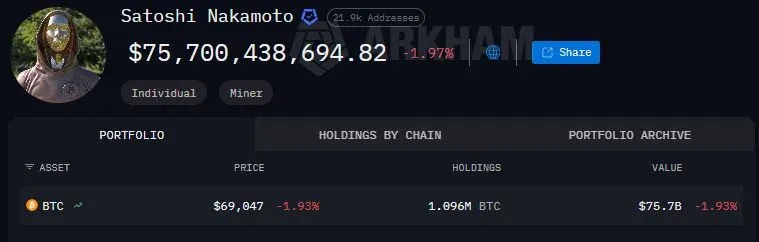
Arkham’s forensic tags further aggregated thousands of dispersed wallets into a single entity, confirming that the 1 096 000 BTC (rounded to 1.1 million) belong to the same address cluster. At the time, the block reward was 50 BTC and almost no other miners were present, making this stash virtually the sole source of newly minted coins in the early network.
Valuation trajectory of Satoshi’s net worth
Bitcoin’s price swung dramatically between 2025 and 2026, directly affecting the paper‑based wealth attributed to Satoshi. In October 2025, Bitcoin hit an all‑time high of $126 100, which placed Satoshi’s net worth at approximately $138.7 billion, briefly landing him among the world’s ten richest individuals. After the start of 2026, macro‑economic uncertainty drove the price down sharply in early February, falling from about $78 693 to a low near $60 000.
| Date (February 2026) | BTC price (USD) | Satoshi’s net worth (USD billion) |
|---|---|---|
| Feb 2 | 78 693 | 86.56 |
| Feb 4 | 70 000 | 77.00 |
| Feb 6 | 64 478 | 70.93 |
| Feb 9 | 70 837 | 77.92 |
The table shows that the asset value can shift by several tens of billions of dollars within a few days, illustrating the high volatility of digital assets. For institutional investors this represents both opportunity and risk—if the entire 1.1 million‑BTC cache were dumped at once, it could exert a significant market impact.
Legal developments
The legal battle over Satoshi’s identity peaked in 2024‑2025. Craig Wright has claimed since 2016 that he is Satoshi, but in March 2024 the England High Court, presided over by Judge James Mellor, found that he had fabricated evidence and ruled that Wright is not Satoshi. By February 2026, Wright was sentenced to a twelve‑month suspended term for contempt of court and was subject to an injunction preventing him from filing related claims again before 2028.
At the same time, James Murphy (aka MetaLawMan) sued the U.S. Department of Homeland Security in 2025, demanding the release of the alleged “Satoshi files.” Those files reportedly contain records of four individuals interviewed by U.S. intelligence agencies about Bitcoin’s origins. As of February 2026 the case is still pending before the U.S. District Court in Washington, D.C.; a forced disclosure could trigger sharp market movements.
The legend of “unspendable” bitcoins
The public commonly believes that Satoshi’s bitcoins are “dead coins.” In reality, only the first 50 BTC mined in the genesis block are hard‑coded as unspendable; the remaining 1 099 950 BTC are technically spendable, but the private keys are believed to be lost or destroyed. On 7 February 2026, an anonymous user sent 2.5 BTC (about $181 000) to the genesis address as a symbolic tribute, but because the private key does not exist the transaction effectively “burned” the coins.
The rise of quantum computing introduces a new risk for these long‑dormant bitcoins. Early P2PK addresses used by Satoshi expose the public key directly; should a functional quantum computer become available, those addresses could be compromised. The Bitcoin community launched post‑quantum cryptography (PQC) testing in early 2026, and a future soft‑fork may “burn” or freeze un‑migrated coins to protect network security.
Wealth comparison with other crypto industry leaders
| Leader/Entity | Estimated net worth (USD billion, 2026) | BTC value (USD) | BTC holding share |
|---|---|---|---|
| Elon Musk (Tesla/SpaceX/xAI) | 8 525 | — | — |
| Changpeng Zhao (CZ) | 790 | — | — |
| Satoshi Nakamoto | 757 | 770 | 5.24 % |
| Giancarlo Devasini (Tether) | 224 | — | — |
| Brian Armstrong (Coinbase) | 127 | — | — |
While Elon Musk’s paper wealth dwarfs Satoshi’s, the latter’s assets exist entirely as Bitcoin, fluctuating with the cryptocurrency’s price and possessing a fully decentralized nature. Unlike Vitalik Buterin, Brian Armstrong and others, Satoshi’s wealth is not tied to any corporation or equity; it derives solely from the protocol itself and has not moved since 2010.
Other large Bitcoin holders
In the 2026 Bitcoin holding landscape, Satoshi remains the single entity with the largest individual or organizational balance, surpassing all custodial platforms and sovereign reserves.
| Entity | Estimated BTC held | Value at $70 000/BTC | Share of supply |
|---|---|---|---|
| Satoshi Nakamoto | 1 100 000 | $770 billion | 5.24 % |
| Coinbase (custody) | 885 000 | $619 billion | 4.21 % |
| BlackRock (IBIT ETF) | 778 000 | $545 billion | 3.70 % |
| MicroStrategy | 674 000 | $472 billion | 3.21 % |
| United States government | 328 000 | $230 billion | 1.56 % |
Conclusion: Is Satoshi’s wealth a “ghost” or a tangible entity?
As of February 2026, Satoshi’s on‑paper assets are roughly $77.9 billion, representing about 5.24 % of Bitcoin’s total supply. The figure fluctuates with global risk appetite, yet it remains essentially a “digital fossil.” 2026 marks the first time the “Satoshi treasure” has faced pressure from the intersection of Bitcoin ETFs, sovereign Bitcoin reserves, and emerging quantum‑computing threats. Whether the founder is a deceased cryptographer, a research team, or an unactivated “dead‑man switch,” the core value lies in the fact that the coins have never moved—this silence carries more impact than any balance sheet.
Frequently asked questions about Satoshi’s net worth
1. How many bitcoins does Satoshi control?
He is estimated to control about 1 100 000 BTC spread across 22 000 addresses.
2. Can Satoshi actually spend these bitcoins?
Technically, all coins except the 50 BTC in the genesis block are spendable, but the private keys are presumed lost, rendering the stash dormant for over 15 years.
3. Is Satoshi a billionaire?
Yes; in 2026 he appears among the world’s top 25 wealthiest individuals.
4. Have any of these bitcoins moved since 2010?
Aside from a few symbolic tribute transactions, the core holdings have shown no movement since 2010.
5. What would happen to the market if Satoshi sold his bitcoins?
A massive sell‑off could dramatically increase supply, potentially driving the price down by 40 %‑70 %.
That concludes the overview of “What is Satoshi Nakamoto’s net worth? How many bitcoins does Satoshi Nakamoto own?” For a deeper dive into Satoshi’s Bitcoin holdings, search the archives of Bitaigen (比特根) or continue reading the related sections below. Thank you for your continued interest and support!
*Note: Cryptocurrency gains may be taxable in your local jurisdiction. When converting to fiat, use USD, SEPA, or SWIFT channels as appropriate.*
Related Reading
- Bitcoin’s Top Holder: Satoshi Nakamoto’s 1.1 Million Coins
- Top Bitcoin Holders in 2025 & Market Impact
- Arkham Traces Massive Mt. Gox Bitcoin Moves, Market Impact
💡 Register on Binance with referral code B2345 for the maximum trading fee discount. See Binance complete guide.



