
 Bitaigen Research
In this article we outline Strategy, the publicly listed company holding the largest amount of Bitcoin, examining its balance‑sheet composition, financing methods, and the logic behind selling under market‑cap pressure. By dissecting key decision points and market liquidity, we help readers assess how its actions could impact Bitcoin.
Key Takeaways
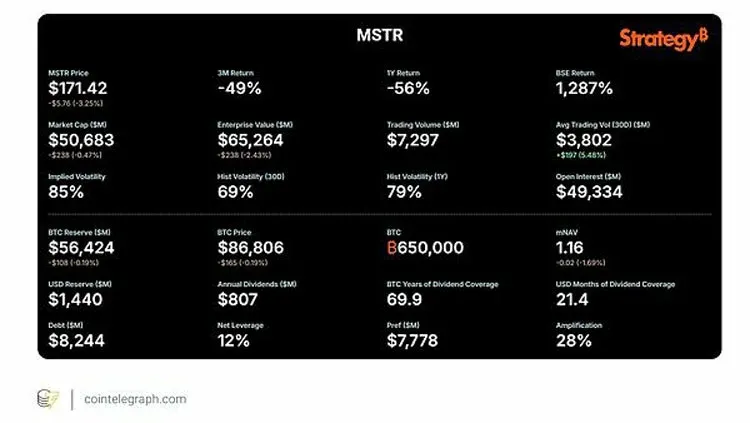
- Strategy is currently the listed company with the greatest Bitcoin holdings, showing roughly 650,000 BTC on its balance sheet.
- Its business model raises capital by issuing common stock, perpetual preferred shares, and occasional convertible bonds, then converting the proceeds into Bitcoin, aiming to keep the market‑cap‑to‑net‑asset‑value ratio (mNAV) above 1.
- CEO Phong Le has stated that selling Bitcoin is only a “last‑resort measure” and would be considered only if mNAV falls below 1 and no further financing can be secured.
- Even if a sale occurs, given Bitcoin’s daily trading volume of several hundred billion USD, any move would likely be localized and targeted rather than a full‑scale exit.
---
Potential Market‑Level Impact
Strategy’s ownership of 650,000 BTC means its shift from a “never‑sell” stance to “possible liquidation under extreme pressure” will be watched closely by the market. Several contextual factors deserve attention:
- Overall Liquidity: Spot and derivatives markets for Bitcoin routinely see daily turnover in the tens of billions of USD, and U.S. spot Bitcoin ETFs can experience net inflows/outflows of several billion USD in a single day. Even a modest off‑load by Strategy would be absorbed quickly within this highly liquid ecosystem.
- Sale Size and Pace: Le emphasized in interviews that any actual disposal would be targeted and executed in batches, intended to meet obligations such as preferred‑share dividends rather than to abandon the Bitcoin position entirely.
- Advance Pricing: Markets tend to price in disclosed information ahead of time. Recent pull‑backs in both Bitcoin’s price and Strategy’s share price, together with the debate around mNAV, exemplify how expectations are pre‑emptively reflected in valuations.
---
Strategy’s Bitcoin Operating Model
On the day‑to‑day level, Strategy runs a relatively straightforward capital cycle:
- Financing Channels: It raises cash from traditional capital markets via a common‑stock ATM (at‑the‑market) program, multiple series of perpetual preferred shares (e.g., STRK, STRF), and occasional convertible bonds.
- Bitcoin Purchases: The overwhelming majority of the raised cash is used to buy Bitcoin, forming the core reserve asset of the company.
- Performance Monitoring: The firm tracks two key metrics to gauge the sustainability of the model and shareholder returns.
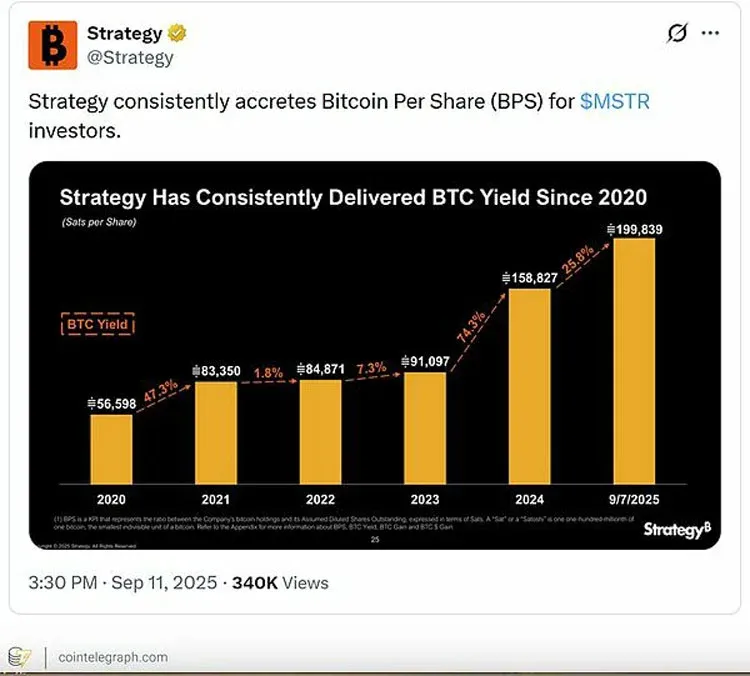
- Bitcoin per Share (BPS): The amount of Bitcoin attributable to each fully diluted share. Strategy publishes this figure as an important performance indicator.
- Market‑Cap‑to‑Net‑Asset‑Value Ratio (mNAV): Total market capitalization divided by the market value of its Bitcoin holdings. When mNAV > 1, the stock trades at a premium to the underlying Bitcoin assets, meaning the company can raise additional capital with relatively low equity dilution and continue accumulating Bitcoin.
When mNAV remains in the premium zone, Strategy can issue new common or preferred shares with less dilution, thereby expanding its Bitcoin reserves and raising BPS.
---
Trigger Conditions for a “Last‑Resort” Sale
In a recent interview, Le made it clear that the company would only contemplate tapping its Bitcoin stash if both of the following hard conditions are met:
- mNAV below 1: The market cap falls to or below the total market value of its Bitcoin holdings.
- Financing channels exhausted: The company can no longer issue common or preferred shares on reasonable terms, leaving it without external cash.
Under such circumstances, selling Bitcoin is viewed as a “last‑resort” means to satisfy obligations such as preferred‑share dividends, not as a shift away from the long‑term accumulation strategy. In short, if the share price drops to parity with the Bitcoin holding value and refinancing becomes impossible, a partial Bitcoin sale would be the minimal‑cost option to preserve the overall corporate structure.
---
Key Factors That Could Push Strategy Toward a Sale
Before the “last‑resort” trigger is reached, investors should monitor several categories of risk signals:
Macro‑Economic Environment and Bitcoin Price
Bitcoin has slipped from the October peak of roughly $126,000 to around $90,000, a decline of about 30%. Further or sustained drops would directly shrink the book value of Strategy’s holdings and exert downward pressure on its share price.
Stock Performance and mNAV Evolution
The premium that the market places on the company relative to its Bitcoin has narrowed sharply after the stock retraced 30%‑60% from its early highs. In mid‑November the share price briefly touched—or even fell below—the spot value of the underlying Bitcoin, indicating that mNAV was approaching 1.
Financing Environment
Strategy’s ability to raise capital hinges on the registration‑based issuance of new common shares, perpetual preferred shares, and the ATM program. A noticeable slowdown in these channels, or investors demanding higher returns, could signal tightening liquidity.
Internal Cost Pressures
The firm must service several hundred million USD of annual preferred‑share dividends and debt repayments each year. Analysts estimate that preferred‑share dividend outlays alone amount to hundreds of millions of USD annually. If cash flow becomes constrained, these fixed obligations could become a decisive factor compelling the company to consider selling Bitcoin.

---
Practical Guide to Tracking Strategy’s Moves
To stay informed about whether the company has entered a “last‑resort” scenario—without being swayed by every headline or social‑media buzz—follow these sources:
- SEC Filings: Forms such as 8‑K reports and supplemental prospectus documents provide the latest updates on financing activities and Bitcoin holding levels.
- Company Announcements: Strategy’s own press releases and investor‑relations communications are primary sources for real‑time information.
---
Related Reading
- Backpack Crypto Exchange to Launch Token Linked to IPO Target
- Cryptocurrency Trading Price Gaps: Why Coins Vary Across Exchanges
- Pavel Durov 2026 Worth: Telegram, Bitcoin & TON Valuation
💡 Register on Binance with referral code B2345 for the maximum trading fee discount. See Binance complete guide.



