
 Bitaigen Research
 At Bitaigen’s editorial team, we systematically dissect Bitcoin’s core technology—from the decentralized ledger to the mechanics of proof‑of‑work—helping readers clear up common conceptual misunderstandings. Through concrete examples, you can visually grasp how transactions propagate and are verified across the network. If you want to dive into the technical details, this article is worth a careful read.
Detailed Explanation of Bitcoin’s Principles

Bitcoin is a cryptography‑based, decentralized electronic currency that leverages a blockchain and a proof‑of‑work consensus mechanism to enable secure peer‑to‑peer transactions and accounting.
1. What Is Bitcoin
Bitcoin is an electronic form of money that uses cryptographic principles to achieve decentralized bookkeeping. On November 1, 2008, Satoshi Nakamoto introduced, in the *Bitcoin Whitepaper*, an electronic accounting system that does not require banks or sovereign credit backing. Traditional e‑cash depends on banks to maintain ledgers, whereas Bitcoin’s bookkeeping is performed collectively by network participants, thereby reducing exposure to sovereign crises and credit risk. This article focuses on the technical implementation layer.
2. Introducing the Problem
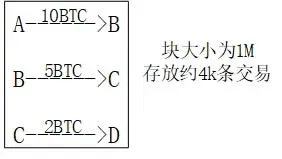
Assume four users—A, B, C, D—who generate the following three transactions:
- A → B 10 BTC
- B → C 5 BTC
- C → D 2 BTC
In a conventional system, these transactions would only be recorded inside a bank’s internal database, and each user would care solely about his or her own balance. Bitcoin, by contrast, requires every node to store a full copy of the ledger, and all copies must stay synchronised in real time, eliminating the need for a central authority.
The Bitcoin bookkeeping process works as follows:
- The transaction initiator broadcasts the transaction data to the entire network.
- A node (a miner) collects transactions that arrived within a certain time window and packs them into a block.
- Blocks are linked sequentially to form a blockchain, creating a unified ledger for the whole network.
Key Questions
- Why should anyone participate in the system and contribute computing resources?
- Whose record should be considered authoritative? Different nodes might have slightly different ordering of transactions.
- How does the system ensure that only the rightful owner can spend a given Bitcoin?
- How are counterfeiting, tampering, and double‑spending prevented?
3. Incentive Mechanism for Bookkeeping
Bookkeeping (i.e., mining) yields two kinds of rewards:
- Block reward: A new block is created roughly every ten minutes. The initial reward was 50 BTC; it halves to 25 BTC after four years, and continues halving every four years until the total supply approaches 21 million BTC.
- Transaction fees: The tiny fee attached to each transaction is awarded in full to the miner who includes the transaction in a block.
Reward formula (approximate):
50 × 6 × 24 × 365 × 4 × (1 + ½ + ¼ + …) ≈ 21 million BTC
4. Whose Record Is Authoritative – The Proof‑of‑Work Mechanism
4.1 Hash Functions
A hash function (also called a digital digest or cryptographic hash) maps an input of arbitrary length to a fixed‑length output and possesses the following properties:
- Different inputs always produce different outputs.
- It is computationally infeasible to reverse‑engineer the original input from the output.
- The probability of two distinct inputs producing the same output (a collision) is vanishingly small.
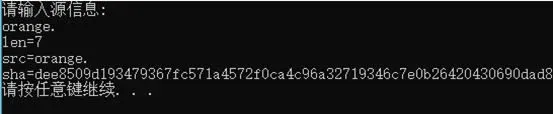
Bitcoin uses the SHA‑256 algorithm. Any string can be fed into SHA‑256, which yields a 256‑bit binary result (commonly displayed as a 64‑character hexadecimal string).


4.2 How Mining Works
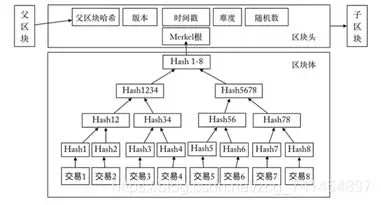
Each block consists of a block header and a block body:
- Block body: Collects a set of transactions and builds a Merkle tree; only the Merkle root hash is stored in the header, which compresses data and simplifies verification.
- Block header: Contains the previous block’s hash, a version number, a timestamp, the difficulty target, a nonce (random number), and the Merkle root.
Mining steps:
- Concatenate the header fields into a single string `str`.
- Compute a double SHA‑256 hash: `hash = SHA256(SHA256(str))`.
- If the leading `n` bits of `hash` are zero (where `n` is the current difficulty), the proof‑of‑work requirement is satisfied and the block is considered valid; otherwise, modify the nonce and repeat.
The difficulty `n` is automatically adjusted by the network’s total hashing power to keep the average block time at ten minutes. For example, if the global hash rate is about 1.4 × 10¹³ H/s, then in ten minutes roughly 8 × 10¹⁹ hash attempts can be performed, giving `2ⁿ ≈ 8 × 10¹⁹` and thus `n ≈ 66`.
Conclusion: The larger the hashing power, the more hash attempts per unit time, and the higher the probability of finding a valid block.
Note: If you need a C++ simulation code, feel free to send an email request; you can adjust the difficulty parameter to demonstrate how block generation speed changes.
5. Counterfeit Prevention, Tamper‑Resistance, and Double‑Spending Protection
5.1 Electronic Signature Technology
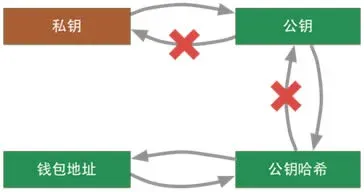
Bitcoin employs the Elliptic Curve Digital Signature Algorithm (ECDSA) for asymmetric cryptography:
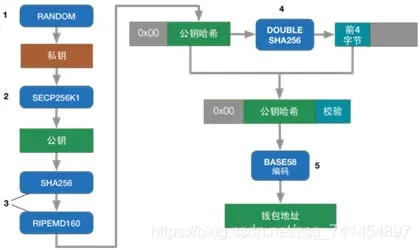
- A random number is turned into a private key (256‑bit binary), which functions as a password and must be kept secret.
- The private key is used with the secp256k1 curve to derive a public key.
- The public key is hashed with SHA‑256, then with RIPEMD‑160, producing a public‑key hash.
- A one‑byte version prefix is added before the hash, and the result is double‑hashed with SHA‑256; the first four bytes of this second hash become a checksum.
- The whole payload (version + hash + checksum) is encoded with Base58Check, yielding a wallet address such as `A1zP1eP5QGefi2DMPTfTL5SLmv7DivfNa`.
Transaction verification workflow:
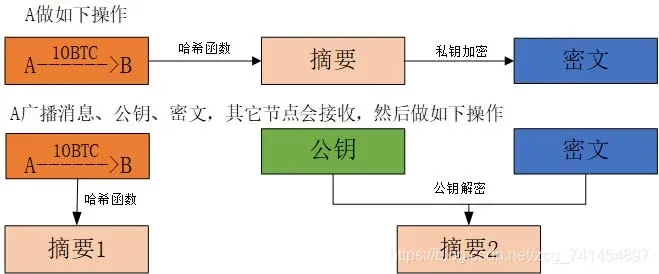
- The sender hashes the transaction data with SHA‑256, producing a digest.
- The sender encrypts the digest with his/her private key, creating a signature (ciphertext).
- The transaction, the signature, and the sender’s public key are broadcast to the network.
- Receivers decrypt the signature using the public key, obtaining a second digest. They also hash the received transaction data themselves to obtain a first digest.
- If digest 1 equals digest 2, the transaction is confirmed to have been signed by the holder of the private key.
5.2 Balance Checking (UTXO Model)
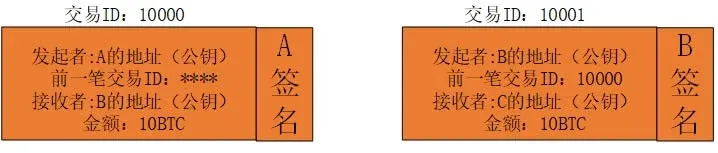
Bitcoin uses the UTXO (Unspent Transaction Output) model rather than traditional account balances. Every transaction must reference previous UTXOs, and the network validates that the sender controls enough unspent outputs to cover the amount being transferred.
5.3 Double‑Spending Protection
If A tries to send 10 BTC to both B and C simultaneously, network nodes will independently verify the two transactions against the same set of UTXOs. The first transaction that gets confirmed and included in a block will consume the relevant UTXOs; any later conflicting transaction will be rejected because the required outputs are no longer available. Which transaction ultimately gets recorded depends on which chain gains proof‑of‑work acceptance first.
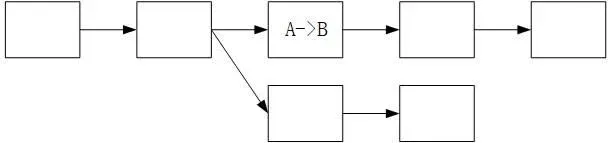
5.4 Tamper‑Resistance – The Longest‑Chain Rule
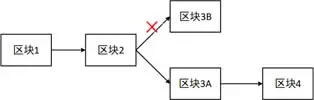
The blockchain follows the longest‑chain (most cumulative work) rule:
- If a fork occurs, the branch that accumulates more hashing power will extend faster and eventually become the consensus chain.
- To rewrite history, an attacker would need to mine an alternative chain longer than the current main chain, which practically requires controlling more than 50 % of the global hash rate—a cost that is astronomically high and economically irrational.
6. Conclusion
A blockchain is not synonymous with Bitcoin; Bitcoin is merely the first successful application of blockchain technology. Bitcoin demonstrates the combined advantages of decentralized bookkeeping, proof‑of‑work consensus, and cryptographic signatures, yet it also faces challenges such as limited anonymity, low throughput, and scalability constraints. Ongoing research aims to broaden blockchain usage across finance, supply‑chain management, identity verification, and many other sectors.
Further Reading
- [How to Mine Bitcoin on a Home Windows PC – Illustrated Guide]
- [How Bitcoin Hashrate Influences BTC Price Movements]
- [Differences Between Bitcoin, Ethereum, and Other Cryptocurrencies]
- Is Buying Bitcoin on Binance Safe? Is the Binance App Secure? *(U.S. residents should use Binance.US, while users elsewhere can use the global Binance platform; fiat deposits and withdrawals are typically processed via USD wire (SEPA/SWIFT) where applicable.)*
- [Does Increasing Mining Difficulty Help or Hurt Miners? How Does Hashrate Impact Price?]
*Please note that cryptocurrency gains may be subject to taxation in your jurisdiction; consult a local tax professional for guidance.*
The above constitutes the full content of “Detailed Explanation of Bitcoin Principles (What Is Bitcoin and How Mining Works)”. For more technical deep‑dives on Bitcoin, follow other articles from Bitaigen.
Translation by:
Related Reading
- How Bitcoin Mining Works: Hash Power, Block Rewards & Satoshi's Rules
- China Bitcoin Laws 2024: Holding Legal, Trading Restricted
- Bitcoin at $93,923: Current Price, History & Drivers
💡 Register on Binance with referral code B2345 for the maximum trading fee discount. See Binance complete guide.



