
 Bitaigen Research
 What is Bitcoin halving? This is a major quadrennial event in the cryptocurrency world. As a pre-set, hard-coded mechanism within the Bitcoin protocol, halving directly slashes the mining rewards for miners, thereby reducing the growth rate of new coins in circulation. This mechanism not only influences the supply structure of Bitcoin but also exerts a profound impact on miners, traders, and the long-term trajectory of the entire crypto market.
Bitcoin Halving is a pre-programmed event built into the Bitcoin protocol that occurs approximately every four years, or every 210,000 blocks produced. This mechanism mandates a 50% reduction in the block rewards earned by miners. It is designed to ensure the total supply cap of 21 million coins by controlling the issuance rate of new coins, thereby simulating scarcity and effectively hedging against inflation.
As the core driver of the cyclical evolution of the crypto market, the halving mechanism is the key to understanding Bitcoin's deflationary properties and scarcity value. This article will provide an in-depth analysis of the operational logic of this hard-coded protocol, exploring how it manages inflationary pressure by regulating the supply structure. By reviewing historical contexts, we aim to help readers gain insights into the far-reaching effects of halving on the miner ecosystem and market landscape, revealing the underlying laws governing Bitcoin as "Digital Gold."
What is Bitcoin Halving?

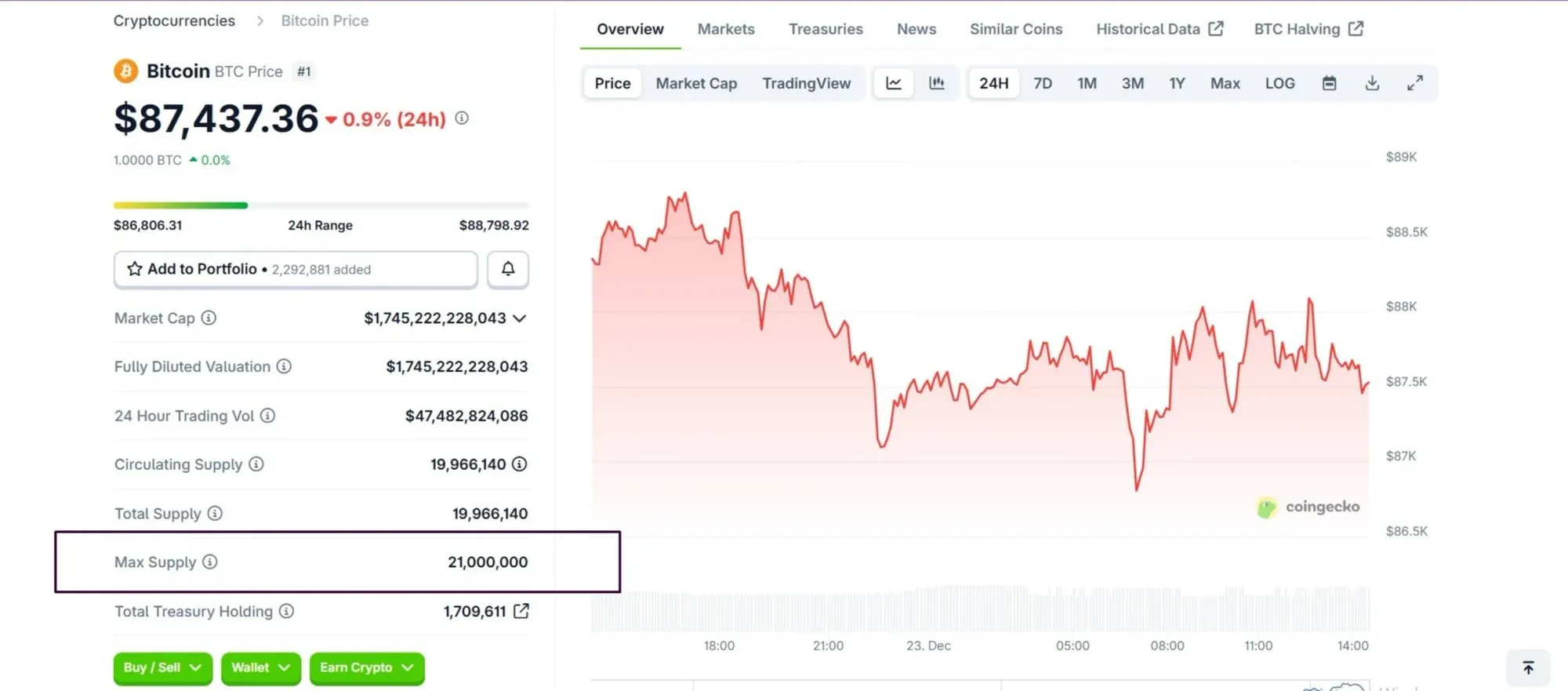
Bitcoin halving is the process by which the Bitcoin network automatically adjusts its algorithm to reduce the output of new coins. When miners successfully verify and add a new block to the blockchain, they receive a specific amount of Bitcoin as a reward. However, the total supply of Bitcoin is strictly limited to 21,000,000 BTC. This fixed supply cap is a core attribute of Bitcoin as "Digital Gold," designed to prevent currency devaluation and enhance its long-term potential value.
To achieve this goal, miners must utilize high-performance computing equipment to solve complex mathematical puzzles to maintain network security. In return, the system periodically distributes newly minted Bitcoins. The Bitcoin Halving event occurs roughly every four years, ensuring that the total supply will never exceed 21 million. To date, Bitcoin has completed four pivotal halvings:
- First Halving (2012): Block rewards were reduced from 50 BTC to 25 BTC.
- Second Halving (2016): Block rewards were reduced from 25 BTC to 12.5 BTC.
- Third Halving (2020): Block rewards were reduced from 12.5 BTC to 6.25 BTC.
- Fourth Halving (2024): Block rewards were reduced from 6.25 BTC to 3.125 BTC.
Following this pattern, the next halving is expected to occur around 2028, at which point the block reward will further shrink to 1.5625 BTC.
Why Does the Bitcoin Halving Phenomenon Occur?
The Bitcoin halving mechanism was originally designed to simulate the scarcity of precious metals and curb inflation. Satoshi Nakamoto, the founder of Bitcoin, implemented this method to ensure that the issuance rate of Bitcoin gradually slows down over time. Unlike traditional fiat currencies (such as the USD or EUR), which can be printed infinitely by central banks, Bitcoin's deflationary nature gives it greater potential for value preservation.
The primary objective of the halving is to control the pace of supply. By halving the rewards every four years, the entire supply of Bitcoin is projected to be fully distributed over approximately 140 years (around the year 2140). This mechanism molds Bitcoin into a deflationary asset. Provided that demand remains stable or grows, the reduction in supply often provides support for its market value.
How Does Bitcoin Halving Work?
Bitcoin halving is a rigid rule executed automatically by the underlying protocol code. Within the Bitcoin network, for every 210,000 blocks produced, the system automatically cuts the block reward by 50%. Miners compete to solve cryptographic puzzles to verify transactions, and the winner receives the newly minted Bitcoin along with the Transaction Fees within that block.
Because the Bitcoin network monitors the Block Height in real-time, the halving instruction takes effect immediately when the height reaches a multiple of 210,000. This transparent and immutable automated process eliminates the possibility of human intervention in the supply volume, thereby enhancing market predictability.
History of Bitcoin Halving Events
Since the birth of the Genesis Block in 2009, Bitcoin has undergone four halvings. Each halving serves as a significant milestone for the industry, accompanied by increased market awareness and ecosystem expansion.
| Date | Block Height | Reward Change | Avg. Price at Halving | Avg. Price One Year Later |
|---|---|---|---|---|
| Nov 28, 2012 | 210,000 | 50 BTC → 25 BTC | $12 | $964 |
| July 9, 2016 | 420,000 | 25 BTC → 12.5 BTC | $663 | $2,550 |
| May 11, 2020 | 630,000 | 12.5 BTC → 6.25 BTC | $8,740 | $58,250 |
| April 20, 2024 | 840,000 | 6.25 BTC → 3.125 BTC | $64,000 (Peak) | $82,000 |
First Halving (2012): The Initial Proliferation of Bitcoin
In November 2012, Bitcoin proved the feasibility of its scarcity mechanism for the first time. At that time, the price was only around $12, but in the following year, the price experienced explosive growth, breaking the $1,000 mark for the first time by the end of 2013.
Second Halving (2016): Awakening of Mainstream Awareness
When the second halving occurred in July 2016, Bitcoin had already begun to attract more attention. Despite significant short-term price volatility following the halving, Bitcoin soared to nearly $20,000 during the super bull market of 2017, solidifying its position in the financial sector.
Third Halving (2020): Entry of Institutional Investors
The May 2020 halving took place under a unique macroeconomic environment. With the influx of institutional capital and global liquidity expansion, Bitcoin reached a new high of $69,000 in 2021, officially becoming part of mainstream asset allocation.
Fourth Halving (2024): Global Financial Integration
In April 2024, the block reward dropped to 3.125 BTC. This stage was characterized by the approval of Spot Bitcoin ETFs, which significantly lowered the barrier to entry for traditional capital. According to records, in October 2025, the Bitcoin price surpassed $126,000, setting a historical record.
What Happens After a Bitcoin Halving?
A Bitcoin halving triggers an immediate supply shock and reshuffles the mining industry. A halving of rewards means an immediate 50% cut in direct income for miners. This often leads to the shutdown of less efficient mining rigs with higher electricity costs, which may cause short-term fluctuations in the network's Hashrate.
However, the market usually self-regulates quickly. As inefficient miners exit, the remaining miners gain a larger market share, prompting the industry to transition toward more efficient hardware and cheaper energy sources. For investors, while short-term price volatility may intensify, historical data suggests that due to the slowing growth of supply, halvings are often catalysts for long-term bull markets.
When is the Next Bitcoin Halving?
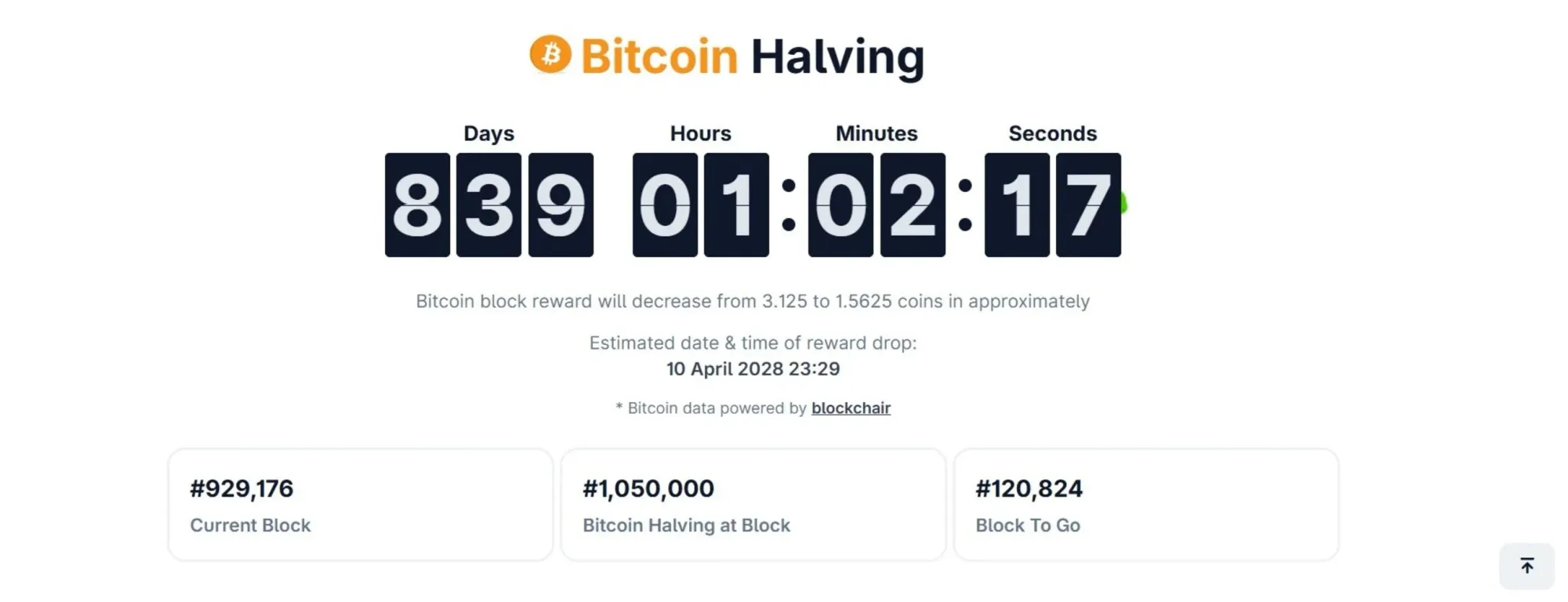
The next Bitcoin halving is expected to occur when the block height reaches 1,050,000. At that time, the block reward will drop from 3.125 BTC to 1.5625 BTC. Based on the current block production speed (averaging one block every 10 minutes), the estimated date is approximately April 2028. As of late 2025, there are roughly 800+ days remaining until the next halving.
The Impact of Bitcoin Halving on the Market
By tightening supply, Bitcoin halvings often trigger broader crypto market rallies. When the price of Bitcoin rises due to increased scarcity, it typically drives market sentiment and attracts massive capital inflows.
This spillover effect often triggers an Altcoin Season. Due to Bitcoin's extremely high market dominance, when its price stabilizes or capital seeks higher returns, funds tend to flow into other crypto assets such as Ethereum (ETH), Solana (SOL), and others. Typical characteristics of an Altcoin Season include a decline in Bitcoin's market share while other major coins outperform Bitcoin over a specific period (e.g., 90 days).
For global investors looking to participate in these cycles, fiat-to-crypto gateways typically involve using SWIFT for international wire transfers or SEPA for transfers within the Eurozone. It is important to note that users in the United States must use Binance.US, as the global Binance platform is restricted in that jurisdiction. Additionally, investors should be aware that cryptocurrency gains may be taxable depending on local laws; for instance, the IRS in the US and various tax authorities in Europe treat crypto gains as taxable income or capital gains.
Common Misconceptions About Bitcoin Halving
There are several misconceptions in the market regarding the halving. Here are the four most common myths:
- Price will inevitably skyrocket immediately: While there is a correlation between halvings and price increases, it is not an absolute causal relationship. Prices are influenced by the macroeconomy, regulatory policies, and the demand side (such as ETFs).
- Miners will go bankrupt en masse: Although rewards are halved, the rise in Bitcoin's price and the increase in Transaction Fees usually offset some of the losses, encouraging the survival of the fittest in the industry.
- Network security will decline: While the hashrate may fluctuate, Bitcoin's Difficulty Adjustment mechanism ensures that the network maintains a stable block production speed.
- Mining will become unprofitable: Miners can maintain profitability by upgrading to energy-efficient equipment, seeking cheap electricity, and earning transaction fees.
Conclusion: Why Bitcoin Halving is So Important
Bitcoin halving is the core pillar for maintaining its deflationary properties and scarcity. It not only ensures transparency in currency issuance but also catalyzes market cycles through periodic supply shocks. As rewards continue to decrease, the Bitcoin network is gradually transitioning from relying on new coin issuance to relying on transaction fees to support its security, signaling the continuous maturation of the ecosystem.
FAQ (Frequently Asked Questions)
Will Bitcoin stop halving?
Bitcoin halving will continue until approximately the year 2140. By then, all 21 million Bitcoins will have been mined, and miners' income will depend entirely on network transaction fees.
How many halvings are left for Bitcoin?
After the completion of the first four halvings, the Bitcoin network will undergo another 28 halvings until all 32 cycles are completed.
Is the halving bullish or bearish?
In the long run, the halving is generally viewed as bullish because it reinforces the asset's scarcity. While short-term volatility may occur, history shows that the 12-18 months following a halving are typically periods of strong price performance.
Does the halving affect other cryptocurrencies?
Yes. As the market bellwether, the attention and capital flow triggered by Bitcoin's halving usually benefit the entire crypto ecosystem and may kickstart an "Altcoin Season."
Is it better to buy before or after the Bitcoin halving?
This depends on an individual's risk tolerance. Historical strategies include Dollar Cost Averaging (DCA), which involves buying in batches during the volatile periods surrounding the halving to average out the cost. Regardless of when you enter, it is crucial to Do Your Own Research (DYOR) and only invest risk capital.
How does the Bitcoin halving affect miners?
The halving directly compresses profit margins, forcing the mining industry toward high efficiency and large-scale operations. Although it presents challenges, price increases and technological advancements usually help the industry remain operational.
---
*This article provides a comprehensive analysis of the Bitcoin halving. For more in-depth content on cryptocurrency, please follow the subsequent reports from Bitaigen.*
Related Reading
- What Is a DEX? Complete Guide to Decentralized Exchanges
- Binance Smart Money: Track Crypto Flows & Spot Early Moves
- Smart Money in Crypto: Institutional Traders Shaping Trends
💡 Register on Binance with referral code B2345 for the maximum trading fee discount. See Binance complete guide.



